Bands & Directors

“Deep in a Dream” (1939)

“Deep in a Dream.” Words by Eddie De Lange, music by Jimmy Van Heusen (1938). Recorded by Elsie Carlisle under the musical direction of George Scott-Wood at Studio 1, Abbey Road, London on February 1, 1939. HMV B.D. 663 mx. OEA7519-1.

Elsie Carlisle – “Deep in a Dream” (1939)

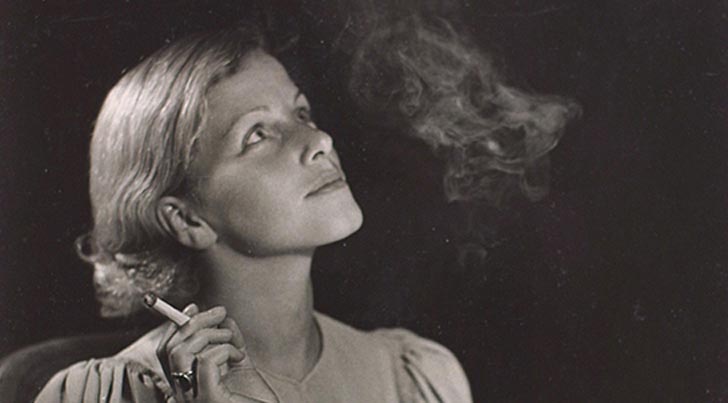
In “Deep in a Dream,” the singer depicts herself sitting in a dark room, smoking and getting drowsy as she remembers a lover who is now inaccessible — whether through distance, dissolution of the romance, or death, we do not really know. The lost lover’s descent on a smoke staircase (as described in the lyrics) might suggest a quirky sort of descent from heaven. At any rate, the genuinely dreamy music swells as the memories of happier times are revived (“Awake or asleep, every memory I’ll keep / Deep in a dream of you”). The reverie ends when the cigarette burns the singer’s fingers and wakes her. To my knowledge, while this is one of three Jimmy Van Heusen songs written in 1938-1939 involving dreams1, it is the only one that uses the absence of fire safety as a plot point.

The lyrics of “Deep in a Dream” leave us in the dark as to what has happened between the two lovers. Elsie Carlisle’s interpretation is successful because she evokes the melancholy of the dark, smoky room, only to imbue her dream with a truly ecstatic spirit. She seems content to express alternating strong emotions, rather than to establish some sort of vocal character, as she often does. The anonymous studio band (led by director George Scott-Wood) complements Elsie’s singing nicely, contributing to this decidedly atmospheric piece.

“Deep in a Dream” was recorded in America in late 1938 and early 1939 by Chick Webb and His Orchestra (v. Ella Fitzgerald)Bob Crosby and His Orchestra (v. Marion Mann), Cab Calloway and His Orchestra (v. Cab Calloway), Artie Shaw and His Orchestra (v. Helen Forrest), and Connie Boswell (accompanied by Woody Herman and His Orchestra).

It was recorded in London in 1939 by Geraldo and His Orchestra (v. Al Bowlly), Carroll Gibbons and the Savoy Hotel Orpheans (v. Anne Lenner), Harry Roy and His Orchestra (v. Bill Currie), Lew Stone and His Band (v. Dorothy Alt), and Oscar Rabin and His Romany Band (v. Garry Gowan).

Notes:

  1. The others being “It’s the Dreamer in Me” and “Darn That Dream”.

“Exactly Like You” (1930)

“Exactly Like You.” Words by Dorothy Fields, music by Jimmy McHugh (1930). Recorded in London in August 1930 by Elsie Carlisle under the musical direction of Jay Wilbur. Imperial 2318 mx. 5448-2.

Personnel: Jay Wilbur dir. / Jack Miranda-cl / Eric Siday-vn / Harry Jacobson-p-cel / Len Fillis-g / sb

Elsie Carlisle – Exactly Like You (-2) (1930)

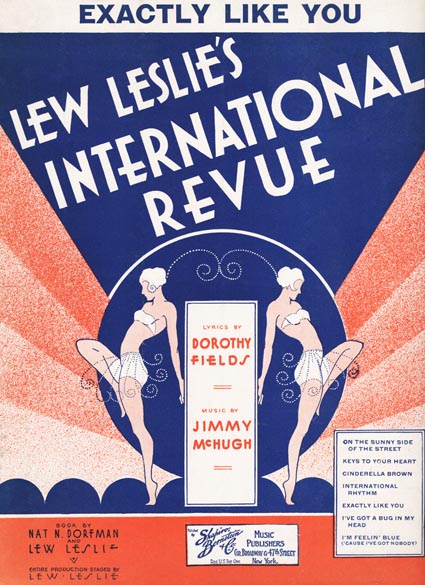
On February 25, 1930, Broadway writer and producer Lew Leslie opened his International Revue at the Majestic Theatre in New York City. One would have expected a show backed by the mastermind of the wildly popular Blackbirds revues, choreographed by Busby Berkeley, and with music by Dorothy Fields and Jimmy McHugh, to be quite a success, but it had a comparatively short run of 95 performances, the last being on May 17, 1930. The lasting legacy of this well-funded flop consists of two songs: “On the Sunny Side of the Street,” introduced by Harry Richman, and “Exactly Like You,” sung in the revue by Richman and British actress Gertrude Lawrence.

In “Exactly Like You,” the singer describes the joy of having had an ideal preconception of love that has suddenly become realized in the form of the song’s addressee. The lyrics use turns of phrase suited to dramatic interpretation:

You make me feel so grand,
I want to hand the world to you.
You seem to understand
Each foolish little scheme I’m scheming,
Dream I’m dreaming.

The music is extraordinarily catchy but presents the singer with quite a challenge in its range (an octave and a fifth).

Elsie Carlisle was up to the task. A veteran of musical theater, she had, of course, introduced Cole Porter’s “What Is This Thing Called Love?” just the previous year, and it has a comparable range. She works her way through the melody’s fourth intervals with dexterity, all the while giving the impression that she is on the verge of faltering. Hers was never a weak voice, but she was an actress who knew the power of the semblance of vulnerability. In the end, while the lyrics argue that we should be impressed by her lover, her overall vocal performance might lead us to admire the character that she has created, some anonymous small person who, prone to sadness, has the sudden opportunity to express great joy. I have argued elsewhere that Elsie did not simply interpret songs; she augmented them by creating comparatively advanced vocal personas that change greatly from song to song.

Elsie’s virtuoso performance is nicely complemented by the memorable instrumental accompaniment put together by Jay Wilbur, a bandleader who was also musical director at Imperial at the time. This was, incidentally, Elsie’s first recording session at Imperial, but she had worked previously with Wilbur at Dominion Records before it went bankrupt. She and the band recorded three different takes of “Exactly Like You” at their session in August 1930. It is worth comparing the slightly different instrumentals of take 2 (above) with take 1:

Elsie Carlisle – Exactly Like You (-1) (1930)

“Exactly Like You” saw many recorded versions in 1930, some of them quite commercially successful, on both sides of the Atlantic. In America, in addition to a recording by Harry Richman himself, there were versions by Roger Wolfe Kahn and His Orchestra, Merle Johnston and His Ceco Couriers, Seger Ellis, The Casa Loma Orchestra (v. Jack Richmond), Sam Lanin and His Orchestra (v. Smith Ballew), Ruth Etting, Grace Hayes, and Louis Armstrong and His Orchestra (v. Louis Armstrong).

The song must have been equally popular in Britain. A London recording was made as early as January by Lou Abelardo. Jack Harris and His Orchestra did a version that was rejected by Decca. Successful issues were made by Jack Payne and His BBC Dance Orchestra (v. Jack Payne), Florence Oldham, Ambrose and His Orchestra (v. Sam Browne), The Rhythmic Eight (directed by John Firman), Bidgood’s Broadcasters (as Ted Summer’s Dance Devils, v. Patrick Waddington), Harry Hudson’s Radio Melody Boys (v. Sam Browne), Sir Robert Peel, Bart., and His Band (v. Sam Browne), and Nat Star and His Dance Orchestra (as Syd Kay’s Orchestra; v. Fred Douglas-Cavan O’Connor). London-based Americans Layton and Johnstone recorded the song as a piano duet that year.

"Exactly Like You" sheet music
“Exactly Like You” original sheet music

“It’s the Talk of the Town” (Two Versions; 1933)

The lyrics of “It’s the Talk of the Town” present a delicate situation: a couple engaged to be married has broken up after having already sent out wedding invitations. The song could be considered a torch song, but it is an atypical one, insofar as the singer’s argument for reconciliation rests less on passionate desire than on feelings of personal embarrassment resulting from gossip, the refrain being “Everybody knows you left me: it’s the talk of the town.”

Elsie Carlisle recorded three takes of “It’s the Talk of the Town” with Ambrose and His Orchestra on October 10, 1933, but they were rejected by Brunswick. On the morning of October 13, she made a successful recording for Decca with an eight-person band whose makeup is unknown but which probably contained Ambrose men:

“It’s the Talk of the Town.” Music by Jerry Levinson, words by Marty Symes and Al J. Neiburg (1933). Recorded by Elsie Carlisle with orchestral accompaniment in London on October 13, 1933. Decca F. 3696 mx. GB6186-1.

Elsie Carlisle – “It’s the Talk of the Town” (1933)

In the early afternoon of the same day, Elsie would make her more famous and instrumentally more compelling recording of the song with Ambrose and His Orchestra. In this version, the emphasis on social awkwardness is highlighted by the band members’ snarling whisper: “IT’S THE TALK OF THE TOWN!”:

“It’s the Talk of the Town.” Recorded by Ambrose and His Orchestra with vocals by Elsie Carlisle in London on October 13, 1933. Brunswick 01607 mx. GB6175-4.

Personnel: Bert Ambrose dir. Max Goldberg-t-mel / Harry Owen-t / Ted Heath-Tony Thorpe-tb / Danny Polo-reeds / Sid Phillips-reeds / Joe Jeannette-as / Billy Amstell-reeds / Bert Read-p / Joe Brannelly-g  / Dick Ball-sb / Max Bacon-d (also humming and speaking by members of the orchestra)

Ambrose and His Orchestra (w. Elsie Carlisle) – “It’s The Talk of The Town” (1933)

“It’s the Talk of the Town” was one of two hits written in 1933 by the team of Levinson, Symes, and Neiburg, the other being “Under a Blanket of Blue.” Neiburg had three years earlier penned the lyrics to “(I’m) Confessin’ (That I Love You),” and Levinson (under the name “Livingston”) went on in later decades to compose noteworthy music for movies and television, although his role in composing the 1943 novelty song “Mairzy Doats” should not be forgotten.

In the late summer of 1933 America saw versions of “It’s the Talk of the Town” recorded by Glen Gray’s Casa Loma Orchestra (with vocals by Kenny Sargent), Connee Boswell, Dick Robertson and His Orchestra, Will Osborne and His Orchestra, Annette Hanshaw, Red McKenzie and His Orchestra, and Fletcher Henderson and His Orchestra.

As summer turned to autumn, British bands did their own versions. In addition to Ambrose’s recording and Elsie’s solo version on Decca, there were recordings made by the BBC Dance Orchestra (under the direction of Henry Hall, with vocal refrain by Phyllis Robins), Jay Wilbur and His Band (with vocalists Dan Donovan and Phyllis Robins), Jack Hylton and His Orchestra (with vocals by Eve Becke), Billy Cotton and His Band (Alan Breeze, vocalist), Jack Payne and His Band (with vocals by Billy Scott-Coomber), Joe Loss and His Band (with Jimmy Messini), George Glover and His Band (also with Jimmy Messini), Bertini and His Orchestra (Jack Plant, vocalist), and Oscar Rabin and His Romany Band (as “Art Willis and His Band,” with vocals by Harry Davis).

“Tell Me More About Love” (1929)

“Tell Me More About Love.” Words and music by Bert Page. Recorded by Elsie Carlisle, accompanied by Jay Wilbur and His Orchestra (uncredited) c. late June 1929. Dominion A. 168 mx. 1363-3.

Personnel: Laurie Payne-Jimmy Gordon-cl-as-bar / George Clarkson-cl-as-ts / Norman Cole-vn / vn / vn / Billy Thorburn-p / Dave Thomas or Bert Thomas-bj-g / Harry Evans-sb / Jack Kosky-d

Elsie Carlisle – “Tell Me More About Love” (1929)

“Tell Me More About Love” is a woman’s account of her love-making technique. Her approach is to seem innocent and to want instruction in the ways of love; hence the repetition of the title line “Tell me more about love.” She represents herself as a sort of student (“I don’t know what to do — / I can learn lots from you…”; “Teach me all — please don’t wait…”). She is “bashful” and “shy,” and explains that “love has never come [her] way,” but then she lets it slip that the various “lines” that she is rehearsing are ones that she practices every night with a different boy! In retrospect, her earlier request to have the lights dimmed or even turned off should have given her away.

Elsie Carlisle’s perky and chatty delivery in “Tell Me More About Love” showcases her talent for dramatizing a song and making it somewhat conversational, in spite of the absence of an interlocutor. Here Elsie’s delivery sounds a bit like that of Helen Kane, minus, of course, the exaggerated Bronx accent. Elsie’s romantic whimper at the end of the song is particularly precious, rivaled only by the primal girlish giggle in “Wasn’t It Nice?” (recorded the next year). A light  and upbeat piece of music, “Tell Me More About Love” contrasts nicely with Elsie’s decidedly plaintive rendition of “Mean to Me” on the flip side of the record.

“Tell Me More About Love” was also recorded that year by Mabel Marks, the Arcadians Dance Orchestra (under the direction of Bert and John Firman), Florence Oldham (accompanied by Sid Bright on the piano and Len Fillis on the guitar — Oldham  is sometimes portrayed on the sheet music), Kay and Kaye (a.k.a. Stanley Kirkby & Rita Bernard), and Billy Bartholomew, an English bandleader who recorded primarily in Germany from 1924-1938.

“My Canary Has Circles Under His Eyes” (1931)

“My Canary Has Circles Under His Eyes.” Words by Ted Koehler and Eddie Pola, music by Jack Golden (1931). Recorded by Elsie Carlisle under the musical direction of Jay Wilbur in June 1931. Imperial 2489 mx. 5717-3.

Personnel: Jay Wilbur dir. Laurie Payne-Jimmy Gordon-cl-as-bar / George Clarkson-cl-ts / Norman Cole-?George Melachrino-vn / Billy Thorburn or Pat Dodd-p / Bert Thomas-g / Harry Evans-sb / ?Max Bacon-d-vib

Elsie Carlisle – “My Canary Has Circles Under His Eyes” (1931)

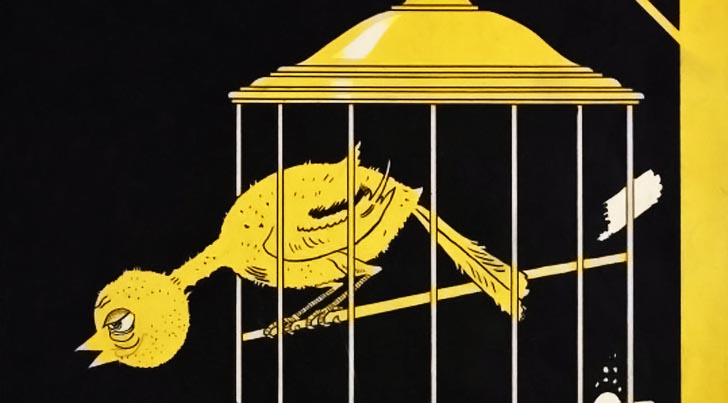
“My Canary Has Circles Under His Eyes” is a somewhat bizarre reflection on the topic of avian overindulgence. It begins with an introduction that marvels at a recent upheaval in social norms:

All this world is up to date —
Even children stay up late.
Things are not just what they used to be.
All this world is off its nut,
Going crazy, nothing but!
Just get this earful from me…

The singer proceeds to list off the ways in which 1931’s fast-paced, bibulous, dance- and sex-crazed society has affected the habits and health of a pet canary. The bird seems to have been infected with a passion for every form of loose living and pedestrian moral decadence. He dances “snake hips.” He is obsessed with some sparrow or another. He may be in some embarrassing sort of trouble (the reference in London recordings of this song to “look[ing] in Swaffer’s column” involves a notorious newspaper source of gossip). Finally, instead of responding favorably to birdseed, it is gin that he now likes — or harder stuff, in some versions.

The words of the song vary a good deal from singer to singer. Elsie Carlisle’s version for the Imperial label references a number of other songs: “Makin’ Whoopee”  (1928), which Eddie Cantor popularized and which provided Anglophone culture with a new term for sexual congress; “The Prisoner’s Song” (1925), which deals with a man who is to be jailed and who will be without his sweetheart — a useful comparandum for the formerly solitary canary in his cage; and “What Is This Thing Called Love” (1929), which only seems to be found in Elsie’s versions, probably out of respect for her having introduced the song two years earlier.

The success of Elsie’s Imperial recording of “My Canary Has Circles Under His Eyes” rests in her realization of the fundamental silliness of the song’s underlying concept. She rattles off the catalogue of her pet’s newfound moral weaknesses fairly seriously, and the mock-solemnity of her complaint enhances the comic effect. We can see this approach to the song in her Pathétone short from the same year that also features it:

Elsie Carlisle (1931)

Video from British Pathé (YouTube)

“My Canary Has Circles Under His Eyes” was recorded in 1931 by Sophie Tucker and by Marion Harris, two American singers then working in London. It was recorded in Wisconsin by Lawrence Welk and His Orchestra (with vocalist Frankie Sanders).  British artists who recorded the song that year were the Debroy Somers Band (with vocalist Dan Donovan), The Waldorfians (with vocalist Al Bowlly), Billie Lockwood, and Fred Spinelly.

"The Idol of the Radio." British dance band singer of the 1920s, 1930s, and 1940s.