Jay Wilbur

“My Canary Has Circles Under His Eyes” (1931)

“My Canary Has Circles Under His Eyes.” Words by Ted Koehler and Eddie Pola, music by Jack Golden (1931). Recorded by Elsie Carlisle under the musical direction of Jay Wilbur in June 1931. Imperial 2489 mx. 5717-3.

Personnel: Jay Wilbur dir. Laurie Payne-Jimmy Gordon-cl-as-bar / George Clarkson-cl-ts / Norman Cole-?George Melachrino-vn / Billy Thorburn or Pat Dodd-p / Bert Thomas-g / Harry Evans-sb / ?Max Bacon-d-vib

Elsie Carlisle – “My Canary Has Circles Under His Eyes” (1931)

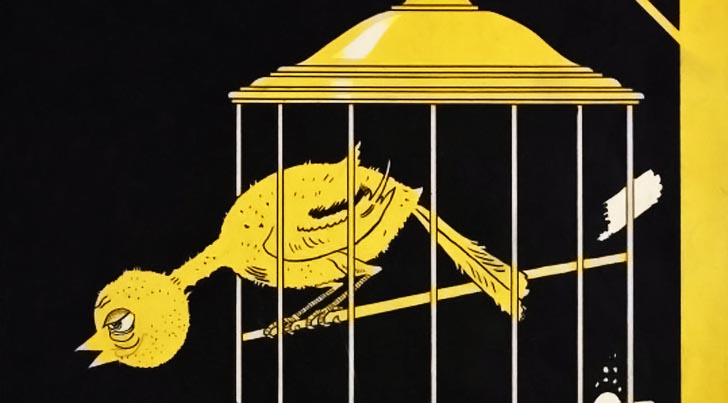
“My Canary Has Circles Under His Eyes” is a somewhat bizarre reflection on the topic of avian overindulgence. It begins with an introduction that marvels at a recent upheaval in social norms:

All this world is up to date --
Even children stay up late.
Things are not just what they used to be

All this world is off its nut,
Going crazy, nothing but!
Just get this earful from me...]

The singer proceeds to list off the ways in which 1931’s fast-paced, bibulous, dance- and sex-crazed society has affected the habits and health of a pet canary. The bird seems to have been infected with a passion for every form of loose living and pedestrian moral decadence. He dances “snake hips.” He is obsessed with some sparrow or another. He may be in some embarrassing sort of trouble (the reference in London recordings of this song to “look[ing] in Swaffer’s column” involves a notorious newspaper source of gossip). Finally, instead of responding favorably to birdseed, it is gin that he now likes — or harder stuff, in some versions.

The words of the song vary a good deal from singer to singer. Elsie Carlisle’s version for the Imperial label references a number of other songs: “Makin’ Whoopee”  (1928), which Eddie Cantor popularized and which provided Anglophone culture with a new term for sexual congress; “The Prisoner’s Song” (1925), which deals with a man who is to be jailed and who will be without his sweetheart — a useful comparandum for the formerly solitary canary in his cage; and “What Is This Thing Called Love” (1929), which only seems to be found in Elsie’s versions, probably out of respect for her having introduced the song two years earlier.

The success of Elsie’s Imperial recording of “My Canary Has Circles Under His Eyes” rests in her realization of the fundamental silliness of the song’s underlying concept. She rattles off the catalogue of her pet’s newfound moral weaknesses fairly seriously, and the mock-solemnity of her complaint enhances the comic effect. We can see this approach to the song in her Pathétone short from the same year that also features it:

Elsie Carlisle (1931)
Video from British Pathé (YouTube)

“My Canary Has Circles Under His Eyes” was recorded in 1931 by Sophie Tucker and by Marion Harris, two American singers then working in London. It was recorded in Wisconsin by Lawrence Welk and His Orchestra (with vocalist Frankie Sanders).  British artists who recorded the song that year were the Debroy Somers Band (with vocalist Dan Donovan), The Waldorfians (with vocalist Al Bowlly), Billie Lockwood, and Fred Spinelly.
Solo Recordings

“The Gentleman Obviously Doesn’t Believe” (1935)

“The Gentleman Obviously Doesn’t Believe.” Words and Music by Michael Carr and Eddie Pola. Recorded by Elsie Carlisle with orchestral accompaniment on May 28, 1935. Decca F-5568 mx. GB-7167-1.

Elsie Carlisle – “The Gentleman Obviously Doesn’t Believe” (1935)

“The Gentleman Obviously Doesn’t Believe” is a catalogue of traits that a certain attractive, anonymous man lacks: he has no fondness for drinking, smoking, dancing, modern popular music, or, most importantly, romance. Through her complaint about the man’s various deficits, the singer reveals herself to be passionate about all of life’s pleasures, and she encourages her audience to identify with her position (“like me…and you…and you”). We are given the impression of a woman inexplicably drawn to her opposite. Elsie Carlisle brings to this recording a sweet sincerity that convincingly conveys both wonder for and enchantment with the attractively puzzling “gentleman.”

“The Gentleman Obviously Doesn’t Believe” had been recorded the previous month by Lew Stone and His Band, with vocals by Lew Stone himself. Later in 1935 there were American versions by Joe Haymes and His Orchestra (with vocalist Clifford Wetterau) and by the Dorsey Brothers’ Orchestra (with Kay Weber, who sings the introduction, whereas Elsie had merely recited it).

Jay Wilbur

“Dreaming of Tomorrow” (1929)

“Dreaming of Tomorrow.” Words and music by Eddie Pola and Phil Cardew. Recorded by Elsie Carlisle under the musical direction of Jay Wilbur in London c. March 1929. Dominion A-83 mx. 1147-3.

Personnel: Jay Wilbur dir. Max Goldberg-Bill Shakespeare-t / Tony Thorpe-tb / Laurie Payne-Jimmy Gordon-George Clarkson-reeds / Norman Cole-vn / Billy Thorburn-p / Dave Thomas or Bert Thomas-bj-g / Harry Evans-bb-sb / Jack Kosky-d-x

Elsie Carlisle – “Dreaming of Tomorrow”

The “Dreaming of Tomorrow” that Elsie Carlisle recorded c. February 1929 is sometimes incorrectly identified as the 1925 composition of the same name by Benny Davis and Joe Sanders (of the Coon-Sanders Original Nighthawk Orchestra, who recorded the earlier song). Elsie’s song was actually composed in 1928 by Eddie Pola and Phil Cardew (the latter a prolific arranger for the BBC Dance Orchestra, amongst other things). It is a song that starts out melancholy but eventually becomes rather upbeat. The title and, for that matter, the lyrics, are apt to be misinterpreted as some form of optimism for the future (so common a theme in the songs of the decade to come), when really they express an intense happiness and satisfaction with the present. The singer contrasts her past infelicity with the bliss that she has found in a new relationship:

It seems to me my dreams
Will all materialize,
Since I got a glimpse
Of the love in your eyes.

Dreaming of tomorrow,
Why should I be blue?
When I know tomorrow's
Gonna give me you?

The song is a suitable vehicle for Elsie’s technique of vocally representing a character in very little time and in few words, and she she expresses her sweet sentiments in an appropriately dreamy way.

“Dreaming of Tomorrow” had been recorded before in November 1928 by Bert and John Firman’s Arcadians Dance Orchestra, with Maurice Elwin as the vocalist. It was also recorded by Philip Lewis and His Dance Orchestra (a.k.a. the Rhythm Maniacs), under the direction of Arthur Lally, in November 1929, again with Maurice Elwin, but that take was rejected by Decca.