
Jay Wilbur, Solo Recordings

“I’m Just in the Mood Tonight” (1929)

“I’m Just in the Mood Tonight.” Words by Edgar Leslie, music by Horatio Nicholls (pseudonym of Lawrence Wright) (1929). Recorded in London c. September 1929 by Elsie Carlisle under the musical direction of Jay Wilbur. Dominion A-180 mx. 1447-2. Elsie Carlisle recorded twenty songs for Dominion between the end of 1928 and the spring of …

Ambrose

“A Bungalow, a Piccolo, and You!” (1932)

“A Bungalow, a Piccolo, and You!” Words and music by Al Lewis, Al Sherman, and Lee David (1932). Recorded in London at Studio 1, Abbey Road on July 22, 1932 by Ambrose and His Orchestra with vocalists Sam Browne and Elsie Carlisle. HMV B-6218 mx. 0B-2378-1. Personnel: Bert Ambrose dir. Max Goldberg-Harry Owen-t / Ted …

Jay Wilbur, Solo Recordings

“When That Man Is Dead and Gone” (1941)

“When That Man Is Dead and Gone.” Words and music by Irving Berlin (1941). Recorded in London on April 9, 1941 by Elsie Carlisle with orchestral accompaniment directed by Jay Wilbur. Rex 9960 mx. R-5566-1. Personnel: Jay Wilbur dir. ?Alfie Noakes-?Chick Smith-t / tb / 3 cl-as-bar / Charles Trimby + 1-vn / p / …

Ambrose, Solo Recordings

“Little Man, You’ve Had a Busy Day” (two versions; 1934)

If risqué elements constitute one of the primary attractions of interwar Anglophone popular music for modern audiences (think “Pu-leeze! Mister Hemingway”), perhaps the sentimental might be seen as the ingredient most likely to repel us. Lullabies and songs about nursery rhymes abound, especially in the 1930s: even in Elsie Carlisle’s repertoire, we have “This Little …

Ray Starita, Sam Browne

“You’ll Find Out” (1932)

“You’ll Find Out.” Words and music composed by Archie Gottler and Betty Treynor (a pseudonym of Lawrence Wright) for On with the Show. Recorded in London on June 15, 1932 by Ray Starita and His Ambassadors with vocalists Elsie Carlisle and Sam Browne. Sterno 984 mx. S-2477-2. Personnel: Ray Starita-cl-ts dir. Nat Gonella-t / t …

Nat Star, Ray Starita, Rudy Starita

“Rock Your Cares Away” (1932)

“Rock Your Cares Away.” Words and music by Leonard Blitz (as Leo Towers), Harry Sugarman (as Harry Leon), Lawrence Wright (as Horatio Nicholls) (1932). Recorded in London on November 5, 1932 by Rudy Starita and His Ambassadors with vocalist Elsie Carlisle. 4 in 1 – 17 mx. X-218-2. Personnel: probably Nat Star-cl-as dir. / Nat …

More on this topic

Nat Star, Ray Starita, Rudy Starita

“Mad about the Boy” (1932)

“Mad about the Boy.” Words and music by Noël Coward for the 1932 revue Words and Music. Recorded in London on November 5, 1932 by Rudy Starita and His Ambassadors with vocalist Elsie Carlisle. 4 in 1 – 17 mx. X-218-2.

Personnel: probably Nat Star-cl-as dir. / Nat Gonella-t / t / tb / cl-as / cl-ts / vn / p / bj-g / bb-sb / Rudy Starita-d-vib-x

Rudy Starita and His Ambassadors (v. Elsie Carlisle) – “Mad About the Boy” (1932)

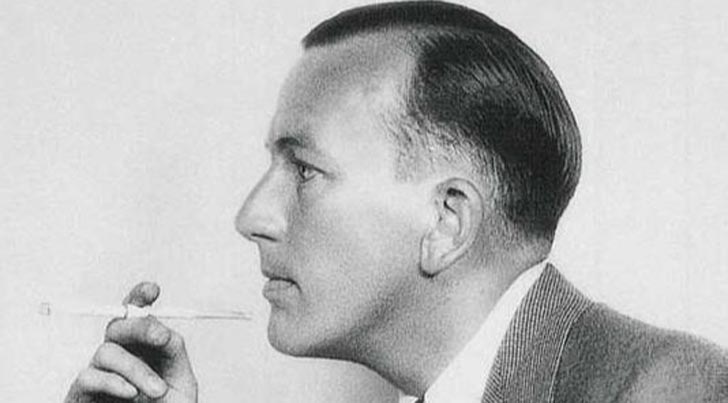
“Mad about the Boy” must be one of Sir Noël Coward’s most successful compositions, especially if we measure success by the fact that the song continues to be recorded and even used in advertising many decades after its debut on the London stage. It originated in the 1932 revue Words and Music, whose words, music, script, and direction were all done by Coward himself; the show included other memorable songs such as “Mad Dogs and Englishmen” and “Let’s Say Goodbye.” “Mad about the Boy” was sung on stage by a cast of female characters — a society lady, a prostitute, a schoolgirl, and a Cockney servant — who describe their passion for a movie star as they wait in line to see one of his films. The lyrics are predictably witty, using a surprising variety of rhymes for the monosyllables “mad” and “boy”.1

It is not clear whether the song was meant to reference a specific film actor. A great deal of effort has been put into identifying an unrequited real-life crush that Coward is said to have had on some American actor (the name Douglas Fairbanks, Jr. comes up frequently). Coward may have contributed to the idea that the song had a homosexual theme by writing verses for a businessman character to sing in the New York version:

(The character was cut from the production — the idea may have been too risqué for its time.)2 I find it ultimately unnecessary, however, to assume that the “boy” of “Mad about the Boy” must have a specific, real-world analogue — in any case, infatuation with an inaccessible celebrity is a very common occurrence.

…I’m mad about the boy
And even Doctor Freud cannot explain
Those vexing dreams
I’ve had about the boy.

…

When I told my wife
She said
"I never heard such nonsense in my life!"
Her lack of sympathy
Embarrassed me
And made me frankly glad about the boy.

Elsie Carlisle’s versions of “Mad about the Boy” were made with Ray Starita’s band, but in the bandleader’s absence — Ray had gone on vacation to America in the summer of 1932 and never returned to England. There are quite a few records whose labels read “Ray Starita and His Ambassadors” that were likely made without him; one of the records with “Mad about the Boy” on them (4 in 1 – 17) is the first to specifically mention Ray’s brother Rudy Starita instead. Yet Rust and Forbes hesitate to say that Rudy was actually the musical director for that session, writing that it was probably Nat Star who played that role.3

It should be noted that the band and Elsie recorded takes for two records of “Mad about the Boy” that day, a Sterno and a 4 in 1 (both products of the British Homophone Company).

The other dance bands’ arrangements of “Mad about the Boy” exclusively used the society lady’s lines from the Words and Music review. For some reason, the Starita band had Elsie sing the prostitute’s verse, which is rather more edgy:

I'm hardly sentimental;
Love isn't so sublime.
I have to pay my rental,
And I can't afford to waste much time.

Elsie’s alternately weepy and enraptured vocal complements the band’s funereally melancholy yet infectiously catchy treatment of the tune. Her evocation of a street-walker’s brooding obsession with a Hollywood persona is really quite convincing.

Other British bands who recorded “Mad About the Boy” in 1932 were Ray Noble and His New Mayfair Orchestra, who did an instrumental version and included it in a  Words and Music medley, the Savoy Hotel Orpheans (dir. Carroll Gibbons / v. Cecile Petrie), the Debroy Somers Band (in a Words and Music medley), Jack Hylton and His Orchestra (v. Phyllis Robins), The Blue Lyres (dir. Bert Ambrose / v. Anona Winn), and The Blue Mountaineers (v. Sam Browne). In 1932 Coward’s close friend and professional associate Gertrude Lawrence would record a version that includes the society lady’s intro. Coward himself recorded “Mad about the Boy” in 1932, but his version was not issued during his lifetime.

  1. Stephen Citron. Noel and Cole: The Sophisticates. United Kingdom: Hal Leonard, 2005, 318. ↩︎
  2. Sheridan Morely. Noël Coward. London: Haus, 2005, 57. ↩︎
  3. Brian Rust and Sandy Forbes. British Dance Bands on Record, 1911 to 1945, and Supplement. Bungay, Suffolk: Richard Clay, Ltd., 1989, 1021-1022. ↩︎
Jay Wilbur, Solo Recordings

“He’s Not Worth Your Tears” (1931)

“He’s Not Worth Your Tears.” Words by Mort Dixon and Billy Rose, music by Harry Warren; composed for the musical Sweet and Low (1930). Recorded in London on February 25, 1931 by Elsie Carlisle (as Gracie Collins) under the musical direction of Jay Wilbur. Eclipse 50 mx. JW-173-3.

Personnel: Jay Wilbur dir. Max Goldberg-Bill Shakespeare-t / Ted Heath or Tony Thorpe-tb / Laurie Payne-Jimmy Gordon-cl-as-bar / Norman Cole-?another-vn / Billy Thorburn or Pat Dodd-p / Bert Thomas-g / Harry Evans-sb / Jack Kosky-d

He’s Not Worth Your Tears – Gracie Collins (Elsie Carlisle) – Eclipse 50
Transfer by Jonathan David Holmes

Sheet music and record labels assert that “He’s Not Worth Your Tears” originated in the 1930 Broadway revue Sweet and Low, and yet sources for original casts and the like omit the song.1 Perhaps it was cut from the show but continued to be marketed as having been in it? At any rate, it was recorded by quite a few artists, Elsie Carlisle among them. This is her only record side with the budget Eclipse label (sold in Woolworth’s), and one of only four small, eight-inch records that she ever made.

This song showcases Elsie as a torch singer capable of appealing to our deepest sympathies for whatever lost or unrequited love she claims to have experienced. And yet this torch song has a bit of a twist: Elsie is not complaining so much about the lover who left her as the people who are trying to comfort her. “He’s not worth your tears,” they tell her to her annoyance. I find the lyrics of the B part particularly memorable:

They never bother an old weeping willow --
They leave it drooping there.
So if I want to confide in my pillow,
Why should strangers care?

Elsie is at her most mournful in this song. There is something deeply attractive about the way that her voice sounds as if it is about to break, but never does. I have listed the personnel that Richard J. Johnson identifies as having made up Jay Wilbur’s studio band at the time,2 but I only hear a pianist and a trumpet player; the latter has a short but memorable solo.

Eclipse 50 was the second Elsie Carlisle record that I ever bought. I put off sharing a transfer of it because my copy is rather worn and I was hoping to find a better one, but it would appear that this is a comparatively rare record. I was very pleased when Jonathan Holmes found a good copy and shared it on YouTube; his transfer is the one used at the beginning of the article. Readers might like to compare my copy, though, as it is take 2, not take 3, and there are interesting little differences in the pacing:

“He’s Not Worth Your Tears.” Recorded in London on February 25, 1931 by Elsie Carlisle (as Gracie Collins) under the musical direction of Jay Wilbur. Eclipse 50 mx. JW-173-2.

Elsie Carlisle – “He’s Not Worth Your Tears” (1931)

Elsie used the pseudonym Gracie Collins on Eclipse 50; the reverse side, “Homesick Blues,” is also supposed to be by Gracie Collins, but it clearly has Betty Bolton’s voice. If that is not confusing enough — having two very different singers pretending to have sung both sides of one record — there also exists a take 1 of “He’s Not Worth Your Tears” that was recorded by a singer named Elaine Rosslyn. I have not heard it myself.3

In America in 1930-1931 there were versions of “He’s Not Worth Your Tears” recorded by Doris Robbins, Marion Harris, Benny Goodman and His Orchestra (v. Helen Rowland), Aileen Stanley (two takes rejected by Victor), Jimmie Noone’s Apex Club Orchestra (v. Mildred Bailey), and Ben Selvin and His Orchestra (v. Helen Rowland).

There were British dance band versions in 1931 by Jack Harris and His Orchestra (“She’s Not Worth Your Tears” — apparently mislabeled as “It’s Not Worth Your Tears”; v. Cavan O’Connor) and by the Debroy Somers Band (also “She’s Not Worth Your Tears”; v. Dan Donovan).

  1. E.g., The Guide to Musical Theatre. ↩︎
  2. Richard J.  Johnson, Elsie Carlisle: A Discography, Aylesbury, Buckinghamshire: Richard J. Johnson, 1994, 12. ↩︎
  3. For more about Eclipse’s “Gracie Collins” pseudonym, see Arthur Badrock’s comments in Talking Machine Review 88 (Autumn/Winter 1994): 2559-2560. ↩︎
Ambrose, Solo Recordings

“The Clouds Will Soon Roll By” (Two Versions; 1932)

“The Clouds Will Soon Roll By.” Words and music by Harry Woods and Billy Hill (the latter using the pseudonym George Brown; 1932). Recorded by Ambrose and His Orchestra (with vocals by Elsie Carlisle) on July 13, 1932. HMV B-6210 mx. 0B-3134-1.

Personnel: Bert Ambrose dir. Max Goldberg-Harry Owen-t / Ted Heath-tb / Joe Crossman-Billy Amstell-Joe Jeannete-reeds / Harry Hines-as / Ernie Lewis-Teddy Sinclair-Peter Rush-vn / Bert Read-p / Joe Brannelly-g / Don Stutely-sb / Max Bacon-d-vib

Ambrose and His Orchestra (v. Elsie Carlisle) – “The Clouds Will Soon Roll By” (1932)

Elsie Carlisle’s recording of “The Clouds Will Soon Roll By” with Ambrose and His Orchestra is fixed in the public’s memory as one of her most representative recordings. It is a perfect example of her ability to project vulnerability, in this case employing optimistic lyrics set to a powerful but somewhat melancholy arrangement. This recording seems to encapsulate our sense of the Great Depression as an era when popular culture offered eloquent expressions of hope amidst global disappointment and despair.

The use of extended meteorological comparisons to encourage an upbeat attitude precedes the Depression, of course. Irving Berlin’s 1926 Blue Skies is another song that similarly combines hopeful lyrics with a rather sad tune. In 1932, the year when Harry Woods and Billy Hill published “The Clouds Will Soon Roll By,” Berlin would write “Let’s Have Another Cup of Coffee,” a much perkier but similarly themed composition, one of whose lines is “And the clouds will soon roll by.”  It is as if songwriters had hit upon the perfect metaphorical vehicle — weather, the most pedestrian topic of light chat — as the best way to convey consolation.

The Ambrose arrangement of “The Clouds Will Soon Roll By” would be memorable even if it lacked Elsie’s vocals. The intro seems to churn and roll like the upper atmosphere in a storm, and the music evokes both sadness and confidence. But Elsie is at her best in this piece. She allows her voice to quaver slightly at important points as if crying, all the while comforting both herself and us. It is worth noting that she sings for barely over a minute of the recording, which is not unusual in a dance band arrangement. What is interesting is that we remember her part so well.

The Ambrose recording is undoubtedly one of the most recognizable pieces of British popular music from the interwar period; it is also one of Elsie Carlisle’s best-known songs. There is a peculiar reason for this. The 1978 Dennis Potter television miniseries Pennies from Heaven featured long and frequently bizarre musical interludes based on British dance band recordings, and in many ways it created a canon of recognizable songs. The very first such song in the very first episode is Ambrose’s “The Clouds Will Soon Roll By,” and when Elsie begins to sing, the actor who mimes to her voice is the very masculine Bob Hoskins. The effect is jarring and memorable. Again, in the 1981 miniseries Brideshead Revisited,1 protragonist Charles Ryder puts the Ambrose record on a gramophone at a moment when comfort is needed, but he and his lover leave the room just as Elsie’s voice begins to be audible.

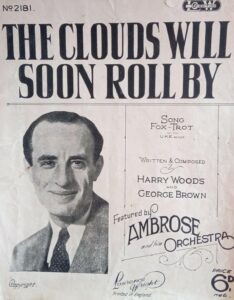
"The Clouds Will Soon Roll By." Sheet music featuring Ambrose's face.

“The Clouds Will Soon Roll By.” Recorded by Elsie Carlisle with piano accompaniment and with Len Fillis on the steel guitar on September 19, 1932 in Chelsea Town Hall, London.  Decca F-3146 mx. GB-4844-4.

Elsie Carlisle – “The Clouds Will Soon Roll By” (1932)

In her later Decca recording, Elsie Carlisle sings “The Clouds Will Soon Roll By” at a more leisurely pace. The accompaniment is a simple piano and Len Fillis on the steel guitar. The song is still bittersweet, but there is a lazy, dreamy quality to it as well. At one point when Fillis’s guitar is foregrounded, Elsie hums the tune and even begins to engage in a half-hearted attempt at scat. The overall effect is not as powerful as the  Ambrose version, but the recording is nevertheless memorable for its playful interpretation of the song.

  1. Season One, Episode Ten. ↩︎