Carroll Gibbons

Before he took up his famous role as bandleader of the Savoy Hotel Orpheans, Carroll Gibbons provided piano accompaniment for Elsie Carlisle at her first recording sessions in 1926-1927.

Carroll Gibbons – Wikipedia

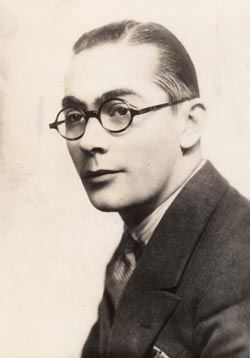
Carroll Gibbons c. 1934

“I Love My Baby” (1926)

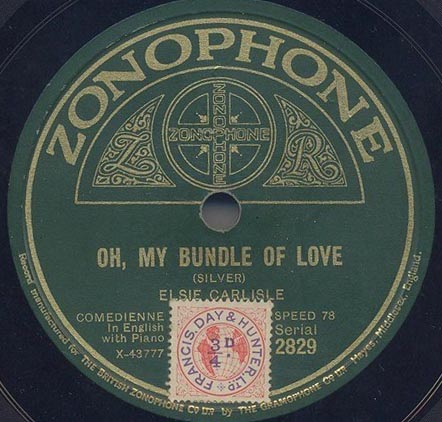
“I Love My Baby (My Baby Loves Me).” Words by Bud Green, music by Harry Warren (1925). Recorded by Elsie Carlisle with piano accompaniment by Carroll Gibbons on May 25, 1926. Zonophone 2772 mx. Bb-8426-2.

Elsie Carlisle – “I Love My Baby” (1926)

Elsie Carlisle made her first commercially successful recording one hundred years ago today. Already an accomplished thirty-year-old actress, she had made her radio broadcasting debut on March 1, 1926. After May 25, 1926, Carlisle would go on to enjoy a fifteen-year recording career, and it is through her records that we still appreciate her artistry.

May 25, 1926, was not actually the first time that she had entered a studio at the Gramophone Company’s facilities in Hayes, Middlesex, to record a song: on March 7, 1918, she had made a test recording of “Some Girl Has Got to Darn His Socks,” but it was never issued as a commercial record, and it remains unclear if a pressing survives. If it seems strange that Carlisle’s first attempt at recording did not result in an issued record, we must remember how greatly technology changed between 1918 and 1926. In 1918, the only way to record sound was using acoustic methods. Carlisle’s talents may simply not have shone under those circumstances. Beginning in 1925, electrical processes rapidly took over the industry, and soon afterwards the crooners emerged, vocal artists who could exploit the microphone’s sensitivity to quiet, intimate singing—something the acoustic horn had never permitted. As a stage actress of that era, Carlisle must have had a powerful voice, but perhaps we can be grateful that her career took off at a time when her softer, subtler efforts could be captured on shellac.

On May 25, then, Carlisle was joined at the Gramophone Company’s B Studio by Carroll Gibbons, who was to be her piano accompanist; he was not yet the famed director of the Savoy Hotel Orpheans. Ralph Graves, in his 1938 journalistic paean to Elsie Carlisle (“Radio Sweetheart No. 1”), recounts how the two first met:

Now for another scene.

This time not a swank lunch, but a very informal party.

Elsie was asked to sing. No, she hadn’t her music, but a quiet, bespectacled young man at the piano knew all the latest numbers, and could instantly transpose into any key Elsie wanted.

She sang several numbers which went down well, but the outstanding thought in Elsie’s mind was what a good accompanist this young man was. And when he played some piano solos on his own afterwards her opinion of him went up.

She asked who he was.

“That chap at the piano? Oh, he’s a Mr. Gibbons. Just come over from the States with Rudy Vallee, you know. Carroll Gibbons I believe his name is….”

That was in the days when Carroll was striving to make a name for himself.

Elsie and Carroll used to meet quite often after that party, as they held each other in mutual esteem. Well, now here’s a secret. Even his best friends will admit that Carroll has a “queer” voice. Those melodious deep tones, so very “Southern” are a characteristic. His announcements are fun, but you can’t imagine him as a singer, can you!

Yet it is a fact that Carroll and Elsie not only made gramophone records together, but on at least one of them Carroll sang part of the vocals! Yes, that vocalist is a fine pianist!1

At this particular session Gibbons did not sing, but his piano accompaniment is flawless, as it would continue to be throughout their collaboration that year.

The pairing of songs recorded that day seems prescient, in retrospect: Harry Warren’s “I Love My Baby” has as its reverse “So Is Your Old Lady,” whose lyrics were penned by Al Dubin—the man now most associated with Warren by lovers of 1930s musical films. The two had collaborated on at least one successful song by 1926, but their celebrated partnership as Warner Bros.’ signature songwriters lay years ahead.

“I Love My Baby” expresses the enthusiasm of giddy young lovers at an insistent tempo that is entirely infectious and is as redolent of the decade of its composition as “The Charleston.” Elsie Carlisle sings the lyrics with a chatty, dramatic delivery, and she adds color with vocal effects such as her husky second repetition of the refrain (most reminiscent, perhaps, of the versions recorded a few months earlier by Aileen Stanley and Lee Morse). The persona Carlisle takes on is one familiar from her later work, an example of brilliant, brainless fun such as we hear in her 1929 “Come On, Baby” with the Rhythm Maniacs. Carlisle would appear on the sheet music for “I Love My Baby” that year.

Noteworthy early American recordings of “I Love My Baby (My Baby Loves Me)” date from the autumn and winter of 1925–26, and include those of Aileen Stanley, Mike Speciale and His Orchestra (v. Jimmy Flynn), Sam Lanin’s Dance Orchestra (v. Irving Kaufman), The University Six (v. Ed Kirkeby), Bailey’s Lucky Seven (v. Arthur Fields), The Little Ramblers, Esther Walker (with the piano accompaniment of Rube Bloom), Lee Morse, Isham Jones, Owen Fallon and His Californians, Peggy English (with Rube Bloom on the piano), Sally Freeman, and Jack Glassner and His Colonial Inn Orchestra.

Other British 1926 versions of the song are those of the New Princes’ Toronto Band (dir. Hal Swain; v. Les Allen) and Don Parker and His Band; Frances White recorded it for HMV with the Kit-Cat Band, but it went unissued.

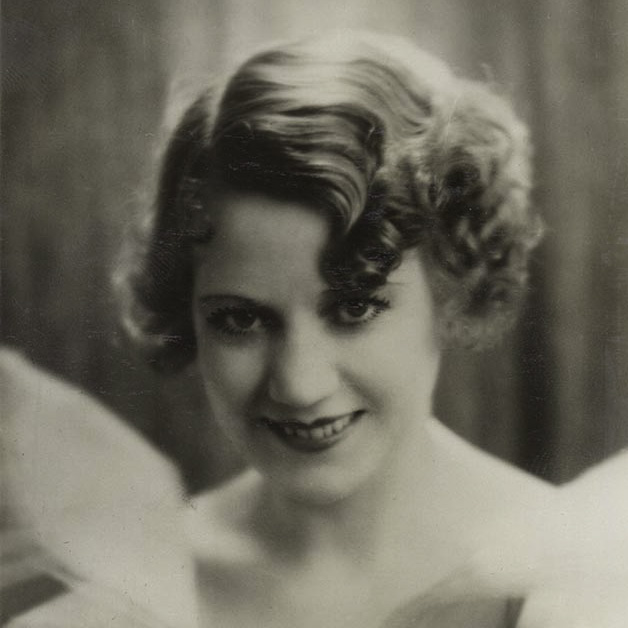
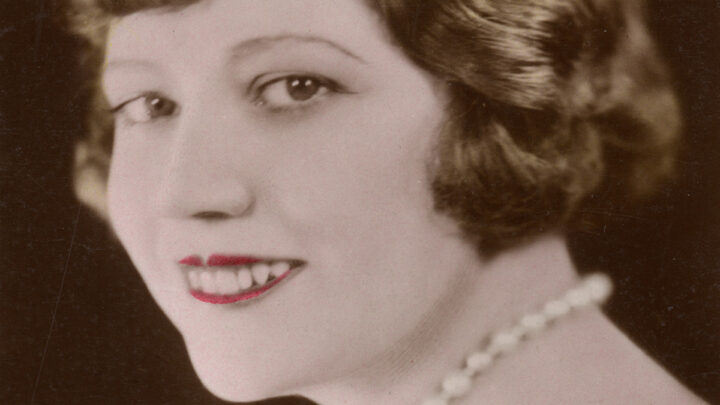
Elsie Carlisle c. 1926

Notes:

  1. Ralph Graves, “Radio Sweetheart No. 1,” Radio Pictorial, no. 251, November 4, 1938, 8. The boldface is Graves’s and typical of the bombastic editorial style of the magazine. Graves is presumably referring to Gibbons’s faint but endearing antiphony in the 1926 “Ya Gotta Know How to Love” (Zonophone 2815), another composition by Bud Green and Harry Warren, as well as in the song on its reverse side, “My Cutey’s Due at Two-to-Two Today”. Gibbons’s “queer” voice (to use Graves’s term) was, I understand, his way of coping with an extreme stutter. Gibbons actually sang quite a bit, but perhaps more so in the period after Graves wrote his piece; I think particularly of “Too Romantic” (1940), “I L-L-Love You So” (1941), and “Elmer’s Tune” (1942).

“So Is Your Old Lady” (1926)

“So Is Your Old Lady.” Words by Al Dubin, music by Joe Burke (1926). Recorded by Elsie Carlisle with piano accompaniment by Carroll Gibbons on May 25, 1926. Ariel 940 mx. Bb8427-1 (also on Zonophone 2757 and Ariel 1006).

Elsie Carlisle – “So Is Your Old Lady” – (1926)

“So’s your old man!” is a somewhat dated rejoinder to an insult, a suggestion that one’s interlocutor can take what he has said and apply it to his own father. One still hears the term “old lady” used to refer to a man’s wife or girlfriend. In this playful 1926 song, lyricist Al Dubin combines the two expressions in an exchange between a wife and a husband, the latter of whom has been philandering a little too obviously. The wife tells him to do as he likes, but to remember that while he is pursuing his affairs, “so is [his] old lady” — a suggestion of reciprocal infidelity. At this recording session in 1926 (which was her first), Elsie Carlisle handled the quick patter and formulaic repetition in the lyrics deftly, bringing something both cute and slightly titillating to the taunting threats of the wife. Carroll Gibbons’s piano playing complements Elsie’s quick, crisp delivery quite nicely. The recording was made for Zonophone but also appeared on the Ariel label under Elsie’s first known pseudonym: “Maisie Ramsey.”

Other versions of “So Is Your Old Lady” were done in 1926 in America by the Original Indiana Five, Ruth Etting,  and Warner’s Seven Aces. In Britain the song was recorded by Jack Hylton and His Orchestra, Teddy Brown and His Café de Paris Band (with vocalist Lionel Rothery), Bert Firman (under the pseudonym of Newton Carlisle’s Dance Orchestra), Hilda Glyder, Victor Sterling and His Band (directed by Nat Star), and the Edison Bell Dance Orchestra (with vocals by Tom Barratt).

“Since I Found You” (1927)

“Since I Found You.” Words by Sidney Clare, music by Harry Woods. Recorded by Elsie Carlisle at Studio B, Hayes, Middlesex, on May 6, 1927. HMV B. 2489 mx. Bb-10690-3.

Elsie Carlisle – “Since I Found You” (1927)

Video by David Weavings (YouTube)

“Since I Found You” is an effusive love song, but one vague on details: the song tells us very little about the “I” or the “you” of the title. Even the sex of the “I” is only implied by that of the singer; there is nothing internal to the song that suggests boy-loves-girl or girl-loves-boy, the two most obvious scenarios for a popular song of the early twentieth century. Ironically, the ambiguity of “Since I Found You” may be one of its strengths.

When I first began to listen carefully to different versions of popular songs from this period, I marveled that artists and arrangers were so adept at shifting the male and female pronouns in love songs around to suit the sex of the singer (and thus incidentally to preserve a heterosexual norm). At length I came to the conclusion that the lyrics were carefully written that way in the first place. A commercially ambitious Tin Pan Alley songwriter would never want to limit the number of artists who could record his music by using words that could not easily be swapped out. An example of success in this regard would be “I Can’t Get Over a Girl Like You (Loving a Boy Like Me)”; the pronouns in the title are simply begging to be reversed, as they were when Elsie Carlisle sang them.

“Since I Found You” is particularly ingenious in this regard, insofar as it mostly involves the first and second grammatical persons (“I” and “you”); there are no he’s that need to become she’s. In fact, the “I” of the song tells us practically nothing about himself (or herself) or about the “you” of the song, except to say that the former is absolutely ecstatic about having found the latter. The singer expresses his or her joy by insisting that the whole universe feels it, by transferring his or her feelings to heavenly bodies, birds, bees, and insects. This clever use of the pathetic fallacy renders the song simultaneously more general and even vague (and thus requiring no adaptations for sex) and yet entirely effective as an effusive emotional outpouring.

I do not mean to suggest that there is any doubt as to Elsie Carlisle’s identity in her version of “Since I Found You”; to the contrary, she is ebullient in a feminine and perhaps even girlish way. The lack of a real plot line does not prevent her from vocally caressing each of the lyrics’ hyperbolic claims regarding the transformation of the natural world by her love life. Elsie’s dulcet cooing is complemented in this 1927 recording by the piano playing of Carroll Gibbons.

“Since I Found You” was recorded in 1926 and 1927 in America by Cliff Edwards (Ukulele Ike) and His Hot Combination, Vincent Lopez and His Casa Lopez Orchestra, Jim Miller and Charlie Farrell, and Vaughn de Leath (in January with an orchestra and in February with piano accompaniment).

British recordings were made in 1927 by Bert Firman’s Dance Orchestra, Bert and John Firman (as Eugene Brockman’s Dance Orchestra), Teddy Brown and His Café de Paris Band (with vocalist John Thorne), Jack Payne and His Hotel Cecil Orchestra (with Jack Payne singing), and the Savoy Havana Band. In late 1927 Al Bowlly recorded “Since I Found You” with Arthur Briggs’ Savoy Syncopaters Orchestra in Berlin.

“Baby” (1927)

“Baby.” Words by Raymond W. Peck and music by Percy Wenrich (1922); featured in the Broadway musical Castles in the Air (1926). Recorded by Elsie Carlisle, accompanied by Carroll Gibbons and an unidentified violinist, on May 6, 1927. HMV B-2489 mx. Bb-10514-5.

Elsie Carlisle – “Baby” (1927)

Video by David Weavings (YouTube)

“Baby (Fox-trot Lullaby)” was written in 1922 but was most prominently featured four years later in Castles in the Air, a musical comedy of manners that saw moderate success in 1926 on Broadway (less so the next year in London, where the show had only 28 performances). The lyrics have a surprisingly simple thesis, suggesting that “old-fashioned lullabies” have given way to modern “fox-trot lullab[ies],” that babies are no longer rocked in cradles but rather in the arms of dancing parents. The song tries to make its point with an introduction that roughly resembles a lullaby but that gives way to a catchy, fast-paced refrain. It would appear that Peck and Wenrich did not originate the notion of a foxtrot lullaby, as there had been a 1921 song entitled “Nestle in My Loving Arms — A Lullaby Fox-Trot.”

Elsie Carlisle successfully realizes the conceit of “Baby” by applying sweet earnestness to the intro at a measured pace but then propelling her way into the refrain. At the end of the song she repeats the refrain in a slow, dreamy way, thus integrating the ideas of “foxtrot” and “lullaby” into one. In the middle of the recording there is a remarkably good, quick-paced violin solo. The identity of the violinist is unknown; a contemporary review in Melody Maker suggests that it could be Hugo Rignold, although the reviewer gets the pianist wrong, suggesting that he is Arthur Young (we can be fairly sure that it is Carroll Gibbons).1

“Baby” was recorded in America in 1926 by Roger Wolfe Kahn and His Orchestra (with vocals by Billy Jones) and by Virginia Rea and Franklyn Baur (accompanied by the Brunswick Hour Orchestra). In 1927 it was recorded in Britain by Jack Hylton and His Orchestra twice (directed the first time by Chappie d’Amato, as Jack Hylton had been injured in a car accident, in a session whose output was rejected by HMV, and  the second time by Jack Hylton himself). It was also recorded by the Debroy Somers Band (with vocalist Bobby Sanders), Hal Christie’s Dance Orchestra (directed by Bert Firman), Victor Sterling and His Band, the Raymond Dance Band (directed by Stan Greening), Alfredo’s Band (with singer Peter Bernard), Will Hurst’s Band (with vocals by Maurice Elwin), and the Savoy Orpheans (directed by Carroll Gibbons, in a selection from Castles in the Air).

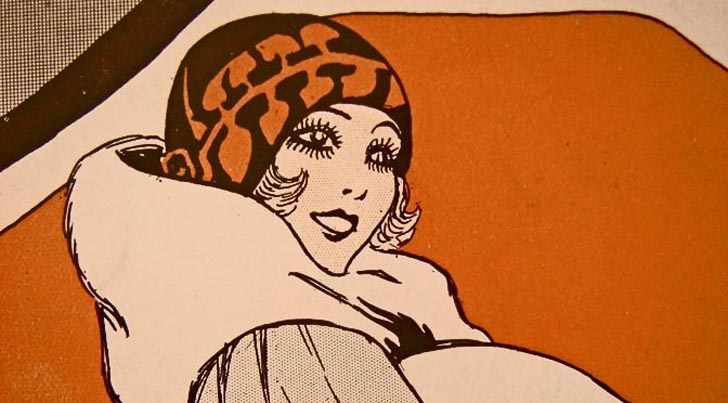
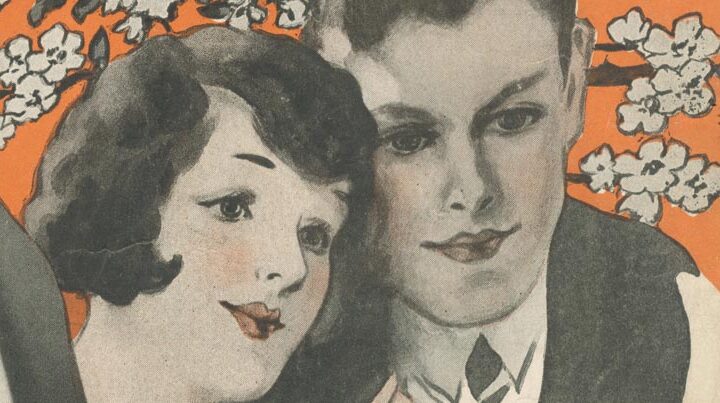
"Baby" (1927) sheet music

Notes:

  1. The Melody Maker and British Metronome 2.20 (August 1, 1927): 784.

“He’s the Last Word” (1927)

“He’s the Last Word.” Lyrics by Gus Kahn, music by Walter Donaldson (1926). Recorded by Elsie Carlisle with accompaniment by piano (Arthur Young) and violin at Studio B, Hayes, Middlesex, on May 6, 1927. HMV B. 2579 mx. Bb10689-2.

Elsie Carlisle – “He’s the Last Word” (1927)

“He’s the Last Word” follows an argument familiar to aficionados of popular music: its singer goes through a catalogue of her “sweet somebody’s” various deficits (insufficient talent at dancing, for example), only to conclude that when it comes to romance, “he’s the last word” — he is the very best. In her recording of the song, Elsie Carlisle is pure enthusiasm, and her frequent nonsensical ejaculations remind us of the fun, popular genre that she is working in. She has excellent accompanists in this recording on the piano and violin. Richard J. Johnson identifies the pianist as Carroll Gibbons and does not attempt to name the violinist.1

Contemporary record reviewer and industry insider Edgar Jackson was under a very different impression as to the identities of the accompanists, writing that

Elsie Carlisle has a thoroughly good vocal record of “He’s the Last Word” [54 at 78] (B2579). She sings tunefully, and is one of the most stylish and rhythmical of all our English comediennes. She has been excellently accompanied by Hugo Rignold (violin) and Arthur Young (piano)—Young does one of the best piano solo choruses I have heard. I wish I could say as much for his effort in “What’s the Use of Crying?” by the same artists on the reverse side.2

As it turns out, the evidence of the Kelly Online Database, which is based on HMV’s ledgers themselves, is that it was Arthur Young on the piano for “He’s the Last Word” (see my discography for further discussion). The suggestion that the violinist is Rignold is interesting. Hugo Rignold was already famous for his exceedingly “jazzy” playing, and certainly the violinist in “He’s the Last Word” gives the impression of being lively and playful, employing double and triple stops.3

Other noteworthy early versions of “He’s the Last Word” include ones by Art Kahn and His Orchestra, Jack Pettis and His Band (with vocalist Billy Hillpot), Ben Pollack and His Californians (with the Williams Sisters), Ben Bernie and His Roosevelt Orchestra (with vocals by Scrappy Lambert), the Broadway Bellhops (with singer Irving Kaufman), Jane Gray, Vaughn de Leath (recording as “Gertrude Dwyer”), The Troubadors, Annette Hanshaw (with Irving Brodsky on the piano), and Jack Linx and His Birmingham Society Serenaders. American Josephine Baker recorded “He’s the Last Word” in Paris accompanied by Jacob’s Jazz, and in August 1927 the Merl Twins (“Syncopating Songsters”) sang it in an early Hollywood Vitaphone short film.

In Britain in 1927, in addition to Elsie Carlisle’s, there were versions of “He’s the Last Word” by The Savoy Orpheans (directed by Carroll Gibbons), Syd Roy’s Lyricals, and Bert Firman’s Dance Orchestra (as Eugene Brockman’s Dance Orchestra).

Notes:

  1. Elsie Carlisle: A Discography. Aylesbury, UK, 1994, p. 6.
  2. The names are emphasized in the original. “The Gramophone Review.” The Melody Maker and British Metronome 2.24 (Dec. 1, 1927): 1273.
  3. See Bret Lowe’s comments below about the violin playing in this recording and his suggestion that the violinist might have been Eric Siday.

"The Idol of the Radio." British dance band singer of the 1920s, 1930s, and 1940s.