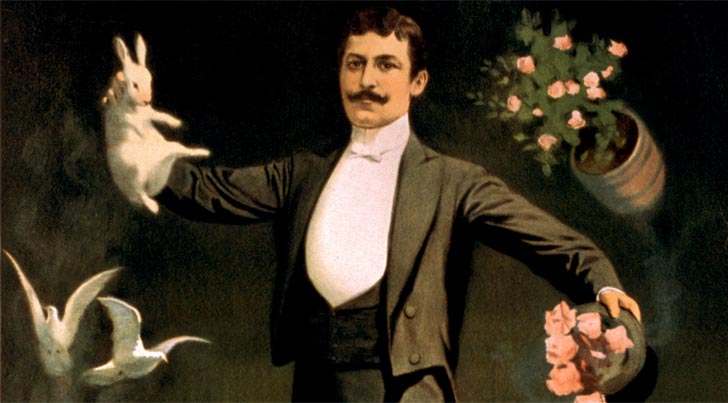
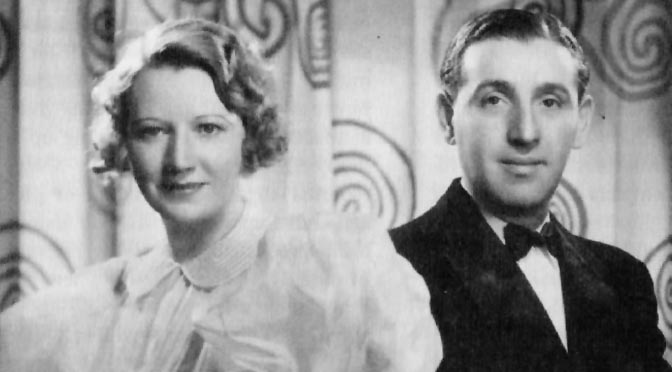
“Mr. Magician (Won’t You Bring My Honey Back to Me?).” Words and music by Charles O’Flynn, James Cavanaugh, and Frank Weldon (1934). Recorded by Elsie Carlisle and Sam Browne with orchestral accompaniment on June 22, 1934. Decca F-5079.
O’Flynn, Cavanaugh, and Weldon were prominent Tin Pan Alley songwriters, but their 1934 “Mr. Magician” does not appear to have inspired many recordings. It may have seemed outrageously corny even by the standards of the time (consider the lines of the refrain: “Hocus, pocus, Mr. Magician, won’t you bring my honey back to me?”). All the same, this melodramatic arrangement (complete with an anonymous carnival barker, with Sam Browne as a grandiose, boasting circus magician, and with Elsie Carlisle as an earnest girl who wants to “find [her] man somehow”) has a certain appeal. Elsie plays the Dorothy to Sam’s Great Oz with a comical insistence; the whole piece is cartoonish, funny, and sweet.
“Seven Years with the Wrong Woman.” Words and melody by Bob Miller (1932). Recorded by Maurice Winnick and His Orchestra, with vocals by Sam Browne and Elsie Carlisle, on May 16, 1933. Panachord 25527 mx. GB-5876-2.
Personnel: Maurice Winnick-vn dir. Charles Price-another-t / 2tb / Harry Hayes-Harry Turoff-as / Percy Winnick-cl-ts-o / Bert Whittam -p / Bill Herbert-g / Tiny Stock-sb / Stanley Marshall-d / Max Bacon-sp (possibly -d also)
“Seven Years with the Wrong Woman,” a comic “hillbilly” waltz by Memphis-born but New York-based Bob Miller, is the lament of an unhappily married man. The henpecked husband and the shrewish wife are perennial stock sources of mirth, and Miller’s encapsulation of the sentiments of the former attracted the attention of such American artists as Cliff Carlisle, Parker & Dodd, Frank Luther, Mac & Bob, and Jess Hillard. The success of the song is attested to by Miller’s having released a second song, “Seven Years with the Wrong Man,” a year later, in which he presented the same situation from the point of view of the fairer sex.
Sam Browne and Elsie Carlisle’s duet in Maurice Winnick’s recording of “Seven Years with the Wrong Woman” is an early example of the sort of song of bickering and vituperation for which they became well known (consider also the 1934 songs “What’s Good for the Goose Is Good for the Gander” and “I’m Gonna Wash My Hands of You”). The verses of the song are interspersed with spoken comic vignettes. The arrangement is whimsical, and it includes a bit of Rachmaninoff’s “Prelude in C Sharp Minor.”1
The comedy is at times rather dark (“Prisoner at the bar, you are accused of striking this woman with your fist. Why did you strike her with your fist?” “Because I couldn’t find a hammer”). The third speaker is Ambrose drummer Max Bacon, who liked to do comedy in a stereotypical Jewish accent whenever the chance presented itself.2
Many thanks to Fred Finnigan for drawing my attention to Bacon’s considerable work as an independent comedian, and not just as Britain’s premier drummer. ↩︎
“You’ve Got Me Crying Again.” Words by Charles Newman, music by Isham Jones (1933). Recorded by Ambrose and His Orchestra with vocal refrain by Elsie Carlisle in London on May 5, 1933. Brunswick 01523 mx. GB-5852-2.
Personnel: Bert Ambrose dir. Max Goldberg-Harry Owen-t / Ted Heath-tb / Danny Polo-cl-as-bar / Joe Jeannette-cl-as / Harry Hayes-as / Billy Amstell-cl-ts / Ernie Lewis-Teddy Sinclair-Peter Rush-vn / Bert Read-p / Joe Brannelly-g / Don Stutely-sb / Max Bacon-d
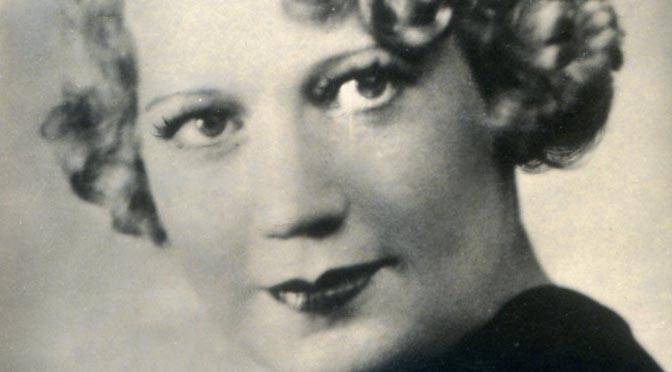
“You’ve Got Me Crying Again” is a particularly good torch song, or “plaintive onion-ballad of the better type,”1 if you prefer. It is an example of a genre that Elsie Carlisle had mastered (compare her renditions of “Mean to Me,”“Body and Soul,”“He’s My Secret Passion,”“Poor Kid,” and “Have You Ever Been Lonely”), and she handles this Isham Jones piece with dramatic dexterity, combining pathos with utter cuteness. The lyrics are the words of a person frustrated by the vicissitudes of a love relationship, but the complaints are really rather generic, and so it is impressive that Elsie is able, in the 45 seconds allotted to her, to impart character to what is fundamentally just a snippet of a speech. She outdoes herself in this recording, but she is matched by the mesmerizing instrumentals of an arrangement outstanding even by the high standards one expects of Ambrose.