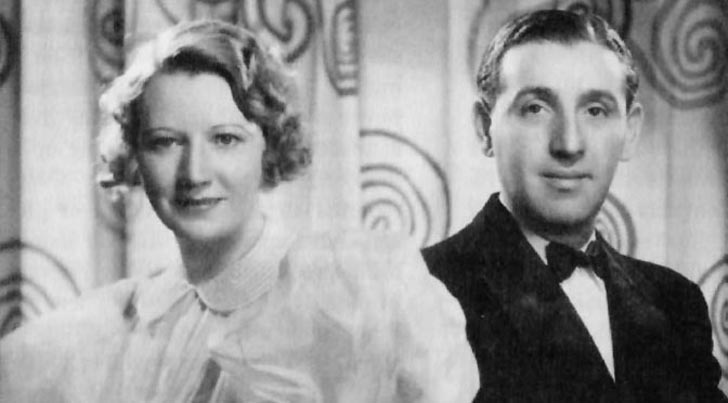
“A Bungalow, a Piccolo, and You!” Words and music by Al Lewis, Al Sherman, and Lee David (1932). Recorded in London at Studio 1, Abbey Road on July 22, 1932 by Ambrose and His Orchestra with vocalists Sam Browne and Elsie Carlisle. HMV B-6218 mx. 0B-2378-1. Personnel: Bert Ambrose dir. Max Goldberg-Harry Owen-t / Ted …
If risqué elements constitute one of the primary attractions of interwar Anglophone popular music for modern audiences (think “Pu-leeze! Mister Hemingway”), perhaps the sentimental might be seen as the ingredient most likely to repel us. Lullabies and songs about nursery rhymes abound, especially in the 1930s: even in Elsie Carlisle’s repertoire, we have “This Little …
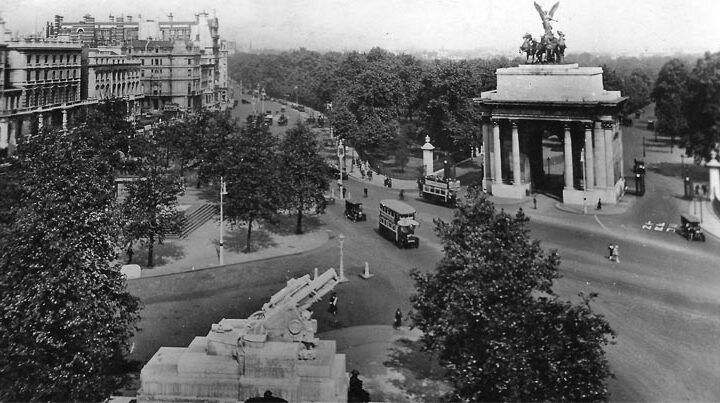
“Hyde Park Corner.” Composed by Stanley J. Damerell, Tolchard Evans, and Robert Hargreaves (1933). Recorded in London on April 7, 1933 by Ambrose and His Orchestra, with vocals by Sam Browne and chorus and with Elsie Carlisle and Max Bacon in speaking roles. Brunswick 1495 mx. GB-5737-1. Personnel: Bert Ambrose dir. Max Goldberg-Harry Owen-t / …
In his 1914 essay “On Narcissism,” Sigmund Freud wrote The child shall have it better than his parents; he shall not be subject to the necessities that we have recognized as prevailing in life. Sickness, death, renunciation of enjoyment, and restrictions on his own will shall not be valid for the child; the laws of …
“This Little Piggie Went to Market” is a mock-lullaby based on the famous nursery rhyme and game of playing with an infant’s toes. One might, therefore, expect it to have had a fairly innocuous origin. Instead, one finds that the song was composed for the 1934 American movie 8 Girls in a Boat, which tells …
The lyrics of “It’s the Talk of the Town” present a delicate situation: a couple engaged to be married has broken up after having already sent out wedding invitations. The song could be considered a torch song, but it is an atypical one, insofar as the singer’s argument for reconciliation rests less on passionate desire …
“Won’t You Come Home, Bill Bailey?” Originally titled “Bill Bailey, Won’t You Please Come Home?”; words and music by Hughie Cannon (1902). Recorded by Ambrose and His Orchestra with vocalists Sam Browne and Elsie Carlisle in London on March 18, 1932. HMV B-6162 mx. 0B-3048-2.
Personnel: Bert Ambrose dir. Max Goldberg-Harry Owen-t / Ted Heath-Tony Thorpe-tb / Billy Amstell-cl-as / Joe Crossman-cl-as-bar / Joe Jeanette-cl-ts / Ernie Lewis-Teddy Sinclair-Peter Rush-vn / Bert Read-p / Joe Brannelly-bj-g / Don Stuteley-sb / Max Bacon-d1
Now a jazz standard, “Won’t You Come Home, Bill Bailey?” originated as a ragtime piece by American songwriter Hughie Cannon and predates Ambrose’s recording by thirty years. It has as its characters an emotionally desperate and abandoned battered wife and a smug husband who seems to think her situation serves her right. Somehow the song usually manages to sound upbeat, most often perhaps because musicians keep the refrain and omit the verses, leaving us to wonder who Bill Bailey is and why he is gone in the first place. In this her first recording session with Ambrose and His Orchestra, Elsie Carlisle plays the wife, who has ejected her husband from their home after he “took and throwed her down, / Bellowing like a prune-fed calf” — but she nevertheless blames herself. For this piece, Elsie adopts an attempt at negro dialect suited to her character:
Won't you come home, Bill Bailey?
Won't you come home?
I moans de whole day long.
I'll do de cooking honey,
I'll pay de rent!
I knows I've done you wrong!
'Member that rainy eve that
I throwed you out
With nothin' but a fine-toothed comb?
I knows I's to blame --
Well, ain't dat a shame?
Bill Bailey, wont you please come home?
The Ambrose recording lacks the second verse, in which it is revealed that Bill Bailey has somehow become rich and experiences Schadenfreude as he hears his wife moan for him.
“Won’t You Come Home, Bill Bailey?” had been recorded in Britain in late 1931 by Jay Wilbur and His Band (with vocalist John Thorne) and by Jack Leon’s Band — in both cases as part of a medley.
Brian Rust and Sandy Forbes, British Dance Bands on Record (1911-1945) and Supplement, p. 25. ↩︎
“Pu-leeze! Mister Hemingway!” Words and music by Milton Drake, Walter Kent, and Abner Silver (1932). Recorded by Ambrose and His Orchestra with Elsie Carlisle as vocalist on November 22, 1932. Regal Zonophone MR-769 mx. 0B-3494-2.
Personnel: Bert Ambrose dir. Max Goldberg-Harry Owen-t / Ted Heath-tb / Danny Polo-Joe Jeannette-Billy Amstell-reeds / Harry Hines-as / Bert Read-p / Joe Brannelly-g / Don Stutely-sb / Max Bacon-d / Freddie Bretherton-a
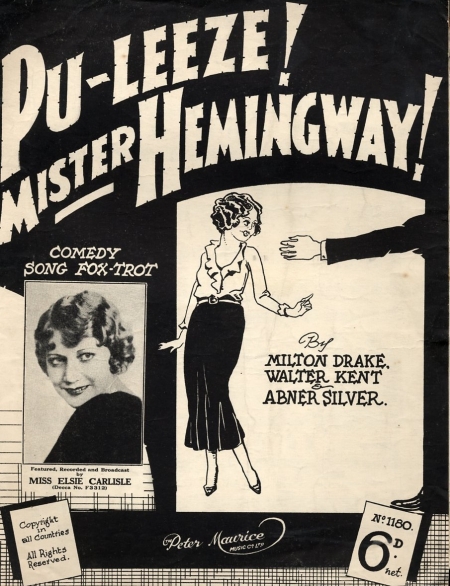
“Pu-leeze! Mister Hemingway” is a composition by notable songwriters Milton Drake (also known for “Java Jive” and “Mairzy Doats”), Walter Kent (most famous for “I’ll Be Home for Christmas” and “The White Cliffs of Dover”), and Abner Silver (who would co-write “No! No! A Thousand Times, No!” — another Elsie Carlisle hit). Elsie recorded “Pu-leeze! Mister Hemingway” five times in November and December of 1932, more times than any other song in her career: first “solo,” then with Ambrose and His Orchestra (by far her best-known version), then in two takes with Rudy Starita and His Band (one on Sterno, the other on Four-in-One), and finally with Harry Hudson and His Melody Men.
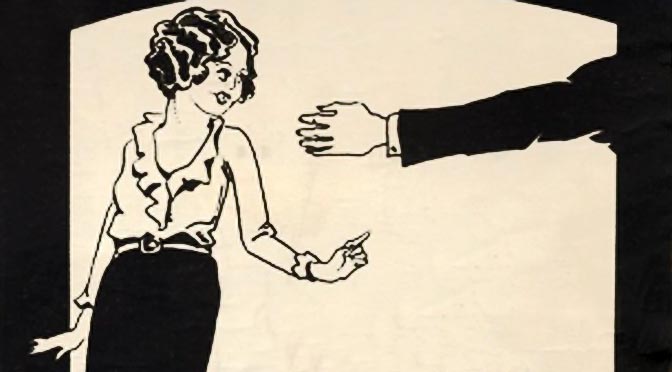
“Pu-leeze! Mister Hemingway!” remains one of Elsie’s most popular songs, most likely on account of her impeccable comic delivery of its risqué lyrics — indeed, it is outdone in sexual suggestiveness only by her two recordings of “My Man O’ War” (perhaps “My Handy Man” would also qualify in this regard). It is the complaint of an attractive woman who admits to liking a bit of flirtation but who has apparently met someone who takes it too far: a certain “Mr. Hemingway.” As the song progress, her description of his impertinent advances escalates, with Mr. Hemingway’s behavior sounding increasingly physically rough. The culmination is justly famous:
And I don't mind your osculations,
But my dear, my operation!]
Oh, pu-leeze! Mister Hemingway!
Two days before she recorded the version with Ambrose and His Orchestra, Elsie had committed to shellac a “solo” recording:
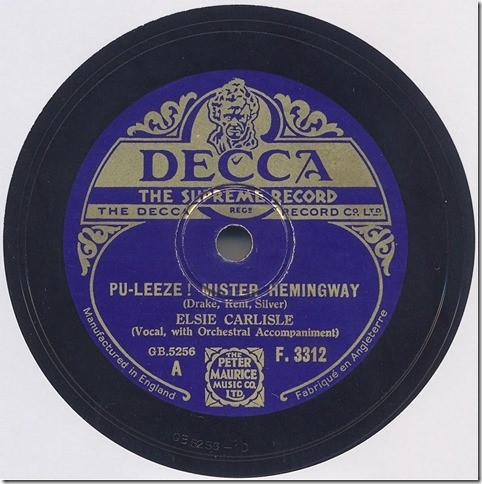
“Pu-leeze! Mister Hemingway!” Recorded by Elsie Carlisle on November 28, 1932. Decca F-3312 mx. GB-5256-1.
Personnel: probably Max Goldberg-t / t / tb / 2cl / as / 2 or 3 vn / Claude Ivy-p / g / sb / d
This version is at a slightly slower tempo, and Elsie’s delivery is more conversational. The arrangement is surprisingly similar to the one that Freddie Bretherton produced for Ambrose.
The last version of “Pul-eeze! Mister Hemingway” that Elsie would record was with Harry Hudson and His Melody Men:
“Pu-leeze! Mister Hemingway!” Recorded by Harry Hudson and His Melody Men (as Rolando and His Blue Salon Orchestra) with Elsie Carlisle as vocalist on December 20, 1932. Edison Bell Winner 5536 mx. 14569-2.
Here the arrangement is a little different, and the orchestra is given a little more time to itself at the end. Elsie’s delivery is chatty, but perhaps not as much as in her solo recording.
There were a number of other artists recording “Pu-leeze! Mister Hemingway!” in late 1932. One problem they ran into was how to have a male singer deliver the song, which was risqué but not entirely unconventional in its sexuality. In America, George Olsen and His Music had male singer Fran Frey recount hearing a woman speak the lyrics, while Gene Kardos and His Orchestra (as Bob Causer and His Cornellians) had Dick Robertson rebuff a certain Mrs. Hemingway! In Britain there were versions by Billy Cotton and His Band, Carroll Gibbons and the Savoy Hotel Orpheans (with vocals by the Caryle Cousins, using the original lyrics), Ann Suter, Jay Wilbur and His Band (as Phil Allen’s Merrymakers, with vocalist Les Allen), and Jack Hylton and His Orchestra (in a Billy Ternent arrangement, with singer Pat O’Malley). Interestingly, the last two bandleaders mentioned did not seem to be bothered by having their male singers complain about being pestered by Mr. Hemingway! Gracie Fields recorded a version of the song that was only released in Australia, and Albert Whelan made one for Panachord accompanied by Harry Hudson’s Melody Men, but I have not been able to discover much about it.
Two final points need to be addressed. People often ask me if it is Ernest Hemingway that Elsie is singing about. I see no particular reason to identify the fictional masher with the American novelist. An open letter addressed to Ernest Hemingway entitled “Please, Mr. Ernest Hemingway” appeared in the American Criterion in 1935, but the addition of Hemingway’s first name would suggest that the letter’s author did not consider the song title that he was citing in jest to be originally about Ernest Hemingway.
“Let’s Make Love.” Words By Stanley J. Damerell, music by Tolchard Evans (1934). Recorded by Ambrose and His Orchestra with vocals by Sam Browne and with Elsie Carlisle in a speaking role on November 1, 1934. Decca F-5297 mx. TB-1704-1.
Personnel: Bert Ambrose dir. Max Goldberg-t-mel / Harry Owen-t / Ted Heath-Tony Thorpe-tb / Danny Polo-reeds / Sid Phillips-reeds / Joe Jeannette-as / Billy Amstell-reeds / Ernie Lewis-Reg Pursglove-others?-vn / Bert Barnes-p / Joe Brannelly-g / Dick Ball-sb / Max Bacon-d
“Let’s Make Love (In Spring, Summer, Autumn and Winter)” is a light waltz written by British songwriters Stanley J. Damerell and Tolchard Evans, who collaborated on such notable songs as “Lady of Spain” (1931) and “If (They Made Me a King)” (1934). There seems to be a general rule that whenever Damerell and Evans have collaborated on a song, Elsie Carlisle ends up with a speaking role. That would appear to be the case in the Ambrose recording of “Hyde Park Corner” (Hargreaves-Damerell-Evans; 1933), in which Sam Browne sings and Elsie and drummer Max Bacon have speaking parts, as well as in the Maurice Winnick version of “Da-Dar-Da-Dar” (also Hargreaves-Damerell-Evans; 1933), in which Sam Browne sings and Elsie is a mere interlocutor. So it is in this Damerell-Evans piece, “Let’s Make Love.”
Jack Payne and His Band had made, in late October 1934, a version of “Let’s Make Love” that relied for its entertainment value largely on comical Northern and Cockney voices provided by Jack Payne and Charlie Asplin; there was yet another version of “Let’s Make Love” in November by Jay Wilbur and His Band, with Fred Latham on the vocals. After an impressive instrumental introduction, the Ambrose recording has Sam Browne sing just the refrain and the first verse of the song. He then proceeds repeatedly to try to sing the first few words of the refrain (or something like them) in foreign accents which are intentionally abysmally done. His try at a Russian accent (“Letsky makesky loveskevitch”) is perhaps the least embarrassing. I cannot say whether his announcing the Russian lover a second time and then correcting himself to “a Spanish lover” is a feigned mistake or a real one. The cannibalistic Zulu with his war cry “Yum, yum, yum!” is awkward at best, as is the shivering Eskimo.
Elsie Carlisle, for her part, merely interjects on occasion that Sam’s “impressions are lousy,” or the like. Sam and Elsie had already played bickering lovers in the 1933 Maurice Winnick recording of “Seven Years with the Wrong Woman,” and it was only weeks after recording “Let’s Make Love” that they would berate each other in “I’m Gonna Wash My Hands with You” with Ambrose and His Orchestra. In “Let’s Make Love,” by contrast, it is not apparent that Sam really means it when he repeatedly sings “Let’s Make Love” to Elsie, nor that her rebuffing of him is anything more than a negative review of his talent. What is clear is that this song is one of the silliest things Sam and Elsie ever collaborated on in their years of working for Ambrose.