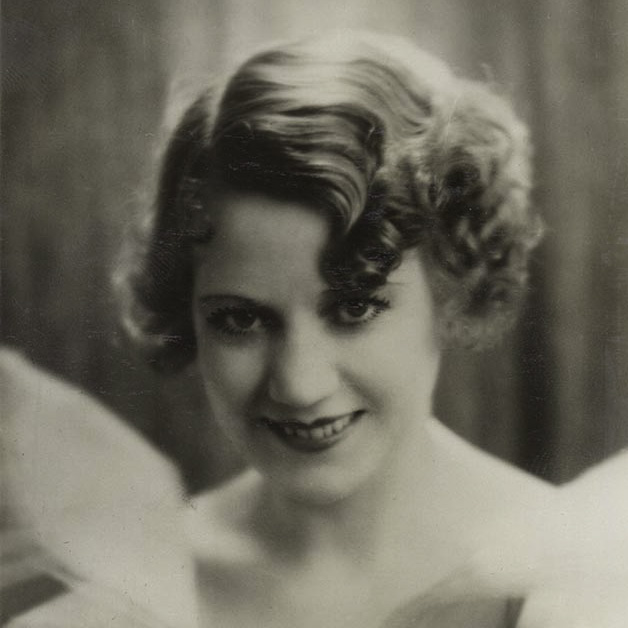
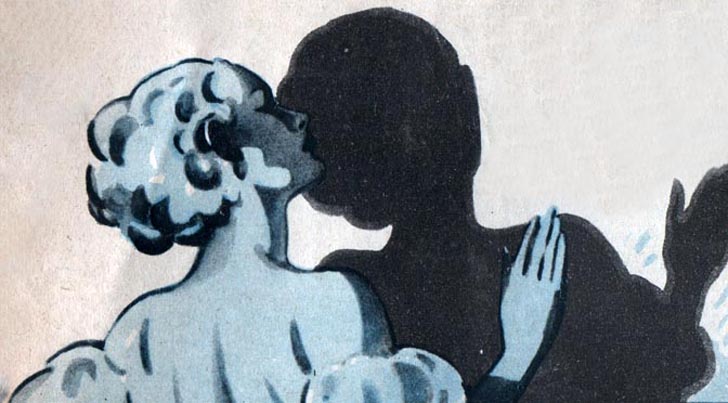
“Dancing with My Shadow.” Composed by Harry Woods for the British musical comedy Thank You So Much. Recorded by Elsie Carlisle, probably with the Embassy Rhythm Eight, on February 5, 1935. Decca F-5436 mx. GB-6927-2.
Personnel: Max Goldberg-t / Lew Davis-tb / Danny Polo-cl / Billy Amstell-ts / Bert Barnes-p / Joe Brannely-g / Max Bacon-d
A song about the loneliness of lovers drawn apart, “Dancing with My Shadow” encapsulates its theme of longing in its refrain:
Dancing with my shadow,
Feeling kind of blue,
Dancing with my shadow
And making believe it's you.
This slow foxtrot was composed by Harry Woods for the British musical comedy Thank You So Much. Woods wrote other notable songs that Elsie Carlisle recorded; one thinks particularly of “The Clouds Will Soon Roll By.” The song also notably appeared in Alfred Hitchcock’s 1935 film adaptation of The 39 Steps. Elsie Carlisle, veteran torch singer, interprets the lyrics masterfully on this record, which she appears to have recorded with the Embassy Rhythm Eight, who went uncredited; this identification is strengthened by an examination of the sequence of matrices on the records they recorded with Decca on the same day.
“Gee-Oh! Gosh – Gosh-Oh! Gee – I Want Somebody to Cuddle Me” sheet music
I have not found any evidence of Elsie Carlisle’s having recorded “I Want Somebody to Cuddle Me”; she must have sung it on the radio. There is a very nice version of the song (going under an alternate title) by Nat Shilkret and His Orchestra, with Belle Mann on the vocals:
“Body and Soul.” Lyrics by Edward Heyman, Robert Sour, and Frank Eyton, with music by Johnny Green (1930). Recorded by Elsie Carlisle under the musical direction of Jay Wilbur in London c. March 1930. Dominion C-307 mx. 1713-1.
In 1929, American composer Johnny Green got together with lyricists Edward Heyman, Robert Sour, and Frank Eyton to write a number of songs for British actress Gertrude Lawrence to sing on the London stage. One of them, “Body and Soul,” was to become a jazz standard par excellence. Lawrence, to her credit, recognized the inherent merit of the song and bought a share in it before going on to introduce it on the London stage and sing it on the radio, where it was heard by British dance band greats Jack Hylton and Bert Ambrose. Their renditions caught the attention of the public and of bandleaders, singers, and instrumentalists alike. After a spring fever of “Body and Soul” in London, recording of the infectious tune subsided for the summer and then resurged in America. In mid-October the song appeared as part of the Broadway revue Three’s a Crowd and was performed and later recorded by Libby Holman.
Elsie Carlisle sang many torch songs early in her recording career; unrequited love was a theme as much in vogue then as it is now, and Elsie’s delicate, sometimes quavering voice was a suitable vehicle for conveying pathos. Her March 1930 “Body and Soul” stands out from the rest because of her especially touching rendering of its mesmerizingly sad motifs. It might seem amusing that this recording is paired on its flip-side with the ribald “My Man O’ War,” which is a sort of sublime, extended series of sexual double entendres, but there is something a little gritty, too, about the lyrics of “Body and Soul” and the intensity with which Elsie expresses them.
In March, in addition to that of Elsie Carlisle, there were British renditions of “Body and Soul” by Spike Hughes, Jack Payne and His Band (an unissued take with vocalist Jack Plant), Hal Swain and His Band, Marie Burke, Herman Darewski and His Famous Melody Band, and Gracie Fields. As the spring went on, versions were made by Pete Mandell and His Rhythm Masters (three takes, including two with Jack Plant), Carroll Gibbons (on the piano, accompanied by violin and saxophone), Nat Star (as Bert Maddison and His Dance Orchestra, with vocalist Sam Browne), Jack Leon’s Dance Band (Jimmy Allen, vocalist), and Alfredo’s Band (with Sam Browne).