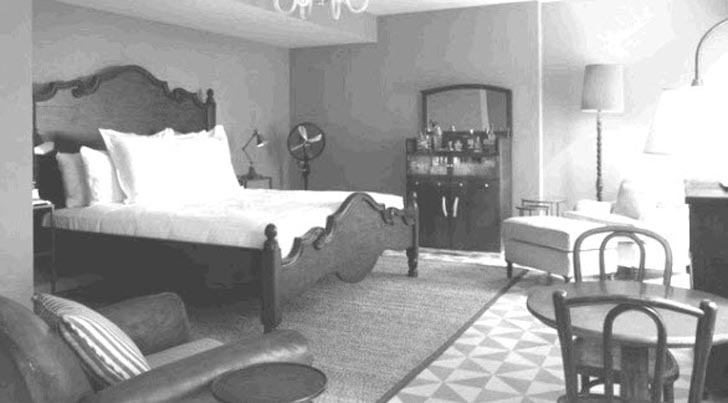

“Room Five-Hundred-and-Four.” Words by Eric Maschwitz, music by George Posford. Composed for the Eric Maschwitz revue New Faces (1940). Recorded by Elsie Carlisle under the musical direction of Jay Wilbur in London on February 10, 1941. Rex 9934 mx. R-5334-1.
Elsie Carlisle – “Room Five-Hundred-and-Four” (1941) Original 78 rpm Transfer by Charles Hippisley-Cox
“Room Five-Hundred-and-Four” has its origins in the 1940 revue New Faces, which is also where “A Nightingale Sang in Berkeley Square” was introduced. The lyrics describe a woman’s happy memory of a night spent with her lover in a luxury hotel too expensive for either of them. She describes the night as “her very first and only rendezvous,” and for good reason: this comparatively wholesome song is about a honeymoon, not a tryst. It is tame, therefore, by the standards of Elsie Carlisle’s songbook, which includes not just “My Man o’ War” but also “Public Sweetheart No. 1.”
Elsie Carlisle committed “Room Five-Hundred-and-Four” to shellac in her last year of recording. While I generally prefer the underlying compositions of her earlier period, it is delightful to hear her voice on her later Rex-label records. Elsie’s later style of singing seems slightly more confident, and the crisp beauty of her voice is made even more evident by the more modern recording techniques available by that time — in spite of Rex’s reputation for “crackly” shellac. The studio band’s virtuosity is showcased nicely in their rather swingy instrumental segment.
“Deep in a Dream.” Words by Eddie De Lange, music by Jimmy Van Heusen (1938). Recorded by Elsie Carlisle under the musical direction of George Scott-Wood at Studio 1, Abbey Road, London on February 1, 1939. HMV BD-663 mx. 0EA-7519-1.
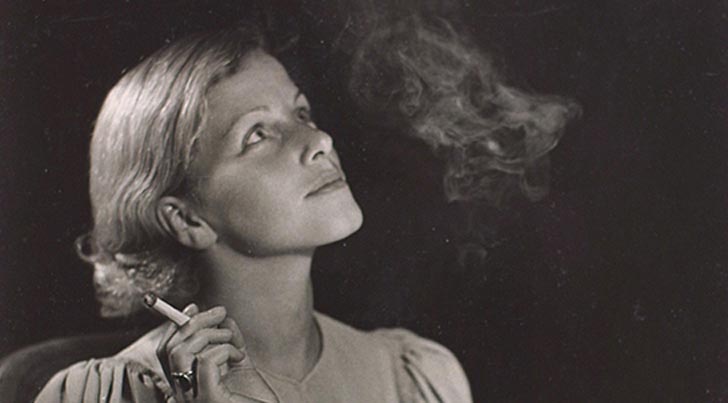
In “Deep in a Dream,” the singer depicts herself sitting in a dark room, smoking and getting drowsy as she remembers a lover who is now inaccessible — whether through distance, dissolution of the romance, or death, we do not really know. The lost lover’s descent on a smoke staircase (as described in the lyrics) might suggest a quirky sort of descent from heaven. At any rate, the genuinely dreamy music swells as the memories of happier times are revived (“Awake or asleep, every memory I’ll keep / Deep in a dream of you”). The reverie ends when the cigarette burns the singer’s fingers and wakes her. To my knowledge, while this is one of three Jimmy Van Heusen songs written in 1938-1939 involving dreams1, it is the only one that uses the absence of fire safety as a plot point.
The lyrics of “Deep in a Dream” leave us in the dark as to what has happened between the two lovers. Elsie Carlisle’s interpretation is successful because she evokes the melancholy of the dark, smoky room, only to imbue her dream with a truly ecstatic spirit. She seems content to express alternating strong emotions, rather than to establish some sort of vocal character, as she often does. The anonymous studio band (led by director George Scott-Wood) complements Elsie’s singing nicely, contributing to this decidedly atmospheric piece.
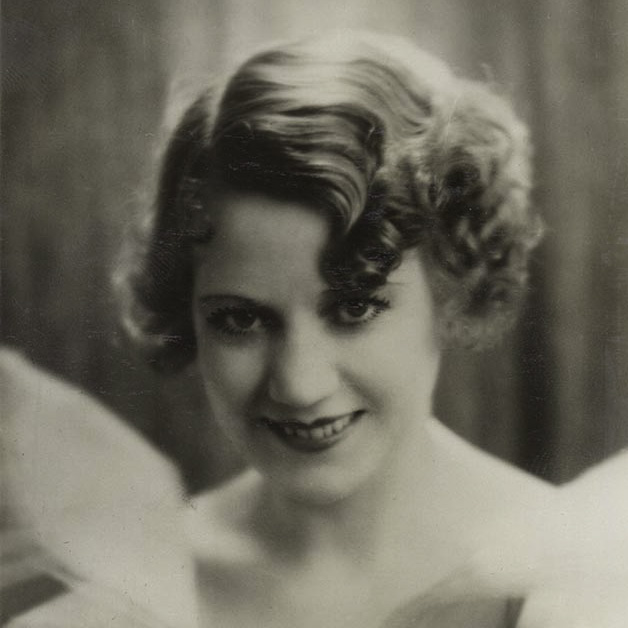
“Exactly Like You.” Words by Dorothy Fields, music by Jimmy McHugh (1930). Recorded in London in August 1930 by Elsie Carlisle under the musical direction of Jay Wilbur. Imperial 2318 mx. 5448-2.
Personnel: Jay Wilbur dir. / Jack Miranda-cl / Eric Siday-vn / Harry Jacobson-p-cel / Len Fillis-g / sb
On February 25, 1930, Broadway writer and producer Lew Leslie opened his International Revue at the Majestic Theatre in New York City. One would have expected a show backed by the mastermind of the wildly popular Blackbirds revues, choreographed by Busby Berkeley, and with music by Dorothy Fields and Jimmy McHugh, to be quite a success, but it had a comparatively short run of 95 performances, the last being on May 17, 1930. The lasting legacy of this well-funded flop consists of two songs: “On the Sunny Side of the Street,” introduced by Harry Richman, and “Exactly Like You,” sung in the revue by Richman and British actress Gertrude Lawrence.
In “Exactly Like You,” the singer describes the joy of having had an ideal preconception of love that has suddenly become realized in the form of the song’s addressee. The lyrics use turns of phrase suited to dramatic interpretation:
You make me feel so grand, I want to hand the world to you. You seem to understand Each foolish little scheme I'm scheming, Dream I'm dreaming.
The music is extraordinarily catchy but presents the singer with quite a challenge in its range (an octave and a fifth).
Elsie Carlisle was up to the task. A veteran of musical theater, she had, of course, introduced Cole Porter’s “What Is This Thing Called Love?” just the previous year, and it has a comparable range. She works her way through the melody’s fourth intervals with dexterity, all the while giving the impression that she is on the verge of faltering. Hers was never a weak voice, but she was an actress who knew the power of the semblance of vulnerability. In the end, while the lyrics argue that we should be impressed by her lover, her overall vocal performance might lead us to admire the character that she has created, some anonymous small person who, prone to sadness, has the sudden opportunity to express great joy. I have argued elsewhere that Elsie did not simply interpret songs; she augmented them by creating comparatively advanced vocal personas that change greatly from song to song.
Elsie’s virtuoso performance is nicely complemented by the memorable instrumental accompaniment put together by Jay Wilbur, a bandleader who was also musical director at Imperial at the time. This was, incidentally, Elsie’s first recording session at Imperial, but she had worked previously with Wilbur at Dominion Records before it went bankrupt. She and the band recorded three different takes of “Exactly Like You” at their session in August 1930. It is worth comparing the slightly different instrumentals of take 2 (above) with take 1: