“Come Up and See Me Sometime.” Words by Arthur Swanstrom, music by Louis Alter; composed for the motion picture Take a Chance (1933). Recorded by Elsie Carlisle with orchestral accompaniment in London on November 8, 1933. Decca F. 3737 mx. GB6297-2.
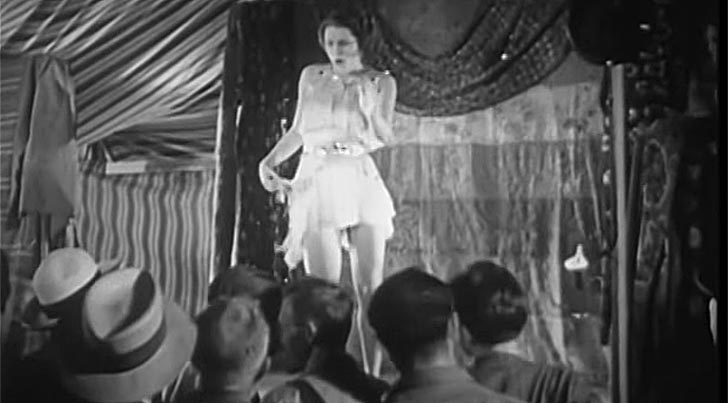
“Come Up and See Me Sometime” was written by Arthur Swanstrom and Louis Alter for Paramount’s 1933 musical comedy Take a Chance, based on the stage play of the same name. The movie apparently inherited little from the play other than a couple of songs, but it augmented what it did borrow with other, more memorable songs, including the perennial “It’s Only a Paper Moon.” “Come Up and See Me Sometime” is introduced by actress Lillian Roth, who sings it while performing a burlesque act. The title of the song presumably derives from a suggestive catchphrase of Mae West’s, which originally took the form “Why don’t you come up sometime and see me?” (in She Done Him Wrong [1933]), but which soon became the rhythmically preferable “Come up and see me sometime” (as it occurs in I’m No Angel [1933]).
Elsie Carlisle dishes out boldness in her version. The visual component of the movie’s burlesque scene is absent, but Elsie leaves no doubt as to the import of the song’s repetitive sultry invitations to get to know her better. As the song progresses, her intonation increasingly approaches that of the vamp, and her final “…any ti-i-i-IME!” finishes our impression of the self-consciously predatory showgirl.
“Dada, Dada (D-d-d-d-d-d-d-d-da-da)” is a “stuttering song,” a song in which the performer either pretends to stutter or plays around with words that naturally sound a bit like stammering (in the present instance, a young woman’s call to her father — “Dada! Dada!” — serves the purpose). One might think that, in imitating a speech impediment, “Dada, Dada” might risk being insensitive, and yet when one considers every other facet of the song, it is the stuttering that emerges as least offensive. “Dada, Dada” is primarily known for its humorous dramatization of a very innocent young woman being taken advantage of by a somewhat predatory boyfriend. Her cries of “Dada! Dada!” reach her father’s ears, but they only serve to remind him of how he came to have a daughter in the first place; he does not come to the aid of the comically naïve and therefore actually rather unfortunate girl. The primary songwriter, Arthur Le Clerq, was not averse to edgy humor; he would go on to write “Is Izzy Azzy Woz?” (1929) which gives ample opportunities for a singer to practice Yiddishisms, and the overtly ageist “Nobody Loves a Fairy When She’s Forty” (1934).
Having admitted that the theme of “Dada, Dada” is fundamentally unwholesome, I must admit that I rather enjoy hearing Elsie Carlisle singing it; her talent for interpreting bawdy, inappropriate lyrics is well known, and the song allows her to show off her upper vocal range by way of adolescent squeaks. A gauge of how much contemporary listeners must have liked her impersonation of a clueless girl is the fact that Elsie recorded it three times in a two-year period.
“Dada, Dada (D-d-d-d-d-d-d-d-da-da).” Words by Arthur Le Clerq and Wallace Dore, music by Arthur Le Clerq (1928). Recorded by Elsie Carlisle with Jay Wilbur and His Orchestra, London, c. December 1928. Dominion A. 43 mx. 1055-2.
Personnel possibly includes Max Goldberg-Bill Shakespeare-t / Tony Thorpe-tb / Laurie Payne-Jimmy Gordon-cl-as-bar / George Clarkson-cl-as-ts / Norman Cole-vn / Billy Thorburn-p / Dave Thomas or Bert Thomas-bj-g / Harry Evans-bb-sb / Jack Kosky-d-chm
In all versions of “Dada, Dada” Elsie alternates between narrating the story and playing its protagonist. In this latter role she is the expert comedian in terms of reenacting the awkward youthful encounter and keeping the mock-stammering from being too implausible or even just annoying and repetitive (for variation she appears to do an imitation of a sort of infantile cuckoo-clock at 1:48). The naughtiness of the lyrics is highlighted by a highly inappropriate reference to Scripture1:
He says I am an angel
And a heavenly little thing!
If angels feel like I do,
“Oh death, where is thy sting?”
In this 1928 version, Jay Wilbur’s orchestra shines out admirably even from the asphalt-like shellac of Dominion Records.
Elsie would sing a bit of “Dada, Dada” again with many of the same accompanists in the “Imperial Revels” medley, recorded in late September 1930. She recorded the whole song again the next month, again with Jay Wilbur and His Orchestra (uncredited):
Elsie Carlisle with Jay Wilbur and His Orchestra, London, October 1930. Imperial 2381 mx. 5536-4.
Personnel possibly includes the following: Max Goldberg-Bill Shakespeare-t / Ted Heath or Tony Thorpe-tb / Laurie Payne-Jimmy Gordon-cl-as-bar / George Melachrino-cl-as-vn / George Clarkson-cl-ts / Norman Cole-vn / Billy Thorburn or Pat Dodd-p / Bert Thomas-g / Harry Evans-bb-sb / Jack Kosky-d
The accompaniment on Imperial 2381 is punchier, heavier on the brass and lighter on the strings, and more explicitly comical: the musicians seem to mimic Elsie’s singing at times. Her delivery of the “Dadas” is less sing-song than in her original version and more closely approaches natural speech, if her strange exclamations can be called that. Overall, one gets the impression of performers trying very hard to keep an inherently repetitive piece fresh and succeeding admirably.
Other versions of “Dada, Dada” were recorded in Britain in 1929 by Ray Starita and His Ambassadors’ Band (with vocals by Phil Allen), The Rhythmics (under the direction of Nat Star, with vocalist Tom Barratt), Clarkson Rose, and comedian Jack Morrison (accompanied by Bidgood’s Broadcasters). The full lyrics that Morrison uses depict an increasingly rough struggle between the young people, thus fully realizing the song’s creepy potential.
It should finally be noted that although Elsie Carlisle does speak briefly in a 1933 recording by Maurice Winnick and His Orchestra entitled “Da-Dar-Da-Dar (Da-Dar-Da-Dee),” stuttering the words “d-d-d-darling” and “d-d-d-dearest,” that song concerns the difficulty young lovers have finding privacy — it is a much less troubling piece delivered almost entirely by Sam Browne, and it should not be mistaken for harder stuff.
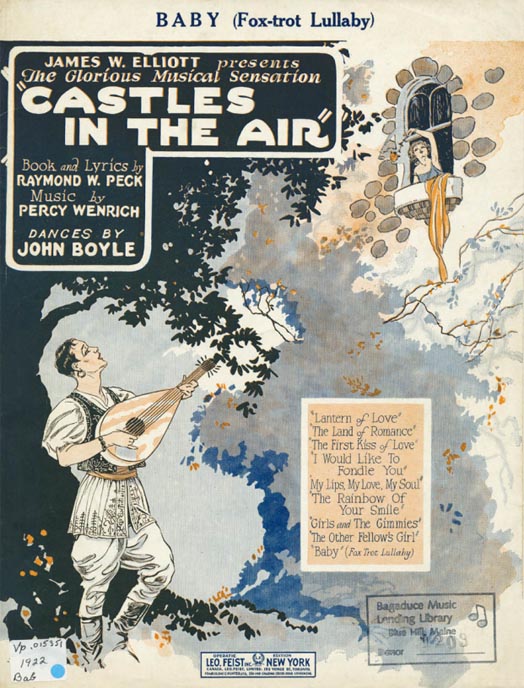
“Baby.” Words by Raymond W. Peck and music by Percy Wenrich (1922); featured in the Broadway musical Castles in the Air (1926). Recorded by Elsie Carlisle, accompanied by Carroll Gibbons and an unidentified violinist, on May 6, 1927. HMV B-2489 mx. Bb-10514-5.
“Baby (Fox-trot Lullaby)” was written in 1922 but was most prominently featured four years later in Castles in the Air, a musical comedy of manners that saw moderate success in 1926 on Broadway (less so the next year in London, where the show had only 28 performances). The lyrics have a surprisingly simple thesis, suggesting that “old-fashioned lullabies” have given way to modern “fox-trot lullab[ies],” that babies are no longer rocked in cradles but rather in the arms of dancing parents. The song tries to make its point with an introduction that roughly resembles a lullaby but that gives way to a catchy, fast-paced refrain. It would appear that Peck and Wenrich did not originate the notion of a foxtrot lullaby, as there had been a 1921 song entitled “Nestle in My Loving Arms — A Lullaby Fox-Trot.”
Elsie Carlisle successfully realizes the conceit of “Baby” by applying sweet earnestness to the intro at a measured pace but then propelling her way into the refrain. At the end of the song she repeats the refrain in a slow, dreamy way, thus integrating the ideas of “foxtrot” and “lullaby” into one. In the middle of the recording there is a remarkably good, quick-paced violin solo. The identity of the violinist is unknown; a contemporary review in Melody Maker suggests that it could be Hugo Rignold, although the reviewer gets the pianist wrong, suggesting that he is Arthur Young (we can be fairly sure that it is Carroll Gibbons).1
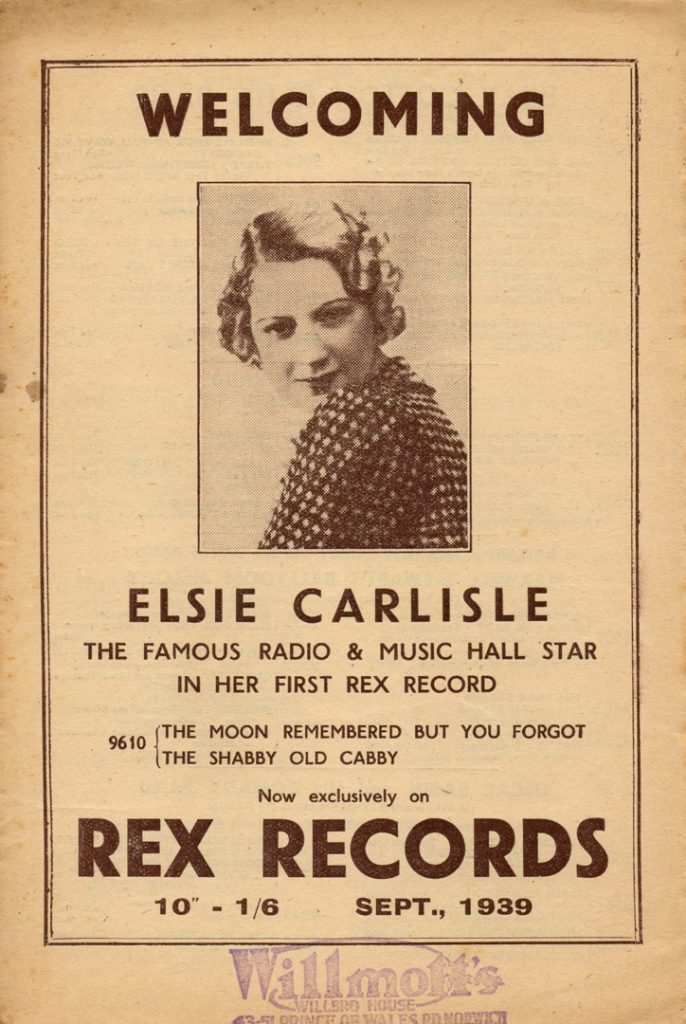
“The Moon Remembered, But You Forgot.” Words by Frank Eyton, music by Noel Gay. Composed for the comedy film Let’s Be Famous (1939). Recorded by Elsie Carlisle with orchestral accompaniment under the musical direction of Jay Wilbur on August 4, 1939. Rex 9610 mx. R3786-1.
“The Moon Remembered, But You Forgot,” from the British comedy film Let’s Be Famous, was composed by Frank Eyton, an English popular lyricist most famous for having contributed to the words of “Body and Soul,” and Noel Gay, a prolific composer who also wrote such popular hits as “The Sun Has Got His Hat On” and “Lambeth Walk.” Its singer describes an outdoor anniversary rendezvous to which her partner does not show up. Left all alone in the presence of the evening moon, she engages in the pathetic fallacy, attributing to the moon human faculties, qualities, and emotions: memory, patience, certainty, and regret. Elsie Carlisle applies her best sincerity and pathos to this song on the first record she made for Rex Records (1939-1942). Rex was the last label that she was signed to, and it was there that she was reunited with musical director Jay Wilbur, who had played the same role in her career in the late 1920s and early 1930s, at Dominion, Imperial, and Eclipse. This was also the last record that Elsie made before war broke out in Europe.
“The Hut-Sut Song.” Words and music by Leo V. Killion, Ted McMichael, and Jack Owens (1941). Recorded by Elsie Carlisle with orchestral accompaniment under the direction of Jay Wilbur on July 4, 1941. Rex 10021 mx. R5971-2.
Personnel: Jay Wilbur dir. Alfie Noakes-Chick Smith-t / 2 unknown from Paul Fenoulhet (t-tb) (Ted Heath/George Rowe (tb) / Frank Johnson-Frank Weir-cl-as / George Smith-Cliff Timms-ts / Matt Heft-p / Jack Simmons-g / Billy Bell-sb / Jack Simpson-d / vocal chorus by the orchestra1
“The Hut-Sut Song (A Swedish Serenade)” has lyrics consisting primarily of the repetitive, catchy refrain
“Hut-Sut Rawlson on the rillerah and a brawla, brawla sooit.”
There are recurring intimations that the mysterious words are Swedish — they are not, of course, anything of the kind, but rather nonsense of the first order. It would appear that “The Hut-Sut Song” is in some way an imitation of a much older song, “Hot Shot Dawson,” which begins with the words
“Hot Shot Dawson on a river boat with his brawlin’, sprawlin’ sweetie….”
In 1941, Time Magazine noted the existence of the older tune, but had difficulty finding anyone who could remember how it went. The similarity between the two songs probably indicates not plagiarism or authorial skullduggery, but mere hut-suttery.
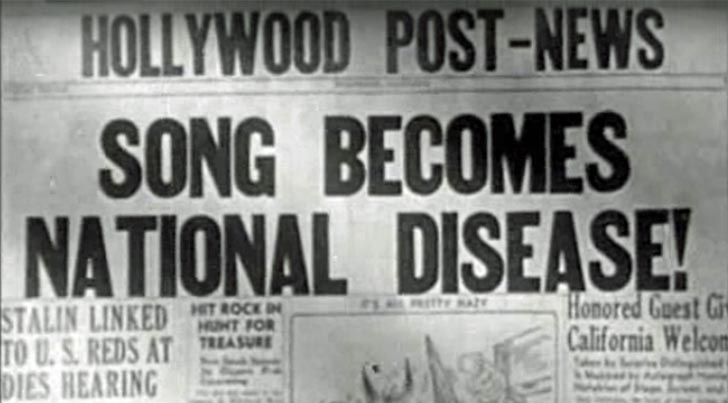
“The Hut-Sut Song” is a novelty song typical of its era (its nonsensical lyrics might remind one of the crypto-sensical and similarly infectious “Mairzy Doats,” which would be composed two years later). Its utter wackiness and surprising popularity inspired a short film portraying a boarding house full of people (played by “The King’s Men” ) who sing it incessantly. The proprietor has them removed to a mental hospital, where they continue singing “Hut-Sut” in a padded cell.
Elsie Carlisle’s version of “The Hut-Sut Song,” recorded under the direction of Jay Wilbur and with the instrumental and choral accompaniment of his studio band, is surprisingly pretty. It is perhaps precisely because the lyrics are so inane that they highlight nicely her crisp, sweet voice. Elsie’s wartime recordings are of a flavor very different from her earlier work, and while the underlying compositions are largely not to my taste, her vocal excellence shines with the aid of the slightly better bandwidth provided by more modern recording technology.
Other British recordings of “The Hut-Sut Song” were made by Lew Stone and His Band (v. Carl Barriteau), Nat Gonella, Harry Roy and His Band (v. Marjorie Kingsley), Billy Cotton and His Band (v. Dolly Elsie), and Harry Leader and His Band (in a Paul Jones Medley).
I would also note that there were three recordings of “The Hut-Sut Song” in 1941 by artists in Sweden! One can only wonder what the Swedes thought about the ridiculous suggestion that the song had anything to do with them, but apparently they were amused.
Notes:
According to Richard J. Johnson in Elsie Carlisle: A Discography (1994). ↩
"The Idol of the Radio." British dance band singer of the 1920s, 1930s, and 1940s.