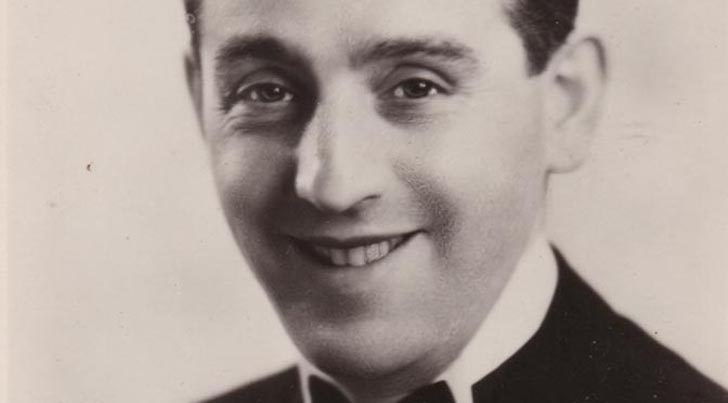
“Umbrella Man” (1939)

“Umbrella Man.” Words and music by James Cavanaugh, Larry Stock, and Vincent Rose (1938). Recorded by Elsie Carlisle with orchestral accompaniment under the musical direction of George Scott-Wood in Studio 2, Abbey Road, London on February 1, 1939. HMV BD-661.

Umbrella Man – Elsie Carlisle

Video by David Weavings (YouTube)

“Umbrella Man” is a slow waltz whose lyrics describe a tinker who specializes in umbrella repair. When work is slow, he will fix other commonplace things, such as socks, clocks, and the occasional broken heart. How he accomplishes the latter is not explained; it is a mere assertion. Elsie Carlisle lends sincerity to this simple song with her imitation of the umbrella man’s intoned value proposition (“Um-BRELL-as!… Any umb-er-ellas to fix today?”).

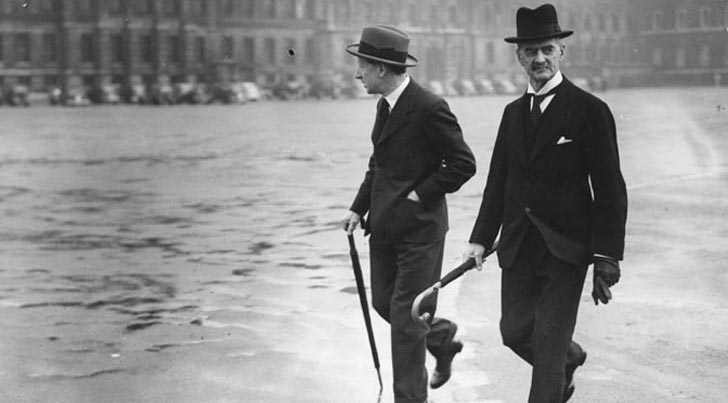
American Kay Kyser recorded his popular version of this song on September 1, 1938. By the end of that month, international attention focused on another Umbrella Man, British Prime Minister Neville Chamberlain, who was seldom photographed or even caricatured without his trademark umbrella. The doomed Munich Agreement signed with the Nazis had put Chamberlain in the international spotlight and may have revived interest in the song “Umbrella Man.” To be sure, many versions were recorded on both sides of the Atlantic, and by March, 1939 the Milwaukee Journal would report

The best selling [sic] song in the country today is “The Umbrella Man,” which owes a part of its popularity to British Prime Minister Chamberlain’s omnipresent umbrella… [D]ozens of cartoonists have used the song title as a text in describing the British statesman… Like many hits, no one wanted to publish it at first and it seemed destined for a pigeonhole until a bandleader got wind of it. Now “The Umbrella Man,” thanks to Neville Chamberlain, will yield its authors about $10,000 per man.

“Umbrella Man” was recorded in America in 1938-1939 by Kay Kyser and His Orchestra (with vocals by Harry Babbitt and Ginny Simms), Johnny Messner and His Orchestra (vocals by The Three Jacks), Swing and Sway with Sammy Kaye, Connee Boswell (accompanied by Woody Herman and His Orchestra), and the Benny Goodman Quintet.

In Britain it was recorded by Nat Gonella and His Georgians (v. Nat Gonella), Ambrose and His Orchestra (with vocals by Denny Dennis), Joe Loss and His Band (with vocalist Chick Henderson), Billy Cotton and His Band (with Alan Breeze, Jack Hylton and His Orchestra (with vocalist Sam Browne), Billy Thorburn’s The Organ, The Dance Band and Me (with vocals by George Barclay), Mantovani and His Orchestra (with Jack Plant), Josephine Bradley and Her Ballroom Orchestra (with Pat O’Regan singing), Harry Roy and His Orchestra (v. Harry Roy), Victor Silvester and His Ballroom Orchestra, and Maxwell Stewart’s Ballroom Melody. A notable version not done by a dance band is that of music hall comedians Flanagan and Allen.

“The Little Boy That Santa Claus Forgot” (1937)

“The Little Boy That Santa Claus Forgot.” Composed by Michael Carr, Tommy Connor, and Jimmy Leach. Recorded by Jack Harris and His Orchestra, with Elsie Carlisle as vocalist, on November 1, 1937. HMV BD-5290 mx. OEA 5120-1.

Personnel: Jack Harris-vn dir. Alfie Noakes-Doug Holman-t / Lewis Davis-Don Binney-tb / Harry Karr-cl-as-f / Freddy Williams-Harry Smith-reeds / George Glover-bar / Max Jaffa-Bill Sniderman-vn / Bert Read-Jack Penn-p / Cyril Halliday-Joe Brannelly-g / Alf Gray-d

Jack Harris & His Orchestra w. Elsie Carlisle – “The Little Boy That Santa Claus Forgot” (1937)

“The Little Boy That Santa Claus Forgot”  is a secular Christmas song concerning a boy who receives no visit from Santa Claus and therefore gets no Christmas gifts. He feels out of place when he considers the treasured argosies awaiting other children. The song reveals that the boy is fatherless, and suddenly we see things from an adult perspective: since we know that it is parents who play the role of the mythical jolly gift-giver, the lack of a father could mean missing out on a common seasonal joy.  In the end, the song changes its focus from a fictional character to the absent father who would normally impersonate him, and the boy’s unfortunate situation is revealed to be year-round, not seasonal.  Jack Harris’s band lends a rich tone to this sad composition, and although the song’s lyrics have the potential to be cloying, Elsie Carlisle’s singing emphasizes their more poignant aspects.

“The Little Boy That Santa Claus Forgot” has been recorded countless times since its composition in 1937. Vera Lynn’s version of it, recorded with Ambrose and His Orchestra six days before Elsie Carlisle did hers with Jack Harris, notably appears in the opening sequence of Pink Floyd’s 1982 movie The Wall, the relevance of its inclusion being that the father of Pink Floyd band member and screenwriter Roger Waters (and that of the fictional character that he based on himself) was killed fighting in the Second World War when Waters was only an infant.

On the same day that Jack Harris recorded “The Little Boy that Santa Claus Forgot” with Elsie Carlisle, Billy Cotton did a version with Alan Breeze as his vocalist; it features a speech by a small child.  Soon afterwards there were recordings by Phyllis Robins and Arthur Tracy. An early American version was recorded by Jimmy Ray and the Southern Serenaders.

“Pu-leeze! Mister Hemingway!” (Three Versions; 1932)

“Pu-leeze! Mister Hemingway!” Words and music by Milton Drake, Walter Kent, and Abner Silver (1932). Recorded by Ambrose and His Orchestra with Elsie Carlisle as vocalist on November 22, 1932. Regal Zonophone MR-769.

Personnel: Bert Ambrose dir. Max Goldberg-Harry Owen-t  / Ted Heath-tb / Danny Polo-Joe Jeannette-Billy Amstell-reeds / Harry Hines-as / Bert Read-p / Joe Brannelly-g / Don Stutely-sb / Max Bacon-d / Freddie Bretherton-a

“Pu-leeze! Mister Hemingway” (Ambrose and His Orchestra with Elsie Carlisle, 1932)

Transfer by Clive Hooley (YouTube)

“Pu-leeze! Mister Hemingway” is a composition by notable songwriters Milton Drake (also known for “Java Jive” and “Mairzy Doats”), Walter Kent (most famous for “I’ll Be Home for Christmas” and “The White Cliffs of Dover”), and Abner Silver (who would co-write “No! No! A Thousand Times, No!” — another Elsie Carlisle hit).  Elsie recorded “Pu-leeze! Mister Hemingway” five times in November and December of 1932, more times than any other song in her career: first “solo,” then with Ambrose and His Orchestra (by far her best-known version), then in two takes with Rudy Starita and His Band (one on Sterno, the other on Four-in-One), and finally with Harry Hudson and His Melody Men.

“Pu-leeze! Mister Hemingway!” remains one of Elsie’s most popular songs, most likely on account of her impeccable comic delivery of its risqué lyrics — indeed, it is outdone in sexual suggestiveness only by her two recordings of “My Man O’ War” (perhaps “My Handy Man” would also qualify in this regard). It is the complaint of an attractive woman who admits to liking a bit of flirtation but who has apparently met someone who takes it too far: a certain “Mr. Hemingway.” As the song progress, her description of his impertinent advances escalates, with Mr. Hemingway’s behavior sounding increasingly physically rough. The culmination is justly famous:

And I don’t mind your osculations,
But my dear, my operation!
Oh, pu-leeze! Mister Hemingway!

Two days before she recorded the version with Ambrose and His Orchestra, Elsie had committed to shellac a “solo” recording:

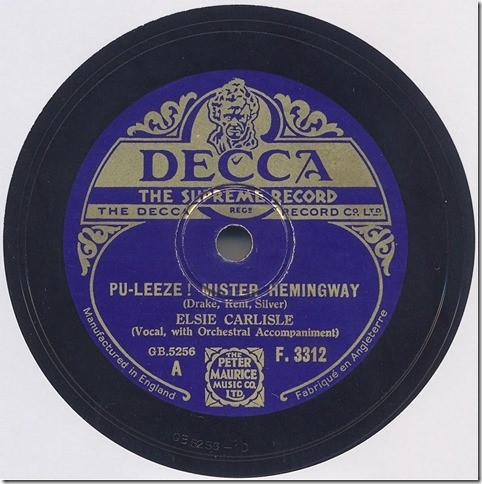
“Pu-leeze! Mister Hemingway!” Recorded by Elsie Carlisle on November 28, 1932. Decca F. 3312.

Personnel: probably Max Goldberg-t / t / tb / 2cl / as / 2 or 3 vn / Claude Ivy-p / g / sb / d

"Pu-leeze! Mister Hemingway!" Decca F. 3312A.

Elsie Carlisle – “Pu-leeze! Mister Hemingway!”

Transfer by Erik Høst

This version is at a slightly slower tempo, and Elsie’s delivery is more conversational. The arrangement is surprisingly similar to the one that Freddie Bretherton produced for Ambrose.

The last version of “Pul-eeze! Mister Hemingway” that Elsie would record was with Harry Hudson and His Melody Men:

“Pu-leeze! Mister Hemingway!” Recorded by Harry Hudson and His Melody Men (as Rolando and His Blue Salon Orchestra) with Elsie Carlisle as vocalist on December 20, 1932. Edison Bell Winner 5536.

Rolando and His Blue Salon Orchestra (a.k.a. Harry Hudson, w. Elsie Carlisle) – “Pu-leeze! Mister Hemingway” (1932)

Transfer by Charles Hippisley-Cox

Here the arrangement is a little different, and the orchestra is given a little more time to itself at the end. Elsie’s delivery is chatty, but perhaps not as much as in her solo recording.

There were a number of other artists recording “Pu-leeze! Mister Hemingway!” in late 1932. One problem they ran into was how to have a male singer deliver the song, which was risqué but not entirely unconventional in its sexuality. In America, George Olsen and His Music had male singer Fran Frey recount hearing a woman speak the lyrics, while Gene Kardos and His Orchestra (as Bob Causer and His Cornellians) had Dick Robertson rebuff a certain Mrs. Hemingway! In Britain there were versions by Billy Cotton and His Band, Carroll Gibbons and the Savoy Hotel Orpheans (with vocals by the Caryle Cousins, using the original lyrics), Ann Suter, Jay Wilbur and His Band (as Phil Allen’s Merrymakers, with vocalist Les Allen), and Jack Hylton and His Orchestra (in a Billy Ternent arrangement, with singer Pat O’Malley). Interestingly, the last two bandleaders mentioned did not seem to be bothered by having their male singers complain about being pestered by Mr. Hemingway! Gracie Fields recorded a version of the song that was only released in Australia, and Albert Whelan made one for Panachord accompanied by Harry Hudson’s Melody Men, but I have not been able to discover much about it.

Two final points need to be addressed. People often ask me if it is Ernest Hemingway that Elsie is singing about. I see no particular reason to identify the fictional masher with the American novelist. An open letter addressed to Ernest Hemingway entitled “Please, Mr. Ernest Hemingway” appeared in the American Criterion in 1935, but the addition of Hemingway’s first name would suggest that the letter’s author did not consider the song title that he was citing in jest to be originally about Ernest Hemingway.

And yes, there is a Steampunk Jazz version of “Pu-leeze! Mister Hemingway!” that samples the Ambrose recording. Pu-leeze!

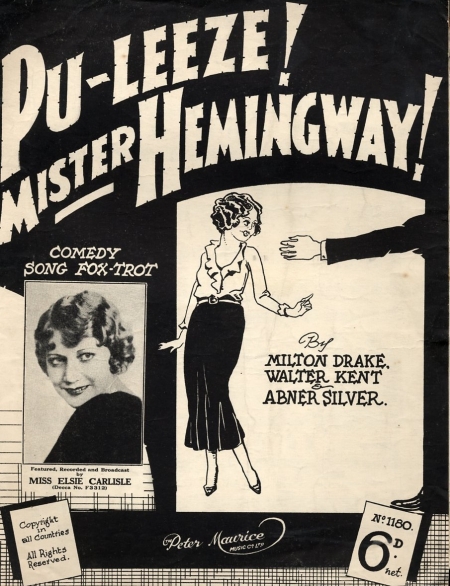
"Pu-leeze! Mister Hemingway" Sheet Music featuring Elsie Carlisle's photograph
“Pu-leeze! Mister Hemingway” Sheet Music featuring Elsie Carlisle’s photograph

“Ya Gotta Know How to Love” (1926)

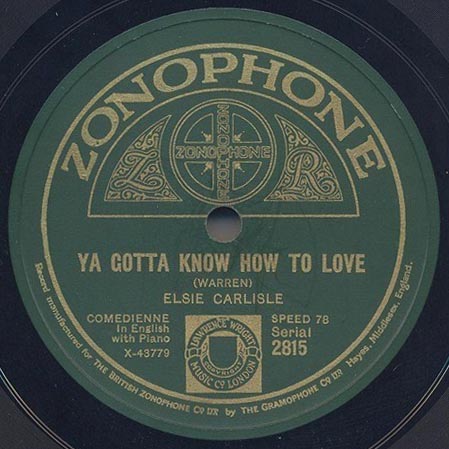
“Ya Gotta Know How to Love.” Words by Bud Green, music by Harry Warren (1926). Recorded on October 6, 1926 by Elsie Carlisle with piano and vocal accompaniment by Carroll Gibbons. Zonophone 2815.

"Ya Gotta Know How to Love" label. Zonophone 2815.

Elsie Carlisle – “Ya Gotta Know How to Love” (1926)

Original 78 rpm transfer by Erik Høst

In his famous November 4, 1938 article in Radio Pictorial (which either originated or, at the least, strongly reinforced Elsie Carlisle’s epithet “Radio Sweetheart No. 1”), reporter Ralph Graves recounts Elsie’s first meeting  with American pianist Carroll Gibbons (who would, the next year, become the bandleader of the Savoy Hotel Orpheans):

Now for another scene.

This time not a swank lunch, but a very informal party.

Elsie was asked to sing.  No, she hadn’t her music, but a quiet, bespectacled young man at the piano knew all the latest numbers, and could instantly transpose into any key Elsie wanted.

She sang several numbers which went down well, but the outstanding thought in Elsie’s mind was what a good accompanist this young man was.  And when he played some piano solos on his own afterwards her opinion of him went up.

She asked who he was.

“That chap at the piano?  Oh, he’s a Mr. Gibbons.  Just come over from the States with Rudy Vallee, you know.  Carroll Gibbons I believe his name is….”

That was in the days when Carroll was striving to make a name for himself.

Elsie and Carroll used to meet quite often after that party, as they held each other in mutual esteem.  Well, now here’s a secret.  Even his best friends will admit that Carroll has a “queer” voice.  Those melodious deep tones, so very “Southern” are a characteristic.  His announcements are fun, but you can’t imagine him as a singer, can you!

Yet it is a fact that Carroll and Elsie not only made gramophone records together, but on at least one of them Carroll sang part of the vocals!  Yes, that vocalist is a fine pianist!

Graves later ends his article by teasing

But if you want to hear Elsie in another vocal team, just try to get one of the old copies of a certain Zono record!  If you’re lucky, you’ll hear a then unknown singer, a Miss Carlisle, singing with a certain Mr. Gibbons, a new pianist, trying to make a name for himself as a Bing Crosby!

Graves’s article overstates quite a few things, among them the idea that Carroll Gibbons had a very notable vocal part on Zonophone 2815 (his piano playing is audible throughout, of course), but it is still a treat to hear Gibbons’s faint antiphony in “Ya Gotta Know How to Love” and in the song on the reverse side of the record, “My Cutey’s Due at Two-to-Two Today.”

“Ya Gotta Know How to Love” is a Harry Warren tune that is infectious in spite of, or perhaps because of, the simplicity of Bud Green’s lyrics.  It does not develop its theme much past the idea contained in the title of the song, namely that in a love relationship, a certain savoir faire is required (with the additional warning that one’s “baby” will be inclined to want expensive things). Elsie Carlisle adopts the persona that she has in many of her early recordings, that of the fetching, frenetic flapper.

“Ya Gotta Know How to Love” was recorded in America in 1926 by Sam Lanin and His Orchestra (as Chick Nelson’s Collegians) with Arthur Fields as vocalistIrving Aaronson and His Commanders (with vocals by Harold Saliers), Esther Walker, the California Ramblers (with Frank Harris, who may be Irving Kaufman going under a pseudonym), Fess Williams, the Varsity Eight, the Locust Sisters, Peggy English, and Betty Marvyn  (unissued).

In Britain, in addition to Elsie Carlisle’s recording, there were versions of “Ya Gotta Know How to Love” by Bert Firman’s Cabaret Novelty Orchestra and by Jack Hylton and His Orchestra (with Jack Hylton providing the vocals).

“Let’s Make Love” (1934)

“Let’s Make Love.” Words By Stanley J. Damerell, music by Tolchard Evans (1934). Recorded by Ambrose and His Orchestra with vocals by Sam Browne and with Elsie Carlisle in a speaking role on November 1, 1934. Decca F. 5297 mx. TB 1704-1.

Personnel: Bert Ambrose dir. Max Goldberg-t-mel / Harry Owen-t / Ted Heath-Tony Thorpe-tb / Danny Polo-reeds / Sid Phillips-reeds / Joe Jeannette-as / Billy Amstell-reeds / Ernie Lewis-Reg Pursglove-others?-vn / Bert Barnes-p / Joe Brannelly-g / Dick Ball-sb / Max Bacon-d

Ambrose & His Orchestra (w. Sam Browne & Elsie Carlisle) – “Let’s Make Love” (1934)

“Let’s Make Love (In Spring, Summer, Autumn and Winter)” is a light waltz written by British songwriters Stanley J. Damerell and Tolchard Evans, who collaborated on such notable songs as “Lady of Spain” (1931) and “If (They Made Me a King)” (1934). There seems to be a general rule that whenever Damerell and Evans have collaborated on a song, Elsie Carlisle ends up with a speaking role.  That would appear to be the case in the Ambrose recording of “Hyde Park Corner” (Hargreaves-Damerell-Evans; 1933), in which Sam Browne sings and Elsie and drummer Max Bacon have speaking parts, as well as in the Maurice Winnick version of “Da-Dar-Da-Dar” (also Hargreaves-Damerell-Evans; 1933), in which Sam Browne sings and Elsie is a mere interlocutor. So it is in this Damerell-Evans piece, “Let’s Make Love.”

Jack Payne and His Band had made, in late October 1934, a version of “Let’s Make Love” that relied for its entertainment value largely on comical Northern and Cockney voices provided by Jack Payne and Charlie Asplin; there was yet another version of “Let’s Make Love” in November by Jay Wilbur and His Band, with Fred Latham on the vocals. After an impressive instrumental introduction, the Ambrose recording has Sam Browne sing just the refrain and the first verse of the song. He then proceeds repeatedly to try to sing the first few words of the refrain (or something like them) in foreign accents which are intentionally abysmally done. His try at a Russian accent (“Letsky makesky loveskevitch”) is perhaps the least embarrassing.  I cannot say whether his announcing the Russian lover a second time and then correcting himself to “a Spanish lover” is a feigned mistake or a real one. The cannibalistic Zulu with his war cry “Yum, yum, yum!” is awkward at best, as is the shivering Eskimo.

Elsie Carlisle, for her part, merely interjects on occasion that Sam’s “impressions are lousy,” or the like. Sam and Elsie had already played bickering lovers in the 1933 Maurice Winnick recording of “Seven Years with the Wrong Woman,” and it was only weeks after recording “Let’s Make Love” that they would berate each other in “I’m Gonna Wash My Hands with You” with Ambrose and His Orchestra.  In “Let’s Make Love,” by contrast, it is not apparent that Sam really means it when he repeatedly sings “Let’s Make Love” to Elsie, nor that her rebuffing of him is anything more than a negative review of his talent.  What is clear is that this song is one of the silliest things Sam and Elsie ever collaborated on in their years of working for Ambrose.