Solo Recordings

It seems almost a misnomer to speak of Elsie Carlisle “solo” recordings, for she always had accompanists. What I here call “solo” recordings are records on which her name is featured, rather than that of a band, and usually only when the accompanists cannot be safely identified.

“Umbrella Man” (1939)

“Umbrella Man.” Words and music by James Cavanaugh, Larry Stock, and Vincent Rose (1938). Recorded by Elsie Carlisle with orchestral accompaniment under the musical direction of George Scott-Wood in Studio 2, Abbey Road, London on February 1, 1939. HMV BD-661.

Umbrella Man – Elsie Carlisle

Video by David Weavings (YouTube)

“Umbrella Man” is a slow waltz whose lyrics describe a tinker who specializes in umbrella repair. When work is slow, he will fix other commonplace things, such as socks, clocks, and the occasional broken heart. How he accomplishes the latter is not explained; it is a mere assertion. Elsie Carlisle lends sincerity to this simple song with her imitation of the umbrella man’s intoned value proposition (“Um-BRELL-as!… Any umb-er-ellas to fix today?”).

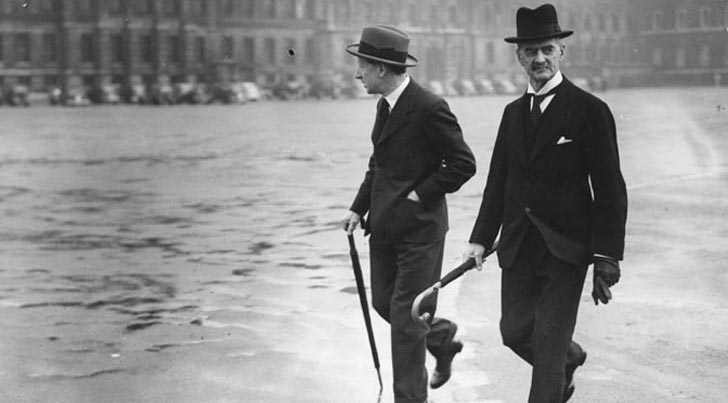
American Kay Kyser recorded his popular version of this song on September 1, 1938. By the end of that month, international attention focused on another Umbrella Man, British Prime Minister Neville Chamberlain, who was seldom photographed or even caricatured without his trademark umbrella. The doomed Munich Agreement signed with the Nazis had put Chamberlain in the international spotlight and may have revived interest in the song “Umbrella Man.” To be sure, many versions were recorded on both sides of the Atlantic, and by March, 1939 the Milwaukee Journal would report

The best selling [sic] song in the country today is “The Umbrella Man,” which owes a part of its popularity to British Prime Minister Chamberlain’s omnipresent umbrella… [D]ozens of cartoonists have used the song title as a text in describing the British statesman… Like many hits, no one wanted to publish it at first and it seemed destined for a pigeonhole until a bandleader got wind of it. Now “The Umbrella Man,” thanks to Neville Chamberlain, will yield its authors about $10,000 per man.

“Umbrella Man” was recorded in America in 1938-1939 by Kay Kyser and His Orchestra (with vocals by Harry Babbitt and Ginny Simms), Johnny Messner and His Orchestra (vocals by The Three Jacks), Swing and Sway with Sammy Kaye, Connee Boswell (accompanied by Woody Herman and His Orchestra), and the Benny Goodman Quintet.

In Britain it was recorded by Nat Gonella and His Georgians (v. Nat Gonella), Ambrose and His Orchestra (with vocals by Denny Dennis), Joe Loss and His Band (with vocalist Chick Henderson), Billy Cotton and His Band (with Alan Breeze, Jack Hylton and His Orchestra (with vocalist Sam Browne), Billy Thorburn’s The Organ, The Dance Band and Me (with vocals by George Barclay), Mantovani and His Orchestra (with Jack Plant), Josephine Bradley and Her Ballroom Orchestra (with Pat O’Regan singing), Harry Roy and His Orchestra (v. Harry Roy), Victor Silvester and His Ballroom Orchestra, and Maxwell Stewart’s Ballroom Melody. A notable version not done by a dance band is that of music hall comedians Flanagan and Allen.
“Pu-leeze! Mister Hemingway!” (Three Versions; 1932)

“Pu-leeze! Mister Hemingway!” Words and music by Milton Drake, Walter Kent, and Abner Silver (1932). Recorded by Ambrose and His Orchestra with Elsie Carlisle as vocalist on November 22, 1932. Regal Zonophone MR-769.

Personnel: Bert Ambrose dir. Max Goldberg-Harry Owen-t  / Ted Heath-tb / Danny Polo-Joe Jeannette-Billy Amstell-reeds / Harry Hines-as / Bert Read-p / Joe Brannelly-g / Don Stutely-sb / Max Bacon-d / Freddie Bretherton-a

“Pu-leeze! Mister Hemingway” (Ambrose and His Orchestra with Elsie Carlisle, 1932)

Transfer by Clive Hooley (YouTube)

“Pu-leeze! Mister Hemingway” is a composition by notable songwriters Milton Drake (also known for “Java Jive” and “Mairzy Doats”), Walter Kent (most famous for “I’ll Be Home for Christmas” and “The White Cliffs of Dover”), and Abner Silver (who would co-write “No! No! A Thousand Times, No!” — another Elsie Carlisle hit).  Elsie recorded “Pu-leeze! Mister Hemingway” five times in November and December of 1932, more times than any other song in her career: first “solo,” then with Ambrose and His Orchestra (by far her best-known version), then in two takes with Rudy Starita and His Band (one on Sterno, the other on Four-in-One), and finally with Harry Hudson and His Melody Men.

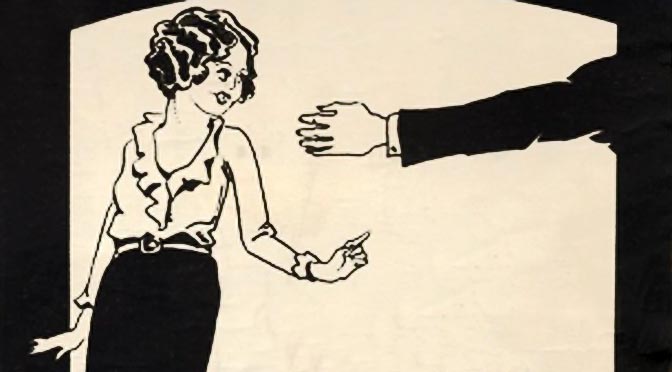
“Pu-leeze! Mister Hemingway!” remains one of Elsie’s most popular songs, most likely on account of her impeccable comic delivery of its risqué lyrics — indeed, it is outdone in sexual suggestiveness only by her two recordings of “My Man O’ War” (perhaps “My Handy Man” would also qualify in this regard). It is the complaint of an attractive woman who admits to liking a bit of flirtation but who has apparently met someone who takes it too far: a certain “Mr. Hemingway.” As the song progress, her description of his impertinent advances escalates, with Mr. Hemingway’s behavior sounding increasingly physically rough. The culmination is justly famous:

And I don’t mind your osculations,
But my dear, my operation!
Oh, pu-leeze! Mister Hemingway!

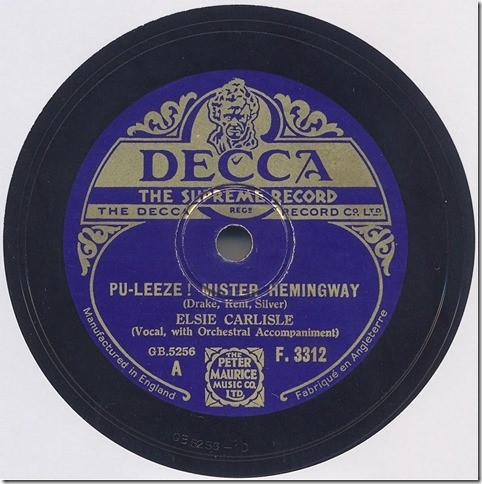
Two days before she recorded the version with Ambrose and His Orchestra, Elsie had committed to shellac a “solo” recording:

“Pu-leeze! Mister Hemingway!” Recorded by Elsie Carlisle on November 28, 1932. Decca F. 3312.

Personnel: probably Max Goldberg-t / t / tb / 2cl / as / 2 or 3 vn / Claude Ivy-p / g / sb / d

"Pu-leeze! Mister Hemingway!" Decca F. 3312A.

Elsie Carlisle – “Pu-leeze! Mister Hemingway!”

Transfer by Erik Høst

This version is at a slightly slower tempo, and Elsie’s delivery is more conversational. The arrangement is surprisingly similar to the one that Freddie Bretherton produced for Ambrose.

The last version of “Pul-eeze! Mister Hemingway” that Elsie would record was with Harry Hudson and His Melody Men:

“Pu-leeze! Mister Hemingway!” Recorded by Harry Hudson and His Melody Men (as Rolando and His Blue Salon Orchestra) with Elsie Carlisle as vocalist on December 20, 1932. Edison Bell Winner 5536.

Rolando and His Blue Salon Orchestra (a.k.a. Harry Hudson, w. Elsie Carlisle) – “Pu-leeze! Mister Hemingway” (1932)

Transfer by Charles Hippisley-Cox

Here the arrangement is a little different, and the orchestra is given a little more time to itself at the end. Elsie’s delivery is chatty, but perhaps not as much as in her solo recording.

There were a number of other artists recording “Pu-leeze! Mister Hemingway!” in late 1932. One problem they ran into was how to have a male singer deliver the song, which was risqué but not entirely unconventional in its sexuality. In America, George Olsen and His Music had male singer Fran Frey recount hearing a woman speak the lyrics, while Gene Kardos and His Orchestra (as Bob Causer and His Cornellians) had Dick Robertson rebuff a certain Mrs. Hemingway! In Britain there were versions by Billy Cotton and His Band, Carroll Gibbons and the Savoy Hotel Orpheans (with vocals by the Caryle Cousins, using the original lyrics), Ann Suter, Jay Wilbur and His Band (as Phil Allen’s Merrymakers, with vocalist Les Allen), and Jack Hylton and His Orchestra (in a Billy Ternent arrangement, with singer Pat O’Malley). Interestingly, the last two bandleaders mentioned did not seem to be bothered by having their male singers complain about being pestered by Mr. Hemingway! Gracie Fields recorded a version of the song that was only released in Australia, and Albert Whelan made one for Panachord accompanied by Harry Hudson’s Melody Men, but I have not been able to discover much about it.

Two final points need to be addressed. People often ask me if it is Ernest Hemingway that Elsie is singing about. I see no particular reason to identify the fictional masher with the American novelist. An open letter addressed to Ernest Hemingway entitled “Please, Mr. Ernest Hemingway” appeared in the American Criterion in 1935, but the addition of Hemingway’s first name would suggest that the letter’s author did not consider the song title that he was citing in jest to be originally about Ernest Hemingway.

And yes, there is a Steampunk Jazz version of “Pu-leeze! Mister Hemingway!” that samples the Ambrose recording. Pu-leeze!

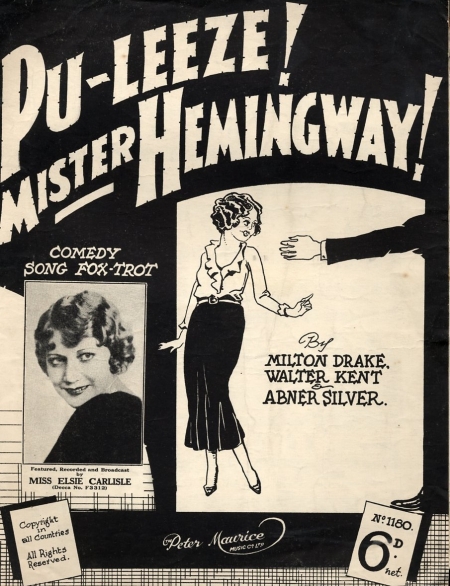
"Pu-leeze! Mister Hemingway" Sheet Music featuring Elsie Carlisle's photograph
“Pu-leeze! Mister Hemingway” Sheet Music featuring Elsie Carlisle’s photograph

“He’s a Good Man to Have Around” (1929)

“He’s a Good Man to Have Around.” Composed by Milton Ager, with lyrics by Jack Yellen, for the 1929 film Honky Tonk. Recorded by Elsie Carlisle (as “Sheila Kay”), with Cecil Norman and His Band, in London, October 16, 1929. World Echo A. 1013.

Personnel: Lloyd Shakespeare-t / Ben Oakley-tb / Les Norman-as / vn / Cecil Norman-p / __ Stanley-bb

He’s a Good Man to Have Around – Elsie Carlisle (as Sheila Kay)

Video by David Weavings (YouTube)

“He’s a Good Man to Have Around” is a torch song fashioned loosely after the model of Mistinguett’s “Mon homme” or its English adaptation “My Man” (introduced by Fanny Brice in the 1921 Ziegfeld Follies). The singer catalogues her “man’s” various faults and insists that she loves him in spite of them. One lyrical advantage that “He’s a Good Man to Have Around” has over comparable songs (such as “Hangin’ On to That Man”) is that the man’s moral deficits creep up comically in intensity; at first one expects the song to remain light, insofar as the man’s faults are merely not being good-looking, being a poor dancer and a poor speaker, and occasionally being mildly irritating. Indeed, the lyrics as used in Elsie’s August 23, 1929 recording of the song with Philip Lewis and His Dance Orchestra (a.k.a. the Rhythm Maniacs)1 stop at this point; they complement the comparatively upbeat instrumental interpretation nicely. In the October 16 Worldecho recording, however, Elsie sings the whole song, including the parts about how her lover is untrustworthy, unfaithful, and apparently such a dangerous fellow as to warrant her having bought a pistol — which she won’t use, for “He’s a Good Man to Have Around!” Elsie Carlisle recorded this record and three others with Worldecho under the name “Sheila Kay”; as she was recording under her own name for the Dominion label at the time, it may be that contractual obligations necessitated the use of the pseudonym.

Originally written for the 1929 film Honky Tonk starring Sophie Tucker (which does not survive as a movie, although the Vitaphone soundtrack is intact), “He’s a Good Man to Have Around” was first recorded by Tucker herself (with Ted Shapiro’s Orchestra). In 1929 versions of the song were also recorded in America by Herman Kenin and His Ambassador Hotel Orchestra, Lee Morse and Her Blue Grass Boys, The Cotton Pickers (both with Libby Holman and without), Kate Smith and the Harmonians, and Jimmy Noone’s Apex Club Orchestra (with vocals by Helen Savage).

“He’s a Good Man to Have Around” was recorded in 1929 in Britain by Florence Oldham (accompanied by Len Fillis on the guitar and by Sid Bright on the piano), Lily Lapidus, the Rhythmic Eight (with vocals by Maurice Elwin), The Picadilly Players (Eddie Collis, vocalist), Mabel Marks, Belle Dyson, the Blue River Band (with vocalist Sybil Jason), and Mabel Lawrence.

Notes:

  1. It is incidentally amusing to hear take one of this Decca recording, in which Elsie gets a couple of notes wrong!

“The Spring Don’t Mean a Thing” (1934)

“The Spring Don’t Mean a Thing.” Composition usually attributed to Lane Leighton; on this disc “Kennedy” is given the credit. Recorded by Elsie Carlisle on August 23, 1934. Decca F. 5173 mx. TB1498-2.

Elsie Carlisle – “The Spring Don’t Mean a Thing” (1934)

This exceedingly melancholy tune describes a love relationship that began in the spring. The affair’s dissolution has, for the speaker of the lyrics, stripped that season of its usual happy associations. Elsie Carlisle, ever the torch singer, draws out the deep pathos of the music in this violin-dominated arrangement.

“The Spring Don’t Mean a Thing to Me” (for that is the song’s full title) was also recorded in 1934 by Billy Cotton and His Band (with vocalist Alan Breeze), Harry Roy and His Orchestra (with vocals by Sam Browne), and Teddy Joyce and His Orchestra (with Eve Becke):

Teddy Joyce and His Orchestra (with Eve Becke) – “The Spring Don’t Mean a Thing to Me” (1934)

“The Spring Don’t Mean a Thing to Me” was included in Charlie Kunz’s “Piano Medley No. 14” (on Sterno). It can also be heard in the background in the 1945 British movie Waterloo Road (at 57:55).

“A Place in Your Heart” (1934)

“A Place in Your Heart.” Words and music by Sam Coslow. Recorded by Elsie Carlisle with orchestral accompaniment on June 14, 1934. Decca F-5071 mx. TB-1320-2.

Elsie Carlisle – “A Place in Your Heart” (1934)

“A Place in Your Heart” is a comparatively conventional love song whose lyrics feature the singer’s professed wish to inhabit a metaphorical dwelling place in her lover’s heart (“Some secret little corner where I’d stay, / Lock the door and throw the key away….”). The tune is pleasant and catchy, but the strongest point of Elsie Carlisle’s version of the song is her passionate yet sincere interpretation of its themes. The extent to which she made the song her own can be gauged by comparing her version to that of composer Sam Coslow himself.

“A Place in Your Heart” was also recorded that year in Britain by Ambrose and His Orchestra (with vocalist Sam Browne), the BBC Dance Orchestra (under the direction of Henry Hall, with vocals by Les Allen, in a Van Phillips arrangement — at a recording session which also featured vocals by composer Sam Coslow himself, singing another of his songs, “Cupid”), The Masterkeys (vocals by Leslie Douglas), Jack Payne and His Band (with Ronnie Genarder), and Louis Freeman and His Playhouse Band.

"The Idol of the Radio." British dance band singer of the 1920s, 1930s, and 1940s.