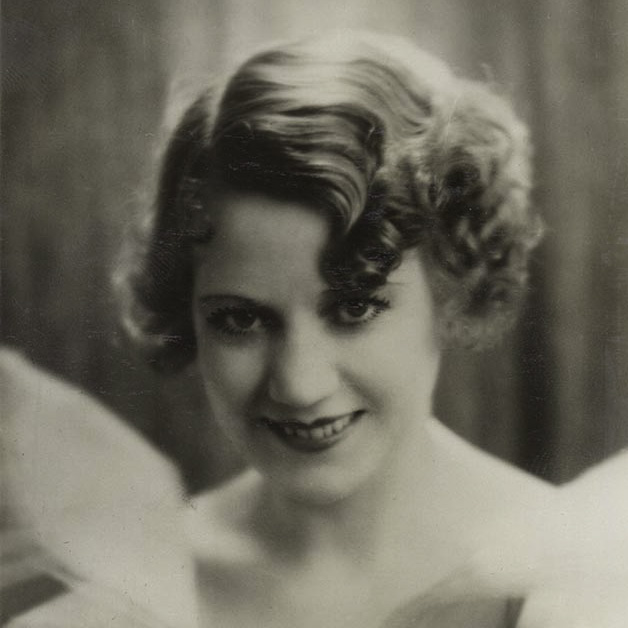
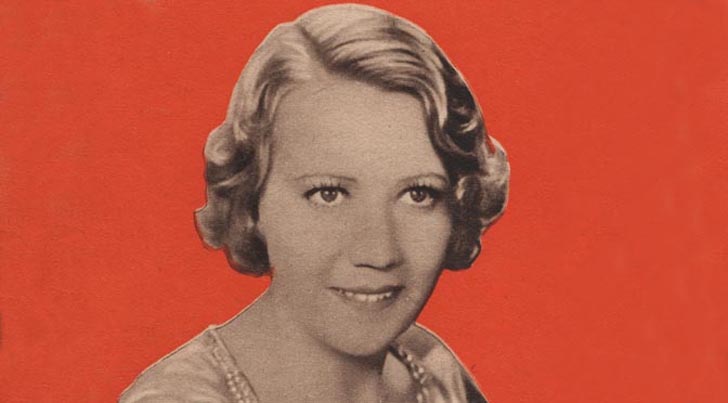
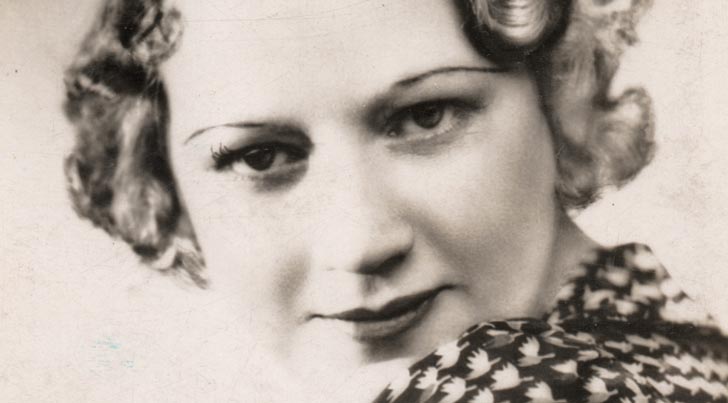
It seems almost a misnomer to speak of Elsie Carlisle “solo” recordings, for she always had accompanists. What I here call “solo” recordings are records on which her name is featured, rather than that of a band, and usually only when the accompanists cannot be safely identified.
“The Spring Don’t Mean a Thing.” Composition usually attributed to Lane Leighton; on this disc “Kennedy” is given the credit. Recorded by Elsie Carlisle on August 23, 1934. Decca F-5173 mx. TB-1498-2.
This exceedingly melancholy tune describes a love relationship that began in the spring. The affair’s dissolution has, for the speaker of the lyrics, stripped that season of its usual happy associations. Elsie Carlisle, ever the torch singer, draws out the deep pathos of the music in this violin-dominated arrangement.
“The Spring Don’t Mean a Thing to Me” was included in Charlie Kunz’s “Piano Medley No. 14” (on Sterno). It can also be heard in the background in the 1945 British movie Waterloo Road (at 57:55).
“A Place in Your Heart.” Words and music by Sam Coslow. Recorded by Elsie Carlisle with orchestral accompaniment on June 14, 1934. Decca F-5071 mx. TB-1320-2.
“A Place in Your Heart” is a comparatively conventional love song whose lyrics feature the singer’s professed wish to inhabit a metaphorical dwelling place in her lover’s heart (“Some secret little corner where I’d stay, / Lock the door and throw the key away….”). The tune is pleasant and catchy, but the strongest point of Elsie Carlisle’s version of the song is her passionate yet sincere interpretation of its themes. The extent to which she made the song her own can be gauged by comparing her version to that of composer Sam Coslow himself.
“A Place in Your Heart” was also recorded that year in Britain by Ambrose and His Orchestra (with vocalist Sam Browne), the BBC Dance Orchestra (under the direction of Henry Hall, with vocals by Les Allen, in a Van Phillips arrangement — at a recording session which also featured vocals by composer Sam Coslow himself, singing another of his songs, “Cupid”), The Masterkeys (vocals by Leslie Douglas), Jack Payne and His Band (with Ronnie Genarder), and Louis Freeman and His Playhouse Band.
“Who Walks In When I Walk Out?” Words by Ralph Freed, music by Al Goodhart and Al Hoffman (1933). Recorded on January 2, 1934 by Elsie Carlisle. Decca F-3838 mx. GB-6451-2.
One might think, from its credits, that this “Goodhart-Hoffman-Freed” song was written by the composers of “Fit as a Fiddle,” which Elsie Carlisle had recorded a year earlier, and one would be just slightly more than two-thirds correct. The music was composed by the same two men, while it was Arthur Freed’s somewhat less famous brother Ralph who penned the lyrics to “Who Walks In When I Walk Out?” The latter song would fit in nicely in a soundtrack for a film about American gangsters, although I am not aware of anyone’s actually having used it that way. It was versatile enough to have crossed generic boundaries early, with a 1935 country version by Bob Wills and His Texas Playboys. For Elsie Carlisle, it provided an opportunity to explore a slightly lower area of her vocal range than usual, and her voice has a brooding quality to it as she makes a series of jealous accusations of infidelity, along with what appears to be a physical threat (“I’m gonna give you the third degree…”).