Solo Recordings

It seems almost a misnomer to speak of Elsie Carlisle “solo” recordings, for she always had accompanists. What I here call “solo” recordings are records on which her name is featured, rather than that of a band, and usually only when the accompanists cannot be safely identified.

“Who Walks In When I Walk Out?” (1934)

“Who Walks In When I Walk Out?” Words by Ralph Freed, music by Al Goodhart and Al Hoffman (1933). Recorded on January 2, 1934 by Elsie Carlisle. Decca F. 3838 mx. GB6451-2.

Elsie Carlisle – “Who Walks In When I Walk Out?” (1934)

One might think, from its credits, that this “Goodhart-Hoffman-Freed” song was written by the composers of “Fit as a Fiddle,” which Elsie Carlisle had recorded a year earlier, and one would be just slightly more than two-thirds correct. The music was composed by the same two men, while it was Arthur Freed’s somewhat less famous brother Ralph who penned the lyrics to “Who Walks In When I Walk Out?” The latter song would fit in nicely in a soundtrack for a film about American gangsters, although I am not aware of anyone’s actually having used it that way. It was versatile enough to have crossed generic boundaries early, with a 1935 country version by Bob Wills and His Texas Playboys. For Elsie Carlisle, it provided an opportunity to explore a slightly lower area of her vocal range than usual, and her voice has a brooding quality to it as she makes a series of jealous accusations of infidelity, along with what appears to be a physical threat (“I’m gonna give you the third degree…”).

In 1934 there were American versions of “Who Walks In When I Walk Out?” by Adrian Rollini and His Orchestra (Herb Weil, vocalist), and Paul Whiteman and His Orchestra (with Ramona Davies). In Britain artists were more prolific, with recordings by Harry Roy and His Orchestra (with vocals by Bill Currie), Scott Wood and His Orchestra (with vocalist Sam Browne), Jack Payne and His Band (who made one record with Billy Scott-Coomber and one for a German label that was entirely instrumental), The New Mayfair Dance Orchestra, under the direction of Ray Noble, with vocals by Al Bowlly (who curiously talks his way through the lyrics — but to great effect), Jock McDermott’s Silver Serenaders (with vocalists Fred and Leslie Douglas), Harry Leader and His Band (as Joe Taub and His Melodians, with Leslie Holmes), Aileen Stanley (who had relocated to London and was accompanied on this recording by Max Goldberg and other British artists), Madame Tussaud’s Dance Orchestra (with vocalist Annette Keith), Dare Lea’s Band, and the Astorians Dance Band.

“Have You Ever Been Lonely?” (1933)

“Have You Ever Been Lonely?” Music by Peter De Rose, lyrics by Billy Hill (using the pseudonym George Brown; 1932). Recorded by Elsie Carlisle in London on February 14, 1933. Decca F-3435 mx. GB-5586-1.

Elsie Carlisle – “Have You Ever Been Lonely?” (1933)

In the 1933 song “Have You Ever Been Lonely?” one can detect the musical sensibilities of composer Peter De Rose, who would write “Deep Purple” to great acclaim the following year. The lyricist deserves attention, too; it was Billy Hill who collaborated with Harry Woods to produce “The Clouds Will Soon Roll By,” which Elsie Carlisle recorded twice in 1932, and which for modern listeners might be her trademark song, in no small part due to Dennis Potter’s Pennies from Heaven television series. “The Clouds Will Soon Roll By,” however, seems very much bound to the era of its composition and has inspired few interpretations by artists since the 1930s, whereas “Have You Ever Been Lonely?” has been recorded frequently and qualifies as a standard. Perhaps it is the latter song’s simple, timeless theme which makes it so attractive to different musical treatments.

Elsie Carlisle brings to this comparatively light torch song her talent for evoking pathos with a voice that quavers selectively and whose timbre (especially around the high notes) suggests an attractive vulnerability. Her delivery is dramatic but precise: when at 2:20 she asks “How can I go on living / Now that we’re apart?” there is the faintest hint of a mournful gulp when she pronounces the word “how.” The languid pace of the recording suits her melancholy interpretation (one might compare the excellent Ray Noble/Al Bowlly version for an example of a faster-paced, generally more upbeat rendition of the tune).

“Have You Ever Been Lonely was recorded in America in 1933 by Ted Lewis and His Band, Adrian Rollini and His Orchestra (with vocals by Dick Robertson), and Chick Bullock and His Orchestra. The song was more prolifically recorded by British bands, including Maurice Winnick and His Band (with vocalist Louis Spiro), Ray Noble and His Orchestra (with Al Bowlly), Jack Hylton and His Orchestra (with Pat O’Malley as vocalist, in a Billy Ternent arrangement), Henry Hall’s B.B.C. Dance Orchestra (with a vocal trio including Sam Browne, in a Sid Phillips arrangement), Sam Browne and Billie Lockwood (as “Jack and Jill”), Harry Roy and His Orchestra (Ivor Moreton, vocalist), Syd Roy and His R.K. Olians (with vocals by Sam Browne), Jack Payne and His Band (with a vocal trio of Billy Scott-Coomber, Bob Busby, and Bob Manning), and Jay Wilbur and His Band (with vocalist Val Rosing). “Have You Ever Been Lonely?” also appeared in medleys by Phil Green’s Studio Orchestra, Jimmy Campbell and His Paramount Band, and Ray Noble and His Orchestra (on a Daily Herald Contest Record).

“I Wish I Knew a Bigger Word Than ‘Love’” (1933)

“I Wish I Knew a Bigger Word Than ‘Love.’” Words and music by Eddie Pola and Melville Gideon (1933). Recorded on February 14, 1933 in London by Elsie Carlisle. Decca F. 3435 mx. GB5585-2.

Elsie Carlisle – “I Wish I Knew a Bigger Word Than ‘Love'” (1933)

A collaboration of American expatriates Eddie Pola and Melville Gideon, “I Wish I Knew a Bigger Word Than ‘Love’” compares the depth and complexity of human affection with that four-letter word “l-o-v-e” and finds the latter wanting. This is a light song, an uncomplicated conceit with repetitive lyrics and a catchy tune attached. Elsie Carlisle’s rendition of it conveys a fair amount of innocent enthusiasm, but one gets the feeling that she is in on the fundamental silliness of the piece when she begins, about halfway through, to speak the lyrics in an exaggeratedly thoughtful way.

“I Wish I Knew a Bigger Word Than ‘Love’” had been recorded during the previous four weeks by Billy Cotton and His Band (with Sam Browne as vocalist), Carroll Gibbons and the Savoy Hotel Orpheans (with vocals by Maurice Elwin), Harry Roy and His Orchestra (with vocalists Harry Roy and Binnie Barnes), and Jack Hylton and His Orchestra (with Pat O’Malley).  In March Jay Wilbur and His Band did a version with vocals by Sam Browne and Billie Lockwood. In August 1933 British Pathé would release a short film of Melville Gideon himself singing his composition at the piano:

Melville Gideon (1933)

Video by British Pathé (YouTube)

“Whisper Sweet” (1935)

“Whisper Sweet.” Words and music by James P. Johnson, Jo Trent, and Horatio Nicholls (a.k.a. Lawrence Wright). Recorded by Elsie Carlisle, probably with the Embassy Rhythm Eight, on February 1, 1935. Decca F. 5436.

“Whisper Sweet” – Elsie Carlisle

Transfer by Clive Hooley (YouTube)

The names James P. Johnson and Horatio Nicholls (a pseudonym of composer, music publisher, and impresario Lawrence Wright) are well known, that of Jo Trent considerably less so, and the origin of their song “Whisper Sweet” is comparatively obscure. Legendary stride pianist James P. Johnson composed many classic jazz tunes, including the original “Charleston.” Jo Trent was a lyricist who worked with many of the great composers, including Johnson; in 1931, for example, the two of them collaborated on the songs “Fooling Around with Love,” “Hanging Around Yo’ Door,” and “Hot Harlem,” but Trent appears to have avoided the spotlight; it has even been uncertain whether he was a man or a woman (he was the former, it seems:  Joseph H. Trent).  Lawrence Wright used his own name when publishing and sometimes even writing music, but he used the pseudonym Horatio Nicholls solely on compositions. There is sheet music for “Whisper Sweet” featuring a photograph of Eve Becke that credits Jo Trent and James P. Johnson as having written the words and music, with no mention of “Nicholls” at all (although the music was published by Lawrence Wright and bears that trademark). It might be asked if Lawrence Wright made some contribution to the arrangement that Elsie Carlisle sang. For what it is worth, I can find no fundamental difference between the arrangement that Elsie used and the one used by Bob Howard the next day in New York.

As with the flip side “Dancing with My Shadow,” it is assumed that Elsie’s accompanists for “Whisper Sweet” were the Embassy Rhythm Eight, as the matrices of Decca F. 5436 and two recordings that the Rhythm Eight did on February 1 and 5 form an interlacing sequence. “Whisper Sweet” is considerably livelier than “Dancing with My Shadow,” and its theme more upbeat. Elsie’s simple, sweet interpretation is suited to the dreamy lyrics, which focus primarily on the subtle outward signs of the beginning of romantic attraction.

The day after Elsie Carlisle recorded “Whisper Sweet,” Bob Howard and His Orchestra did a version in New York. Later in January there were London recordings by Carroll Gibbons and the Savoy Hotel Orpheans (with singer Brian Lawrance) and by Pat Hyde. In April Valaida Snow sang it for Parlophone, again in London. Sometime that year Eve Becke must have both broadcasted and recorded it, something which is asserted by the cover of the Lawrence Wright sheet music, but I have not identified an actual disc.

“Dancing with My Shadow” (1935)

“Dancing with My Shadow.” Composed by Harry Woods for the British musical comedy Thank You So Much. Recorded by Elsie Carlisle, probably with the Embassy Rhythm Eight, on February 5, 1935. Decca F-5436.

Personnel: Max Goldberg-t / Lew Davis-tb / Danny Polo-cl / Billy Amstell-ts / Bert Barnes-p / Joe Brannely-g / Max Bacon-d

Elsie Carlisle – “Dancing with My Shadow” (1935)

Transfer by Clive Hooley (YouTube)

A song about the loneliness of lovers drawn apart, “Dancing with My Shadow” encapsulates its theme of longing in its refrain:

Dancing with my shadow,
Feeling kind of blue,
Dancing with my shadow
And making believe it’s you.

This slow foxtrot was composed by Harry Woods for the British musical comedy Thank You So Much. Woods wrote other notable songs that Elsie Carlisle recorded; one thinks particularly of “The Clouds Will Soon Roll By.” The song also notably appeared in Alfred Hitchcock’s 1935 film adaptation of The 39 Steps. Elsie Carlisle, veteran torch singer, interprets the lyrics masterfully on this record, which she appears to have recorded with the Embassy Rhythm Eight, who went uncredited; this identification is strengthened by an examination of the sequence of matrices on the records they recorded with Decca on the same day.

“Dancing with My Shadow” had been recorded in the United States the previous year by Richard Himber and His Ritz-Carlton Orchestra and by Joe Reichman and His Orchestra (with vocalist Paul Small). In Britain in early 1935 there were versions by Billy Cotton and His Band (with Alan Breeze), Harry Roy and His Orchestra (Ivor Moreton, vocalist), the Piccadilly Hotel Band (with vocalist Jack Plant), the New Grosvenor House Band, Joseph Swindin and His Boys (Frank Gough, vocalist), and Harry Leader and His Band. The song was even popular in Swedish and Danish translations.

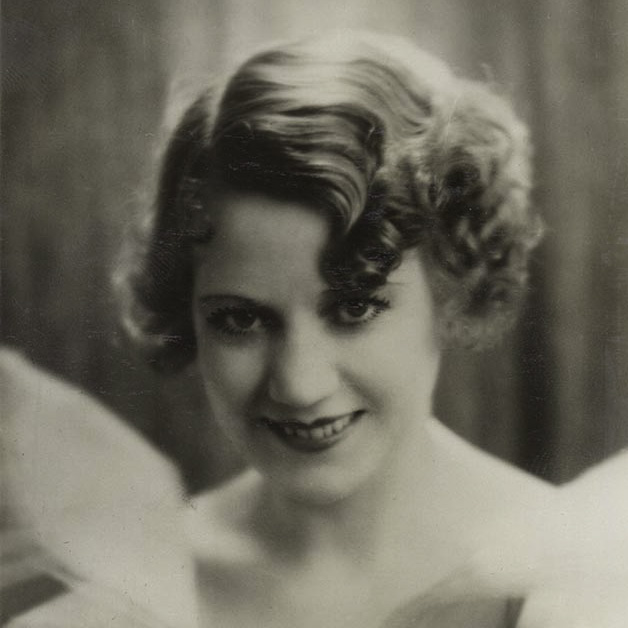
"The Idol of the Radio." British dance band singer of the 1920s, 1930s, and 1940s.