Solo Recordings

“Come Up and See Me Sometime” (1933)

“Come Up and See Me Sometime.” Words by Arthur Swanstrom, music by Louis Alter; composed for the motion picture Take a Chance (1933). Recorded by Elsie Carlisle with orchestral accompaniment in London on November 8, 1933. Decca F-3737 mx. GB-6297-2.

Elsie Carlisle – “Come Up and See Me Sometime” (1933)

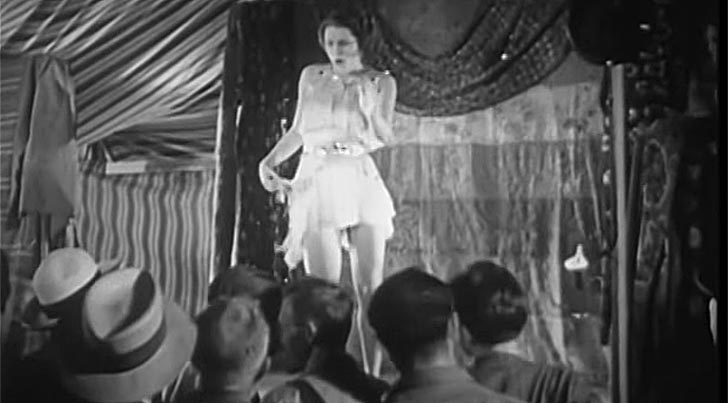
“Come Up and See Me Sometime” was written by Arthur Swanstrom and Louis Alter for Paramount’s 1933 musical comedy Take a Chance, based on the stage play of the same name. The movie apparently inherited little from the play other than a couple of songs, but it augmented what it did borrow with other, more memorable songs, including the perennial “It’s Only a Paper Moon.” “Come Up and See Me Sometime” is introduced by actress Lillian Roth, who sings it while performing a burlesque act. The title of the song presumably derives from a suggestive catchphrase of Mae West’s, which originally took the form “Why don’t you come up sometime and see me?” (in She Done Him Wrong [1933]), but which soon became the rhythmically preferable “Come up and see me sometime” (as it occurs in I’m No Angel [1933]).

Elsie Carlisle dishes out boldness in her version. The visual component of the movie’s burlesque scene is absent, but Elsie leaves no doubt as to the import of the song’s repetitive sultry invitations to get to know her better. As the song progresses, her intonation increasingly approaches that of the vamp, and her final “…any ti-i-i-IME!” finishes our impression of the self-consciously predatory showgirl.

“Come Up and See Me Sometime” was recorded in America in 1933 by Ramona Davies (on vocals and piano) and Cliff Edwards (a.k.a. Ukulele Ike). In March 1934 two versions were recorded by Ethel Waters.

In Britain in 1933 there were also recordings of “Come Up and See Me Sometime” by The BBC Dance Orchestra (directed by Henry Hall, with vocalist Phyllis Robins, in a striking Phil Cardew arrangement), Scott Wood and His Orchestra (with vocals by Sam Browne), the Casani Club Orchestra (directed by Charlie Kunz, with vocalist Cecile Petrie; the recording was never issued), and Joe Loss and His Band (with singer Annette Keith).

Solo Recordings

“With My Eyes Wide Open I’m Dreaming” (1934)

“With My Eyes Wide Open I’m Dreaming.” Words and music composed by Mack Gordon and Harry Revel for the Paramount film Shoot the Works (1934). Recorded by Elsie Carlisle with orchestral accompaniment on August 23, 1934. Decca F-5173 mx. TB-1491-1.

Elsie Carlisle – “With My Eyes Wide Open I’m Dreaming” (1934)

“With My Eyes Wide Open I’m Dreaming” was written by Mack Gordon and Harry Revel for the Paramount film Shoot the Works.1

They had composed “Did You Ever See a Dream Walking?” (which Elsie Carlisle also recorded) the previous year for another Paramount picture, and the two songs have similar conceits: the singer expresses surprise at finding herself in a love relationship so ideal that it seems more like a dream than reality. Elsie’s recording of “With My Eyes Wide Open I’m Dreaming” seems dreamy to me mostly because of Elsie’s dreamy delivery; it lacks the otherworldly introduction that the earlier song has. Its atmosphere is greatly augmented by the short  but exceedingly beautiful clarinet and violin interlude. I will admit that Elsie’s voice goes pitchy in the last note of the song; it would stretch credulity if I tried to argue that she did that for effect.

“With My Eyes Wide Open I’m Dreaming” was recorded in America in 1934 by Ruth Etting, Isham Jones and His Orchestra (v. Joe Martin), Ted Hanson and His Normandie Orchestra (v. George Gould), Gene Kardos and His Orchestra (v. Dick Robertson), and Leo Reisman and His Orchestra (v. George Beuler).

In addition to Elsie Carlisle’s, there were recordings made of “With My Eyes Wide Open I’m Dreaming” in Britain later that year by Lew Stone and His Band (v. Al Bowlly), the BBC Dance Orchestra (dir. Henry Hall, v. Les Allen), Jay Wilbur and His Band (v. Cyril Grantham), Madame Tussaud’s Dance Orchestra (dir. Stanley Barnett), Jack Payne and His Band (v. Billy Scott-Coomber), The Casani Club Orchestra (dir. Charlie Kunz, v. Phyllis Robins), Bobby Howell’s Band, and Phyllis Robins.

  1. It was released in Britain as Thank Your Stars, presumably because “shoot the works” (referring to the making of a large expenditure or effort) was indecipherable American slang; the expression appears to have faded from use in recent decades. ↩︎
Solo Recordings

“When a Woman Loves a Man” (1934)

“When a Woman Loves a Man.” Words by Johnny Mercer, music by Bernard Hanighen and Gordon Jenkins (1934). Recorded by Elsie Carlisle with orchestral accompaniment on June 14, 1934. Decca F-5071 mx. TB-1321-2.

Elsie Carlisle – “When a Woman Loves a Man” (1934)

It must first be noted that the song “When a Woman Loves a Man” recorded by Elsie Carlisle for Decca is not the Billy Rose/Ralph Rainger composition that Fanny Brice introduced in the 1930 film Be Yourselfbut rather a later composition by prolific American songwriters Johnny Mercer, Bernard Hanighen, and Gordon Jenkins. Both songs describe women in love as being wholly different from their male counterparts and in most ways more admirable in terms of tenacity and loyalty, but the Mercer lyrics have a sentimental quality that poses a special problem for the singer. How can one make such bold generalizations about half of the human population without seeming disingenuous? Fortunately, one of Elsie’s many talents was to add sincerity to her material by way of measured pathos, and in this recording the beauty of her delivery allows us to suspend disbelief.

Elsie had made a recording of “When a Woman Loves a Man” on June 1 with Ambrose and His Orchestra, but it was rejected. Other notable versions of the song were made in America by Eddy Duchin and His Orchestra (with vocals by the DeMarco Sisters) and by Art Tatum; British versions were recorded by Pat Hyde (accompanied by Edgar Jackson and His Orchestra), Harry Roy and His Orchestra (with vocals by Harry Roy himself), and Phyllis Robins.