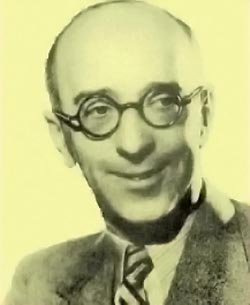
Jay Wilbur

“Honey” (1929)

“Honey.” Music by Richard A. Whiting, lyrics by Haven Gillespie and Seymour Simons (1928). Recorded by Elsie Carlisle under the musical direction of Jay Wilbur in London, c. mid-October 1929. Dominion A-215 mx. 1532-2.

“Honey” is a sentimental 1928 foxtrot of which many popular recordings were made in 1929 and which is still quite familiar to the general public. Elsie Carlisle’s version of it, with piano and string accompaniment, is paired with “Ain’t Misbehavin'” on Dominion A. 215, and the juxtaposition seems fitting. In “Ain’t Misbehavin'” she articulates the themes of sincerity and fidelity convincingly in a straightforward interpretation of the lyrics. She sings “Honey” equally sweetly and with an air of innocence suited to its simple lyrics. In this song we find a sustained expression of affection; there is none of the unrequited love so frequently found in her other songs, and none of her famed naughtiness. “Honey” showcases Elsie’s mezzo-soprano voice and her ability to convey emotion in the musical medium.

“Honey” was popularized in a wildly successful February 1929 recording by Rudy Vallée and His Connecticut Yankees. Other artists who issued versions of the song in the first half of 1929 were Hal Kemp’s Caroline Club Orchestra, the Mills Merry Makers (with vocals by Scrappy Lambert, as “Harold Lang”), Ben Selvin’s Knickerbockers (Larry Murphy, vocalist), Smith Ballew, the California Ramblers (as the Golden Gate Orchestra, with vocals by Ed Kirkeby, on a very late Edison cylinder recording), Vaughn de Leath, and Mildred Hunt.

“Honey” was in vogue with British recording artists in the second half of 1929, with recordings made by Jack Hylton and His Orchestra (with vocals by Sam Browne), Tommy Kinsman’s Florida Club Dance Band, Nat Star and His Orchestra (as Bernie Blake and His Orchestra on Sterno or as Eugene Brockman’s Dance Orchestra on Homochord, with vocals by Cavan O’Connor), Bidgood’s Broadcasters (vocals by Fairy South), the New Mayfair Dance Orchestra (in a Paul Jones medley), Teddy Brown, Cecil and Leslie Norman’s Savoy Plaza Band (Cavan O’Connor, vocalist), Philip Lewis and His Orchestra (a.k.a the Rhythm Maniacs, under the direction of Arthur Lally, with vocals by Maurice Elwin), Ronnie Munro and His Dance Orchestra (in the medley “Talkieland Selection Part 5”), and G. H. Elliott (accompanied by an Edison Bell Radio studio band directed by Harry Hudson).

The composer and lyricists of “Honey” are remembered for a number of other popular songs, many of which were featured in motion pictures. Whiting, Gillespie, and Simons had already collaborated in writing “Breezin’ Along with the Breeze” in 1926, and that same year Whiting and Simons (without Gillespie) had produced “Hello Baby.” Simons is perhaps best remembered for co-writing the 1931 song “All of Me” with Gerald Marks. Haven Gillespie penned the lyrics to “Santa Claus is Coming to Town” in 1934, and in that same year Whiting would compose the song “Rock and Roll” (whose title seems to be the origin of name of the musical genre) and “On the Good Ship Lollipop.” In 1937 he composed “Hooray for Hollywood” (with Johnny Mercer as his lyricist). “Honey” would later appear in the 1945 movie “Her Highness and the Bellboy,” starring Hedy Lamarr.

Jay Wilbur

“Ain’t Misbehavin’” (1929)

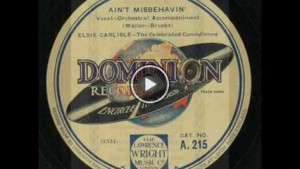
“Ain’t Misbehavin’.” Music by Fats Waller and Harry Brooks, with lyrics by Andy Razaf (1929). Recorded by Elsie Carlisle under the musical direction of Jay Wilbur in London, c. October 1929. Dominion A-215 mx. 1531-?.

Elsie Carlisle – “Ain’t Misbehavin’”
Transfer  by Mick Johnson (YouTube)

For a song that has been recorded well over a thousand times over the better part of a century, “Ain’t Misbehavin’” seems particularly evocative of the time of its conception: the year 1929, in the months preceding the stock market crash. It was composed for an all-black musical revue called Hot Chocolates which was so popular with audiences at the popular Harlem speakeasy Connie’s Inn that it moved on to the Hudson Theatre on Broadway, where it had 219 performances. It was at Hudson Theatre during the run of Hot Chocolates that Louis Armstrong had a sort of Broadway debut; he played “Ain’t Misbehavin’” on the trumpet during intermissions.

Credited co-composer Harry Brooks, who has been occasionally dismissed as a mere arranger of the song for Hot Chocolates, would later explain that the tune of “Ain’t Misbehavin’” was written in imitation of the beginning notes and bridge of Gershwin’s 1924 song “The Man I Love.” Fats Waller claimed that the title “Ain’t Misbehavin’” was a reference to his inability to misbehave in alimony jail, which is where he claimed to have composed the song. Andy Razaf, who outlived Waller by three decades, would later explain that Waller was misbehaving in misleading people: Razaf had come up with the title and the lyrics in Waller’s house in New York, where they finished the whole song in 45 minutes.

Elsie Carlisle sang other music with lyrics by Andy Razaf, including “My Man o’ War,” “The Porter’s Love Song,” “My Handy Man,” and “My Handy Man Ain’t Handy No More,” but whereas those songs lean towards naughtiness – misbehavin’, one might almost say – “Ain’t Misbehavin’” is charming in that it defines the qualities of fidelity and sincerity by alluding to their opposites. Elsie sounds fetchingly innocent as she declares her loyalty and denies any misconduct. Particularly touching is how she handles the upwards and downards progressions with the lyrics

Like Jack Horner
In the corner,
Don't go nowhere.
What do I care?
Your kisses are worth waiting for,
Believe me.

It is ironic that Elsie’s recorded image would later make an unintentional appearance in what would appear to be a rather pornographic 1974 movie (I have not had the pleasure of seeing it myself) entitled Ain’t Misbehavin’,  in which old footage is used of her singing “My Canary Has Circles Under His Eyes,” along with Fats Waller singing “Ain’t Misbehavin’” and “Honeysuckle Rose” (and Django Reinhardt playing Gershwin’s “The Man I Love,” and who knows what else that appears in this article), all interspersed with vintage lewd footage – or so I am told.

In the summer of 1929 there were American recordings of “Ain’t Misbehavin’” by the Charleston Chasers (with vocals by Eva Taylor), Ben Selvin’s Bar Harbor Society Orchestra (going under the name “Jerry Mason and His Californians, with Irving Kaufman singing under the pseudonym “Robert Wood”), Leo Reisman and His Orchestra (Lew Conrad, vocalist), Louis Armstrong and His Orchestra, Gene Austin, Ruth Etting, the California Ramblers (as the Golden Gate Orchestra), Irving Mills and His Hotsy Totsy Gang (with Bill “Bojangles” Robinson singing and tap-dancing), and Fess Williams and His Royal Flush Orchestra.

Composer Fats Waller recorded his own piano version of the piece on August 2, 1929 and would revisit it on a 1938 record made with his band (“Fats Waller and His Rhythm”) in which he sings the lyrics, but perhaps his most memorable performance is in the 1943 film Stormy Weather, made just before he died. It could be argued that he risked being upstaged by his own eyebrows in one scene.

Autumn 1929 saw British bands begin to record this Jazz Age anthem. On October 8, Jack Hylton and His Orchestra, with Sam Browne as their vocalist, made two records, one of standard length, the other a longer “concert arrangement” on a twelve-inch disc (Billy Ternent being the arranger); both versions involve recurrent allusions to George Gershwin’s “Rhapsody in Blue.” That same day Bidgood’s Broadcasters also recorded “Ain’t Misbehavin’,” and as the season progressed there were versions made by the Rhythmic Eight, Hal Swain’s Café Royal Band, Ambrose and His Orchestra (with vocalist Lou Abelardo, in a Lew Stone arrangement), Arthur Roseberry and His Dance Band (as Bert Maddison and His Dance Orchestra, with vocal refrain by Len Lees), Cecil and Leslie Norman’s Savoy Plaza Band (Cavan O’Connor, vocalist), Nat Star and His Dance Orchestra (as Eugene Brockman’s Dance Orchestra), and Percival Mackey’s Band (with vocals by Billy Milton). Jim Kelleher’s Piccadilly Band recorded two takes of “Ain’t Misbehavin’” that were never issued. In November, Harry Jacobson sang the song while playing the piano, accompanied by the Edison Bell studio orchestra directed by Harry Hudson (you may hear it in John Wright’s British Dance Band Show podcast #275, at 8:09). In this latter rendition, the band musically cites “Rhapsody in Blue” (at 9:35), much as Jack Hylton’s orchestra had done.

Jay Wilbur

“He’s My Secret Passion” (1930)

“He’s My Secret Passion.” Composed by Arthur Young, with lyrics by Val Valentine (1930). Recorded by Elsie Carlisle with orchestral accompaniment (probably under the musical direction of Jay Wilbur) c. September 3, 1930. Imperial 2333 mx. 5464-4.

Personnel:  ?Jay Wilbur dir. Jack Miranda-cl-ts / Eric Siday-vn / Harry Jacobson-p-cel / Len Fillis-g

Elsie Carlisle – “He’s My Secret Passion” (1930)

“He’s My Secret Passion” was written for a British crime drama called “Children of Chance” (1930) starring Elissa Landi and John Stuart. Elsie Carlisle’s September 1930 versions of the song appear on Imperial 2333 mx. 5464 with the take numbers -3, -4, and -5, and discographers Richard Johnson and Ross Laird have deduced from the high take numbers that recording spanned over more than one session. Elsie had begun to record for Imperial, where Jay Wilbur was musical director, the previous month after a four-month hiatus following the closing of Dominion Records (whose music Wilbur had also supervised).

One might reasonably call “He’s My Secret Passion” a torch song, insofar as it involves a longing lament over an unrealized romance, but the lyrics involve enough amorous boasting (e.g. “I’ll burn him up when I sit on his knee”) that perhaps the song transcends the genre. Elsie conveys her yearning with a slightly quavering voice, and her delivery becomes more confident as the argument of the lyrics becomes stronger. The studio band plays in a subdued and mellow fashion, nicely showcasing Elsie’s voice.

1930 saw British versions of “He’s My Secret Passion” (often turned into “She’s My Secret Passion,” as suggested in the original sheet music, when sung by male vocalists) by the Rhythm Maniacs (vocalist Ella Logan), Ambrose and His Orchestra (Sam Browne, vocalist), the Four Bright Sparks (vocalist Queenie Leonard, with Arthur Young on the piano), Harry Bidgood’s Broadcasters (Tom Barratt, vocalist), Bert Madison and His Dance Orchestra (Nat Star, again with Tom Barratt doing the singing), Len Fillis’s Phantom Players (vocalist Al Bowlly), and Jay Wilbur and His Band (with Les Allen as vocalist).

In America, the song was recorded in 1930 by Doris Robbins, Danny Yates and His Orchestra (with vocals by Smith Ballew), Lee Morse and Her Blue Grass Boys, Marion Harris, and in February 1931 by McKinney’s Cotton Pickers (with vocals by Donald King).