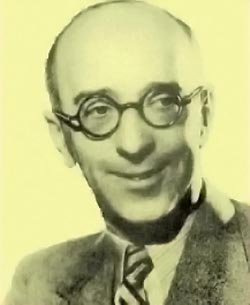
An accomplished bandleader in his own right, Jay Wilbur (1898-1970) had enormous influence over the recording of British dance band music and over Elsie Carlisle’s “solo” output in his role as musical director for such labels as Dominion, Imperial, Eclipse, and Rex. Just as it has long been the custom to identify the glorious voices (including Elsie’s) credited only as “vocal refrain” on dance band records, it is increasingly common to recognize the part that people such as Wilbur played in determining the sound of British popular music. It would be fair to say that Wilbur’s contributions to Elsie’s career rival those of Ambrose.
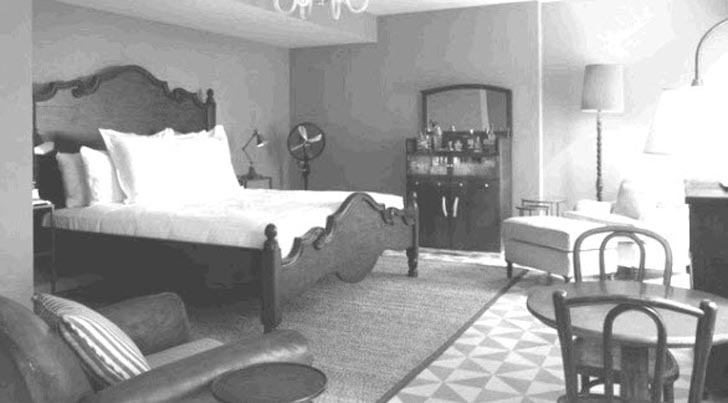
“Room Five-Hundred-and-Four.” Words by Eric Maschwitz, music by George Posford. Composed for the Eric Maschwitz revue New Faces (1940). Recorded by Elsie Carlisle under the musical direction of Jay Wilbur in London on February 10, 1941. Rex 9934 mx. R-5334-1.
Elsie Carlisle – “Room Five-Hundred-and-Four” (1941) Original 78 rpm Transfer by Charles Hippisley-Cox
“Room Five-Hundred-and-Four” has its origins in the 1940 revue New Faces, which is also where “A Nightingale Sang in Berkeley Square” was introduced. The lyrics describe a woman’s happy memory of a night spent with her lover in a luxury hotel too expensive for either of them. She describes the night as “her very first and only rendezvous,” and for good reason: this comparatively wholesome song is about a honeymoon, not a tryst. It is tame, therefore, by the standards of Elsie Carlisle’s songbook, which includes not just “My Man o’ War” but also “Public Sweetheart No. 1.”
Elsie Carlisle committed “Room Five-Hundred-and-Four” to shellac in her last year of recording. While I generally prefer the underlying compositions of her earlier period, it is delightful to hear her voice on her later Rex-label records. Elsie’s later style of singing seems slightly more confident, and the crisp beauty of her voice is made even more evident by the more modern recording techniques available by that time — in spite of Rex’s reputation for “crackly” shellac. The studio band’s virtuosity is showcased nicely in their rather swingy instrumental segment.
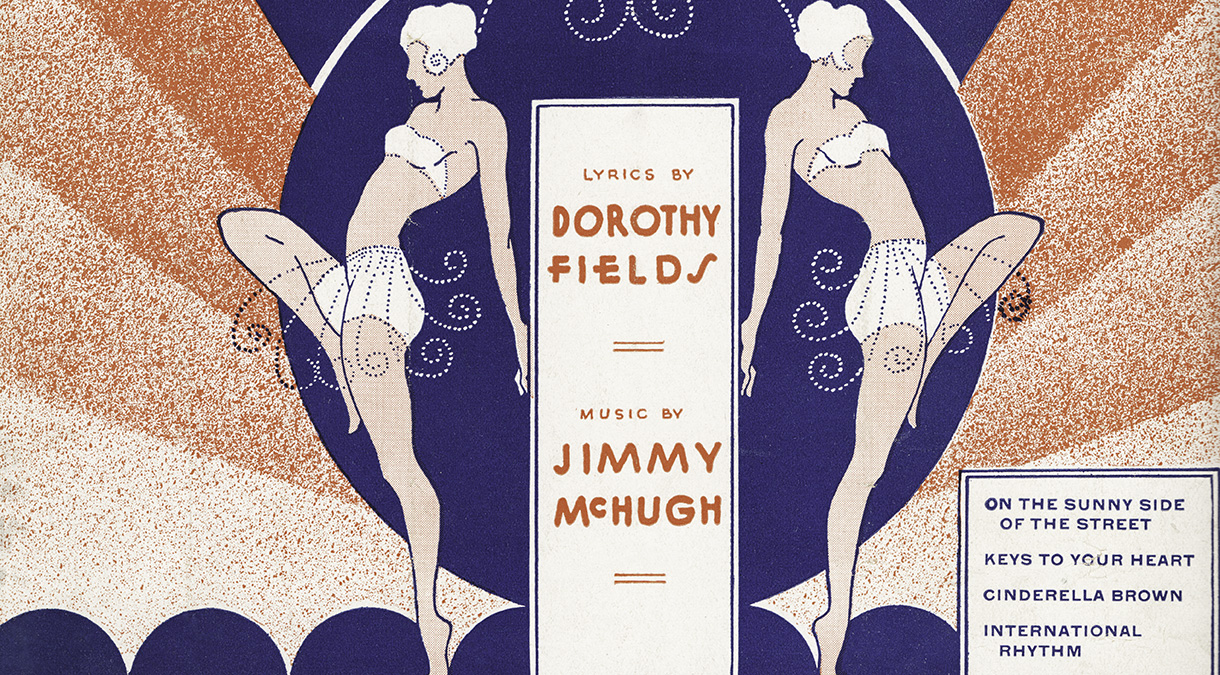
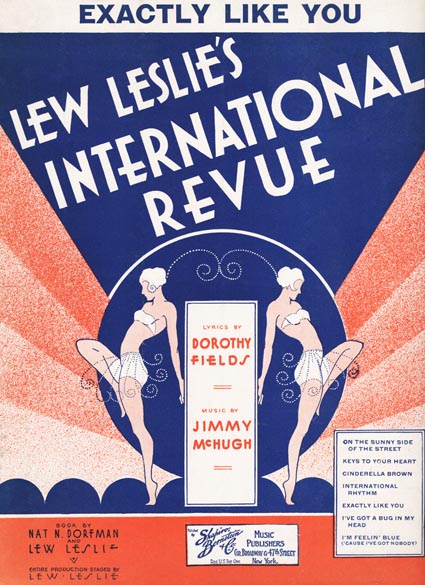
“Exactly Like You.” Words by Dorothy Fields, music by Jimmy McHugh (1930). Recorded in London in August 1930 by Elsie Carlisle under the musical direction of Jay Wilbur. Imperial 2318 mx. 5448-2.
Personnel: Jay Wilbur dir. / Jack Miranda-cl / Eric Siday-vn / Harry Jacobson-p-cel / Len Fillis-g / sb
On February 25, 1930, Broadway writer and producer Lew Leslie opened his International Revue at the Majestic Theatre in New York City. One would have expected a show backed by the mastermind of the wildly popular Blackbirds revues, choreographed by Busby Berkeley, and with music by Dorothy Fields and Jimmy McHugh, to be quite a success, but it had a comparatively short run of 95 performances, the last being on May 17, 1930. The lasting legacy of this well-funded flop consists of two songs: “On the Sunny Side of the Street,” introduced by Harry Richman, and “Exactly Like You,” sung in the revue by Richman and British actress Gertrude Lawrence.
In “Exactly Like You,” the singer describes the joy of having had an ideal preconception of love that has suddenly become realized in the form of the song’s addressee. The lyrics use turns of phrase suited to dramatic interpretation:
You make me feel so grand,
I want to hand the world to you.
You seem to understand
Each foolish little scheme I'm scheming,
Dream I'm dreaming.
The music is extraordinarily catchy but presents the singer with quite a challenge in its range (an octave and a fifth).
Elsie Carlisle was up to the task. A veteran of musical theater, she had, of course, introduced Cole Porter’s “What Is This Thing Called Love?” just the previous year, and it has a comparable range. She works her way through the melody’s fourth intervals with dexterity, all the while giving the impression that she is on the verge of faltering. Hers was never a weak voice, but she was an actress who knew the power of the semblance of vulnerability. In the end, while the lyrics argue that we should be impressed by her lover, her overall vocal performance might lead us to admire the character that she has created, some anonymous small person who, prone to sadness, has the sudden opportunity to express great joy. I have argued elsewhere that Elsie did not simply interpret songs; she augmented them by creating comparatively advanced vocal personas that change greatly from song to song.
Elsie’s virtuoso performance is nicely complemented by the memorable instrumental accompaniment put together by Jay Wilbur, a bandleader who was also musical director at Imperial at the time. This was, incidentally, Elsie’s first recording session at Imperial, but she had worked previously with Wilbur at Dominion Records before it went bankrupt. She and the band recorded three different takes of “Exactly Like You” at their session in August 1930. It is worth comparing the slightly different instrumentals of take 2 (above) with take 1:
“Tell Me More About Love.” Words and music by Bert Page. Recorded by Elsie Carlisle, accompanied by Jay Wilbur and His Orchestra (uncredited) c. late June 1929. Dominion A-168 mx. 1363-3.
Personnel: Laurie Payne-Jimmy Gordon-cl-as-bar / George Clarkson-cl-as-ts / Norman Cole-vn / vn / vn / Billy Thorburn-p / Dave Thomas or Bert Thomas-bj-g / Harry Evans-sb / Jack Kosky-d
“Tell Me More About Love” is a woman’s account of her love-making technique. Her approach is to seem innocent and to want instruction in the ways of love; hence the repetition of the title line “Tell me more about love.” She represents herself as a sort of student (“I don’t know what to do — / I can learn lots from you…”; “Teach me all — please don’t wait…”). She is “bashful” and “shy,” and explains that “love has never come [her] way,” but then she lets it slip that the various “lines” that she is rehearsing are ones that she practices every night with a different boy! In retrospect, her earlier request to have the lights dimmed or even turned off should have given her away.
Elsie Carlisle’s perky and chatty delivery in “Tell Me More About Love” showcases her talent for dramatizing a song and making it somewhat conversational, in spite of the absence of an interlocutor. Here Elsie’s delivery sounds a bit like that of Helen Kane, minus, of course, the exaggerated Bronx accent. Elsie’s romantic whimper at the end of the song is particularly precious, rivaled only by the primal girlish giggle in “Wasn’t It Nice?” (recorded the next year). A light and upbeat piece of music, “Tell Me More About Love” contrasts nicely with Elsie’s decidedly plaintive rendition of “Mean to Me” on the flip side of the record.
“Tell Me More About Love” was also recorded that year by Mabel Marks, the Arcadians Dance Orchestra (under the direction of Bert and John Firman), Florence Oldham (accompanied by Sid Bright on the piano and Len Fillis on the guitar — Oldham is sometimes portrayed on the sheet music), Kay and Kaye (a.k.a. Stanley Kirkby & Rita Bernard), and Billy Bartholomew, an English bandleader who recorded primarily in Germany from 1924-1938.