Partners & Accompanists

“Ya Gotta Know How to Love” (1926)

“Ya Gotta Know How to Love.” Words by Bud Green, music by Harry Warren (1926). Recorded on October 6, 1926 by Elsie Carlisle with piano and vocal accompaniment by Carroll Gibbons. Zonophone 2815.
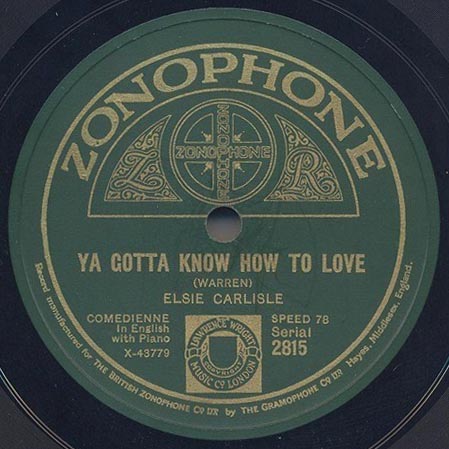
"Ya Gotta Know How to Love" label. Zonophone 2815.

Elsie Carlisle – “Ya Gotta Know How to Love” (1926)

Original 78 rpm transfer by Erik Høst

In his famous November 4, 1938 article in Radio Pictorial (which either originated or, at the least, strongly reinforced Elsie Carlisle’s epithet “Radio Sweetheart No. 1”), reporter Ralph Graves recounts Elsie’s first meeting  with American pianist Carroll Gibbons (who would, the next year, become the bandleader of the Savoy Hotel Orpheans):

Now for another scene.

This time not a swank lunch, but a very informal party.

Elsie was asked to sing.  No, she hadn’t her music, but a quiet, bespectacled young man at the piano knew all the latest numbers, and could instantly transpose into any key Elsie wanted.

She sang several numbers which went down well, but the outstanding thought in Elsie’s mind was what a good accompanist this young man was.  And when he played some piano solos on his own afterwards her opinion of him went up.

She asked who he was.

“That chap at the piano?  Oh, he’s a Mr. Gibbons.  Just come over from the States with Rudy Vallee, you know.  Carroll Gibbons I believe his name is….”

That was in the days when Carroll was striving to make a name for himself.

Elsie and Carroll used to meet quite often after that party, as they held each other in mutual esteem.  Well, now here’s a secret.  Even his best friends will admit that Carroll has a “queer” voice.  Those melodious deep tones, so very “Southern” are a characteristic.  His announcements are fun, but you can’t imagine him as a singer, can you!

Yet it is a fact that Carroll and Elsie not only made gramophone records together, but on at least one of them Carroll sang part of the vocals!  Yes, that vocalist is a fine pianist!

Graves later ends his article by teasing

But if you want to hear Elsie in another vocal team, just try to get one of the old copies of a certain Zono record!  If you’re lucky, you’ll hear a then unknown singer, a Miss Carlisle, singing with a certain Mr. Gibbons, a new pianist, trying to make a name for himself as a Bing Crosby!

Graves’s article overstates quite a few things, among them the idea that Carroll Gibbons had a very notable vocal part on Zonophone 2815 (his piano playing is audible throughout, of course), but it is still a treat to hear Gibbons’s faint antiphony in “Ya Gotta Know How to Love” and in the song on the reverse side of the record, “My Cutey’s Due at Two-to-Two Today.”

“Ya Gotta Know How to Love” is a Harry Warren tune that is infectious in spite of, or perhaps because of, the simplicity of Bud Green’s lyrics.  It does not develop its theme much past the idea contained in the title of the song, namely that in a love relationship, a certain savoir faire is required (with the additional warning that one’s “baby” will be inclined to want expensive things). Elsie Carlisle adopts the persona that she has in many of her early recordings, that of the fetching, frenetic flapper.

“Ya Gotta Know How to Love” was recorded in America in 1926 by Sam Lanin and His Orchestra (as Chick Nelson’s Collegians) with Arthur Fields as vocalistIrving Aaronson and His Commanders (with vocals by Harold Saliers), Esther Walker, the California Ramblers (with Frank Harris, who may be Irving Kaufman going under a pseudonym), Fess Williams, the Varsity Eight, the Locust Sisters, Peggy English, and Betty Marvyn  (unissued).

In Britain, in addition to Elsie Carlisle’s recording, there were versions of “Ya Gotta Know How to Love” by Bert Firman’s Cabaret Novelty Orchestra and by Jack Hylton and His Orchestra (with Jack Hylton providing the vocals).
“Let’s Make Love” (1934)

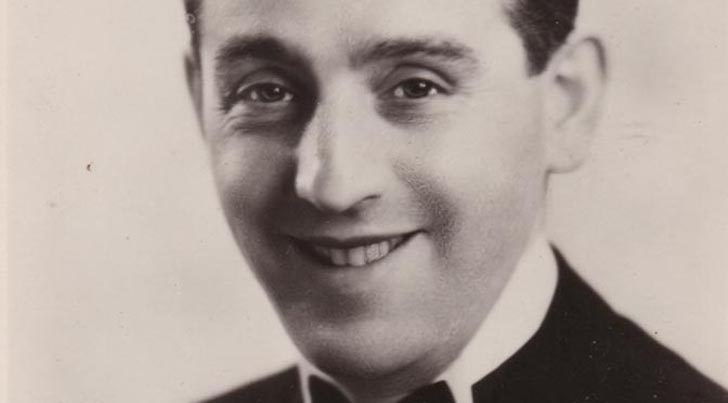
“Let’s Make Love.” Words By Stanley J. Damerell, music by Tolchard Evans (1934). Recorded by Ambrose and His Orchestra with vocals by Sam Browne and with Elsie Carlisle in a speaking role on November 1, 1934. Decca F. 5297 mx. TB 1704-1.

Personnel: Bert Ambrose dir. Max Goldberg-t-mel / Harry Owen-t / Ted Heath-Tony Thorpe-tb / Danny Polo-reeds / Sid Phillips-reeds / Joe Jeannette-as / Billy Amstell-reeds / Ernie Lewis-Reg Pursglove-others?-vn / Bert Barnes-p / Joe Brannelly-g / Dick Ball-sb / Max Bacon-d

Ambrose & His Orchestra (w. Sam Browne & Elsie Carlisle) – “Let’s Make Love” (1934)

“Let’s Make Love (In Spring, Summer, Autumn and Winter)” is a light waltz written by British songwriters Stanley J. Damerell and Tolchard Evans, who collaborated on such notable songs as “Lady of Spain” (1931) and “If (They Made Me a King)” (1934). There seems to be a general rule that whenever Damerell and Evans have collaborated on a song, Elsie Carlisle ends up with a speaking role.  That would appear to be the case in the Ambrose recording of “Hyde Park Corner” (Hargreaves-Damerell-Evans; 1933), in which Sam Browne sings and Elsie and drummer Max Bacon have speaking parts, as well as in the Maurice Winnick version of “Da-Dar-Da-Dar” (also Hargreaves-Damerell-Evans; 1933), in which Sam Browne sings and Elsie is a mere interlocutor. So it is in this Damerell-Evans piece, “Let’s Make Love.”

Jack Payne and His Band had made, in late October 1934, a version of “Let’s Make Love” that relied for its entertainment value largely on comical Northern and Cockney voices provided by Jack Payne and Charlie Asplin; there was yet another version of “Let’s Make Love” in November by Jay Wilbur and His Band, with Fred Latham on the vocals. After an impressive instrumental introduction, the Ambrose recording has Sam Browne sing just the refrain and the first verse of the song. He then proceeds repeatedly to try to sing the first few words of the refrain (or something like them) in foreign accents which are intentionally abysmally done. His try at a Russian accent (“Letsky makesky loveskevitch”) is perhaps the least embarrassing.  I cannot say whether his announcing the Russian lover a second time and then correcting himself to “a Spanish lover” is a feigned mistake or a real one. The cannibalistic Zulu with his war cry “Yum, yum, yum!” is awkward at best, as is the shivering Eskimo.

Elsie Carlisle, for her part, merely interjects on occasion that Sam’s “impressions are lousy,” or the like. Sam and Elsie had already played bickering lovers in the 1933 Maurice Winnick recording of “Seven Years with the Wrong Woman,” and it was only weeks after recording “Let’s Make Love” that they would berate each other in “I’m Gonna Wash My Hands with You” with Ambrose and His Orchestra.  In “Let’s Make Love,” by contrast, it is not apparent that Sam really means it when he repeatedly sings “Let’s Make Love” to Elsie, nor that her rebuffing of him is anything more than a negative review of his talent.  What is clear is that this song is one of the silliest things Sam and Elsie ever collaborated on in their years of working for Ambrose.

“My Cutey’s Due at Two-to-Two Today” (1926)

“My Cutey’s Due at Two-to-Two Today.” Music by Albert Von Tilzer, lyrics by Leo Robin (1926). Recorded by Elsie Carlisle with piano and vocal accompaniment by Carroll Gibbons in London on October 6, 1926. Zonophone 2815.

My Cutey’s Due At Two-To-Two To-Day – Elsie Carlisle

Video by David Weavings (YouTube)

Von Tilzer and Robin’s “My Cutey’s Due at Two-to-Two Today,” an example of the “train song” genre, is a light composition that makes up for a fundamental lack of profundity by being ridiculously catchy, almost addictive. It speaks primarily of faithfulness in one’s lover’s absence and of the giddy anticipation of reunion. Elsie Carlisle brings to it the requisite frantic, girlish enthusiasm and applies her vaguely conversational style of delivery to the song’s rhythmical patter with great effectiveness. She is accompanied on this record, not only by Carroll Gibbon’s piano playing, but also by his voice; he engages in a muted antiphony with Elsie for part of the song.

“My Cutey’s Due” was recorded in America in 1926 by Sam Lanin and His Orchestra (as the Missouri Jazz Band), Ted Weems (Park Gibbs, vocalist), the Happiness Boys (Billy Jones and Ernest Hare), The Clevelanders (with vocals by Tom Stacks), and the Little Ramblers (with vocalist Ed Kirkeby). In Britain there were 1926 versions by Bert Firman’s Dance Orchestra, Don Parker and His Band, Victor Sterling and His Band, Van Straten and His Riviera Dance Orchestra (with vocals by Harry Fay). In early 1927 there were recordings made by Alfredo’s Band and by the Picadilly Revels Band.

“Oh, My Bundle of Love” (1926)

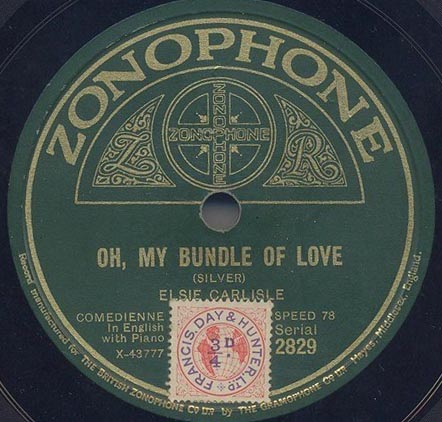
“Oh, My Bundle of Love.” Words by George Price, music by Abner Silver. Recorded by Elsie Carlisle with piano accompaniment by Carroll Gibbons on October 6, 1926. Zonophone 2829.

Elsie Carlisle's "Oh, My Bundle of Love" on Zonophone 2829 (label). Image courtesy of Erik Høst.
Elsie Carlisle’s “Oh, My Bundle of Love” on Zonophone 2829. Image courtesy of Erik Høst.

Elsie Carlisle – “Oh, My Bundle of Love” (1926)

Original 78 rpm transfer by Erik Høst

Elsie Carlisle sang “Oh, My Bundle of Love”1 at her third recording session, for her third record, accompanied, as she always would be that year, by a 23-year-old Carroll Gibbons on the piano. The composition has a bubbly energy typical of the dance music of its period, and the lyrics express the goofy enthusiasm of a young lover by way of precious, cutesy colloquialisms (e.g. “sweetie-sweet”). For this song, Elsie dons a persona of somewhat mindless ebullience that reminds me of her 1930 version of “Wasn’t It Nice?”; she is the picture of pure, giggly fun. The recording is also a good example of Carroll Gibbons’s developing piano virtuosity (he would not be known as a band leader for another year).

“My Bundle of Love” was recorded in America in 1925 by Gene Austin (accompanied by Jack Shilkret on the piano) and by Cliff “Ukulele Ike” Edwards. In 1926 there were versions by Mal Hallett and His Orchestra, Emerson Gill and His Castle of Paris Orchestra (with vocals by Pinkey Hunter), Ben Bernie and His Hotel Roosevelt Orchestra, The Southerners (with vocalist Jack Kaufman), and Nick Lucas.  There is a piano roll of the song from that year by Ralph Reichenthal (a.k.a Ralph Rainger), the composer of “Moanin’ Low,” amongst other successful tunes.

Elsie Carlisle’s 1926 recording of “Oh, My Bundle of Love” was preceded that year in Britain by a take by Jay Whidden and His New Midnight Follies Band (rejected by Columbia) and by a version by Jack Hylton and His Orchestra.

Notes:

  1. “Oh, My Bundle of Love” more commonly has the simpler title of “My Bundle of Love,” and why not? The expression “Oh, My Bundle of Love” does not occur in the song.

“Coming Thro’ the Cornfield” (1926)

“Coming Thro’ the Cornfield.” Words and music by Horatio Nicholls (a.k.a. Lawrence Wright). Recorded by Elsie Carlisle with piano accompaniment  by Carroll Gibbons on June 21, 1926 at the Gramophone Company’s Studio B at Hayes in Middlesex. Zonophone 2772 mx. Yy8563-2.

Elsie Carlisle – “Coming Thro’ the Cornfield” (1926)

Elsie Carlisle sang “Coming Thro’ the Cornfield” at her second recording session for what was to be her second record, accompanied by pianist Carroll Gibbons, who would soon become the famed director of the Savoy Hotel Orpheans. The song was written by performer, music publisher, impresario, and composer Lawrence Wright, who tended to use the pseudonym “Horatio Nicholls” on his own original compositions. Elsie handles this effusive expression of love in a rustic setting with her usual sweetness, and the pairing with “I Love My Baby” on the other side of the record allows her to adopt the personae of two very different girls in love.

“Coming Thro’ the Cornfield” was recorded two days later by the Savoy Havana Band, in late July 1926 by Bert Firman’s Dance Orchestra, and again in late September by Bert Firman’s band (as “Newton Carlisle’s Dance Orchestra” on Homochord and as “Dan Frederick and His Dance Orchestra” on Sterno).

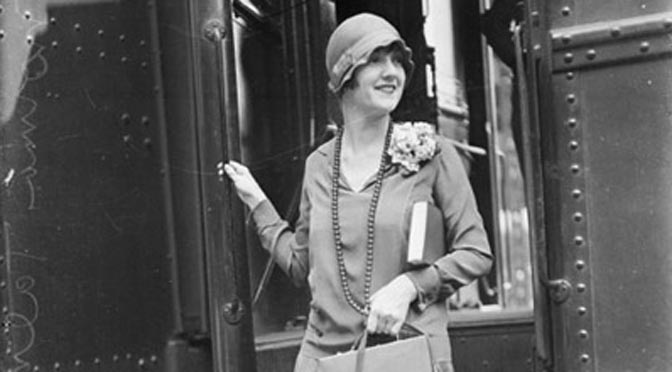
"The Idol of the Radio." British dance band singer of the 1920s, 1930s, and 1940s.