Carroll Gibbons, Solo Recordings

“He’s the Last Word” (1927)

“He’s the Last Word.” Lyrics by Gus Kahn, music by Walter Donaldson (1926). Recorded by Elsie Carlisle with accompaniment by piano (Arthur Young) and violin at Studio B, Hayes, Middlesex, on May 6, 1927. HMV B-2579 mx. Bb-10689-2.

Elsie Carlisle – “He’s the Last Word” (1927)

“He’s the Last Word” follows an argument familiar to aficionados of popular music: its singer goes through a catalogue of her “sweet somebody’s” various deficits (insufficient talent at dancing, for example), only to conclude that when it comes to romance, “he’s the last word” — he is the very best. In her recording of the song, Elsie Carlisle is pure enthusiasm, and her frequent nonsensical ejaculations remind us of the fun, popular genre that she is working in. She has excellent accompanists in this recording on the piano and violin. Richard J. Johnson identifies the pianist as Carroll Gibbons and does not attempt to name the violinist.1

Contemporary record reviewer and industry insider Edgar Jackson was under a very different impression as to the identities of the accompanists, writing that

Elsie Carlisle has a thoroughly good vocal record of “He’s the Last Word” [54 at 78] (B2579). She sings tunefully, and is one of the most stylish and rhythmical of all our English comediennes. She has been excellently accompanied by Hugo Rignold (violin) and Arthur Young (piano)—Young does one of the best piano solo choruses I have heard. I wish I could say as much for his effort in “What’s the Use of Crying?” by the same artists on the reverse side.2

As it turns out, the evidence of the Kelly Online Database, which is based on HMV’s ledgers themselves, is that it was Arthur Young on the piano for “He’s the Last Word” (see my discography for further discussion). The suggestion that the violinist is Rignold is interesting. Hugo Rignold was already famous for his exceedingly “jazzy” playing, and certainly the violinist in “He’s the Last Word” gives the impression of being lively and playful, employing double and triple stops.3

Other noteworthy early versions of “He’s the Last Word” include ones by Art Kahn and His Orchestra, Jack Pettis and His Band (with vocalist Billy Hillpot), Ben Pollack and His Californians (with the Williams Sisters), Ben Bernie and His Roosevelt Orchestra (with vocals by Scrappy Lambert), the Broadway Bellhops (with singer Irving Kaufman), Jane Gray, Vaughn de Leath (recording as “Gertrude Dwyer”), The Troubadors, Annette Hanshaw (with Irving Brodsky on the piano), and Jack Linx and His Birmingham Society Serenaders. American Josephine Baker recorded “He’s the Last Word” in Paris accompanied by Jacob’s Jazz, and in August 1927 the Merl Twins (“Syncopating Songsters”) sang it in an early Hollywood Vitaphone short film.

In Britain in 1927, in addition to Elsie Carlisle’s, there were versions of “He’s the Last Word” by The Savoy Orpheans (directed by Carroll Gibbons), Syd Roy’s Lyricals, and Bert Firman’s Dance Orchestra (as Eugene Brockman’s Dance Orchestra).

  1. Elsie Carlisle: A Discography. Aylesbury, UK, 1994, p. 6. ↩︎
  2. The names are emphasized in the original. “The Gramophone Review.” The Melody Maker and British Metronome 2.24 (Dec. 1, 1927): 1273. ↩︎
  3. See Bret Lowe’s comments below about the violin playing in this recording and his suggestion that the violinist might have been Eric Siday. ↩︎
Sam Browne

“Hold Up Your Hands (In the Name of the Law of Love)” (1933)

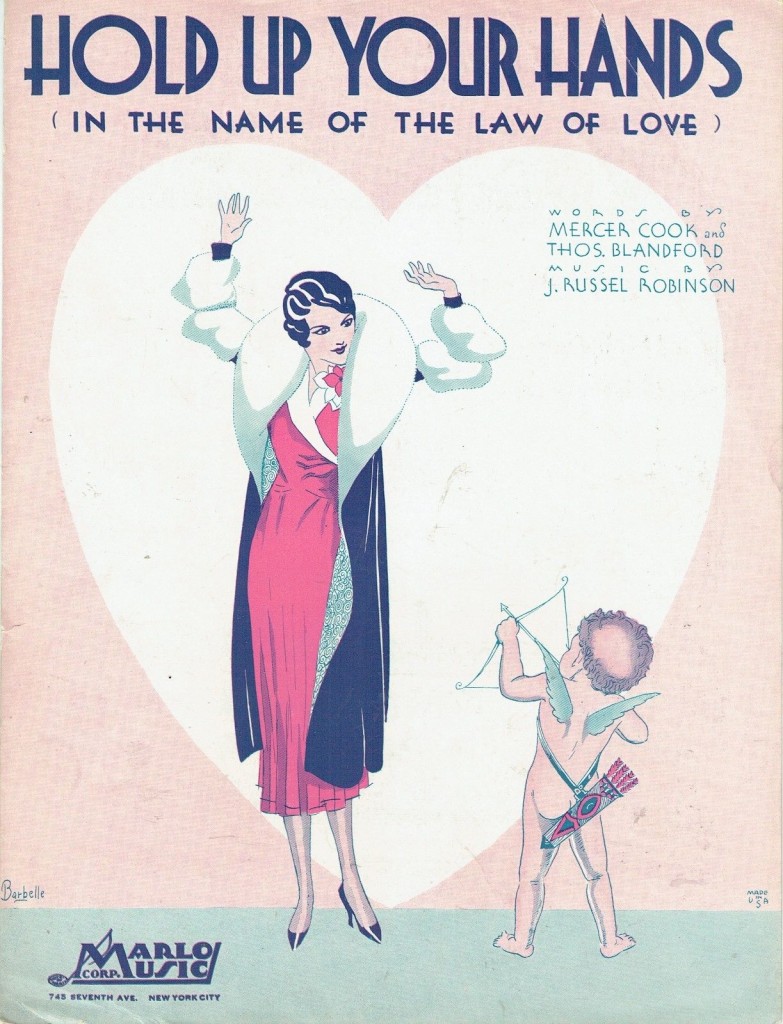
“Hold Up Your Hands (In the Name of the Law of Love).” Words by Mercer Cook and Thomas Blandford, music by J. Russel Robinson (1932). Recorded by Elsie Carlisle and Sam Browne on March 3, 1933. Decca F-3504 mx. GB-5634-2.

Elsie Carlisle & Sam Browne – “Hold Up Your Hands (In the Name of the Law of Love)” (1933)

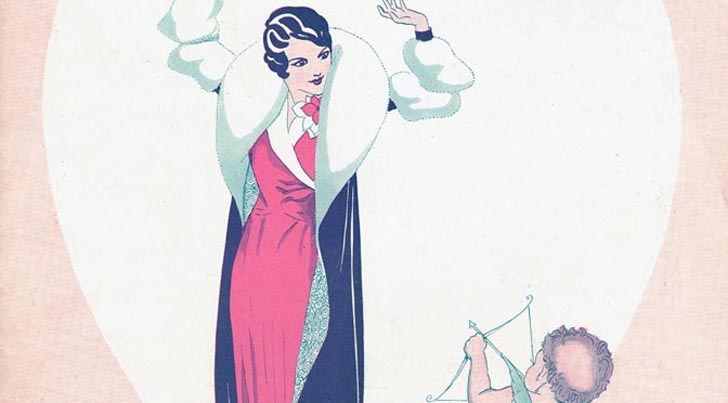
“Hold Up Your Hands (In the Name of the Law of Love)” was written by American songwriters Mercer Cook, Thomas Blandford, and J. Russel Robinson in 1932; that year they also wrote the very successful “Is I in Love? I Is,” as well as “Stop the Sun, Stop the Moon,” which Elsie Carlisle recorded with Ray Starita and His Ambassadors. This duet involves a fanciful metaphor in which it is not clear whether Sam Browne is an agent of “the law” he keeps invoking (viz. the law of love or of Cupid) or a robber carrying out a holdup; he seems to entertain both notions. At any rate, Elsie seems to acquiesce to his demands that she “put up [her]  lips, and hold up [her] hands” with little resistance. 1933 was the second year of Sam and Elsie’s recording duets together, and “Hold Up Your Hands” is fairly representative of their duetting style (when they are not bickering, of course).

“Hold Up Your Hands” had been recorded in America in September 1932 by Victor Arden, Phil Ohman, and Their Orchestra (with vocals by Frank Luther). It was also recorded in 1933 in Britain by Maurice Winnick and His Band (with vocalist Louis Spiro).

"Hold Up Your Hands" original sheet music
Carroll Gibbons

“Ya Gotta Know How to Love” (1926)

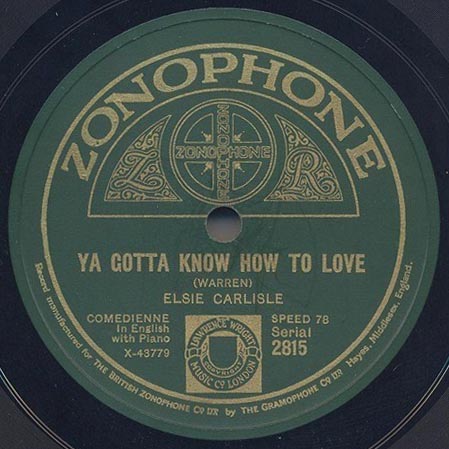
“Ya Gotta Know How to Love.” Words by Bud Green, music by Harry Warren (1926). Recorded on October 6, 1926 by Elsie Carlisle with piano and vocal accompaniment by Carroll Gibbons. Zonophone 2815 mx. Yy-9073-2.

"Ya Gotta Know How to Love" label. Zonophone 2815.

Elsie Carlisle – “Ya Gotta Know How to Love” (1926)
Original 78 rpm transfer by Erik Høst

In his famous November 4, 1938 article in Radio Pictorial (which either originated or, at the least, strongly reinforced Elsie Carlisle’s epithet “Radio Sweetheart No. 1”), reporter Ralph Graves recounts Elsie’s first meeting  with American pianist Carroll Gibbons (who would, the next year, become the bandleader of the Savoy Hotel Orpheans):

Now for another scene.

This time not a swank lunch, but a very informal party.

Elsie was asked to sing.  No, she hadn’t her music, but a quiet, bespectacled young man at the piano knew all the latest numbers, and could instantly transpose into any key Elsie wanted.

She sang several numbers which went down well, but the outstanding thought in Elsie’s mind was what a good accompanist this young man was.  And when he played some piano solos on his own afterwards her opinion of him went up.

She asked who he was.

“That chap at the piano?  Oh, he’s a Mr. Gibbons.  Just come over from the States with Rudy Vallee, you know.  Carroll Gibbons I believe his name is….”

That was in the days when Carroll was striving to make a name for himself.

Elsie and Carroll used to meet quite often after that party, as they held each other in mutual esteem.  Well, now here’s a secret.  Even his best friends will admit that Carroll has a “queer” voice.  Those melodious deep tones, so very “Southern” are a characteristic.  His announcements are fun, but you can’t imagine him as a singer, can you!

Yet it is a fact that Carroll and Elsie not only made gramophone records together, but on at least one of them Carroll sang part of the vocals!  Yes, that vocalist is a fine pianist!

Graves later ends his article by teasing

But if you want to hear Elsie in another vocal team, just try to get one of the old copies of a certain Zono record!  If you’re lucky, you’ll hear a then unknown singer, a Miss Carlisle, singing with a certain Mr. Gibbons, a new pianist, trying to make a name for himself as a Bing Crosby!

Graves’s article overstates quite a few things, among them the idea that Carroll Gibbons had a very noteworthy vocal part on Zonophone 2815 (his piano playing is pleasantly audible throughout, of course), but it is still a treat to hear Gibbons’s faint antiphony in “Ya Gotta Know How to Love” and in the song on the reverse side of the record, “My Cutey’s Due at Two-to-Two Today.”

“Ya Gotta Know How to Love” is a Harry Warren tune that is infectious in spite of, or perhaps because of, the simplicity of Bud Green’s lyrics.  It does not develop its theme much past the idea contained in the title of the song, namely that in a love relationship, a certain savoir faire is required (with the additional warning that one’s “baby” will be inclined to want expensive things). Elsie Carlisle adopts the persona that she has in many of her early recordings, that of the fetching, frenetic flapper.

“Ya Gotta Know How to Love” was recorded in America in 1926 by Sam Lanin and His Orchestra (as Chick Nelson’s Collegians) with Arthur Fields as vocalistIrving Aaronson and His Commanders (with vocals by Harold Saliers), Esther Walker, the California Ramblers (with Frank Harris, who may be Irving Kaufman going under a pseudonym), Fess Williams, the Varsity Eight, the Locust Sisters, Peggy English, and Betty Marvyn  (unissued).

In Britain, in addition to Elsie Carlisle’s recording, there were versions of “Ya Gotta Know How to Love” by Bert Firman’s Cabaret Novelty Orchestra and by Jack Hylton and His Orchestra (with Jack Hylton providing the vocals).