Partners & Accompanists

“Won’t You Come Home, Bill Bailey?” (1932)

“Won’t You Come Home, Bill Bailey?” Originally titled “Bill Bailey, Won’t You Please Come Home?”; words and music by Hughie Cannon (1902). Recorded by Ambrose and His Orchestra with vocalists Sam Browne and Elsie Carlisle in London on March 18, 1932. HMV B. 6162.

Personnel: Bert Ambrose dir. Max Goldberg-Harry Owen-t / Ted Heath-Tony Thorpe-tb / Billy Amstell-cl-as / Joe Crossman-cl-as-bar / Joe Jeanette-cl-ts / Ernie Lewis-Teddy Sinclair-Peter Rush-vn / Bert Read-p / Joe Brannelly-bj-g / Don Stuteley-sb / Max Bacon-d1

Won’t You Come Home, Bill Bailey? Ambrose & his Orchestra (with Sam Browne & Elsie Carlisle

Video by David Weavings (YouTube)

Now a jazz standard, “Won’t You Come Home, Bill Bailey?” originated as a ragtime piece by American songwriter Hughie Cannon and predates Ambrose’s recording by thirty years. It has as its characters an emotionally desperate and abandoned battered wife and a smug husband who seems to think her situation serves her right. Somehow the song usually manages to sound upbeat, most often perhaps because musicians keep the refrain and omit the verses, leaving us to wonder who Bill Bailey is and why he is gone in the first place. In this her first recording session with Ambrose and His Orchestra, Elsie Carlisle plays the wife, who has ejected her husband from their home after he “took and throwed her down, / Bellowing like a prune-fed calf” — but she nevertheless blames herself. For this piece, Elsie adopts an attempt at negro dialect suited to her character:

Won’t you come home, Bill Bailey?
Won’t you come home?
I moans de whole day long.
I’ll do de cooking honey,
I’ll pay de rent!
I knows I’ve done you wrong!
‘Member that rainy eve that
I throwed you out
With nothin’ but a fine-toothed comb?
I knows I’s to blame —
Well, ain’t dat a shame?
Bill Bailey, wont you please come home?

The Ambrose recording lacks the second verse, in which it is revealed that Bill Bailey has somehow become rich and experiences Schadenfreude as he hears his wife moan for him.

“Won’t You Come Home, Bill Bailey?” had been recorded in Britain in late 1931 by Jay Wilbur and His Band (with vocalist John Thorne) and by Jack Leon’s Band — in both cases as part of a medley.

Notes:

  1. Brian Rust and Sandy Forbes, British Dance Bands on Record (1911-1945) and Supplement, p. 25.

“Baby” (1927)

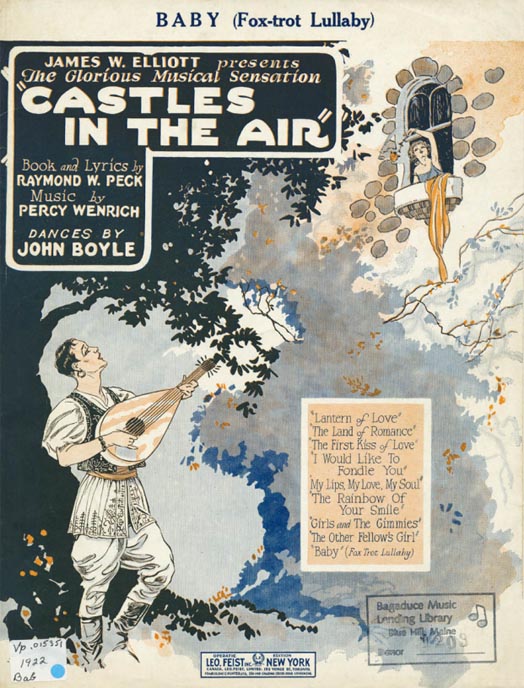
“Baby.” Words by Raymond W. Peck and music by Percy Wenrich (1922); featured in the Broadway musical Castles in the Air (1926). Recorded by Elsie Carlisle, accompanied by Carroll Gibbons and an unidentified violinist, on May 6, 1927. HMV B-2489 mx. Bb-10514-5.

Elsie Carlisle – “Baby” (1927)

Video by David Weavings (YouTube)

“Baby (Fox-trot Lullaby)” was written in 1922 but was most prominently featured four years later in Castles in the Air, a musical comedy of manners that saw moderate success in 1926 on Broadway (less so the next year in London, where the show had only 28 performances). The lyrics have a surprisingly simple thesis, suggesting that “old-fashioned lullabies” have given way to modern “fox-trot lullab[ies],” that babies are no longer rocked in cradles but rather in the arms of dancing parents. The song tries to make its point with an introduction that roughly resembles a lullaby but that gives way to a catchy, fast-paced refrain. It would appear that Peck and Wenrich did not originate the notion of a foxtrot lullaby, as there had been a 1921 song entitled “Nestle in My Loving Arms — A Lullaby Fox-Trot.”

Elsie Carlisle successfully realizes the conceit of “Baby” by applying sweet earnestness to the intro at a measured pace but then propelling her way into the refrain. At the end of the song she repeats the refrain in a slow, dreamy way, thus integrating the ideas of “foxtrot” and “lullaby” into one. In the middle of the recording there is a remarkably good, quick-paced violin solo. The identity of the violinist is unknown; a contemporary review in Melody Maker suggests that it could be Hugo Rignold, although the reviewer gets the pianist wrong, suggesting that he is Arthur Young (we can be fairly sure that it is Carroll Gibbons).1

“Baby” was recorded in America in 1926 by Roger Wolfe Kahn and His Orchestra (with vocals by Billy Jones) and by Virginia Rea and Franklyn Baur (accompanied by the Brunswick Hour Orchestra). In 1927 it was recorded in Britain by Jack Hylton and His Orchestra twice (directed the first time by Chappie d’Amato, as Jack Hylton had been injured in a car accident, in a session whose output was rejected by HMV, and  the second time by Jack Hylton himself). It was also recorded by the Debroy Somers Band (with vocalist Bobby Sanders), Hal Christie’s Dance Orchestra (directed by Bert Firman), Victor Sterling and His Band, the Raymond Dance Band (directed by Stan Greening), Alfredo’s Band (with singer Peter Bernard), Will Hurst’s Band (with vocals by Maurice Elwin), and the Savoy Orpheans (directed by Carroll Gibbons, in a selection from Castles in the Air).

"Baby" (1927) sheet music

Notes:

  1. The Melody Maker and British Metronome 2.20 (August 1, 1927): 784.

“Da-Dar-Da-Dar” (1933)

“Da-Dar-Da-Dar (Da-Dar-Da-Dee).” Words by Robert Hargreaves and Stanley J. Damerell, music by Tolchard Evans. Recorded on May 16, 1933 by Maurice Winnick and His Orchestra, with vocal refrain by Sam Browne (and with Elsie Carlisle in a speaking part). Panachord 25529 mx. GB5875-2.

Personnel: Maurice Winnick-vn dir. Charles Price-another-t / 2tb /Harry Hayes-Harry Turoff-as / Percy Winnick-cl-ts-o /Bert Whittam-p / Bill Herbert-g / Tiny Stock-sb / Stanley Marshall and possibly Max Bacon-d

Maurice Winnick and His Orchestra – “Da-Dar-Da-Dar” (1933)

“Da-Dar-Da-Dar” features Elsie Carlisle in only the tiniest speaking role (for eight seconds at 1:56, when she says, “Oh, d-d-d-darling!” and “Oh, d-d-d-dearest!”), but I include it in this collection for the sake of completeness and because it is a very good comic waltz with a vocal refrain by Elsie’s long-term singing partner Sam Browne. Elsie’s sole recording session with Maurice Winnick and His Orchestra yielded up a second comic waltz with Sam that was issued on Panachord 25527, “Seven Years with the Wrong Woman.” But whereas that song involves disgruntled married people, “Da-Dar-Da-Dar” involves the complications that young people face in arranging a tryst, what with the omnipresence of parents.  Indeed, its scenario includes a complication involving a younger brother whom Sam must pay off to get some time alone with his girlfriend (voiced by Elsie).1 The overall idea of the awkwardness of youthful rendezvous is comparable to that produced by the song “Sittin’ in the Dark,” of which Sam and Elsie had recorded three versions in March 1933. One might also be reminded of Elsie’s 1928 and 1930 versions of “Dada! Dada!” but the name of that song refers to the father who is listening in on his youthful daughter’s first encounter with the opposite sex — really a very different idea entirely, and much less wholesome, for the song title “Da-Dar-Da-Dar” is meant only to imitate the rhythm of a waltz, and Elsie’s father, we are grateful to hear from Sam, is not present.

“Da-Dar-Da-Dar” was also recorded in 1933 by Sydney Lipton’s New Grosvenor House Band (v. Sam Browne), the BBC Dance Orchestra (directed by Henry Hall, with vocal refrain by Les Allen, in a Ronnie Munro arrangement), and Syd Roy and His R.K. Olians (vocalists Bill Currie, Ivor Moreton, and chorus).

Notes:

  1. It is not clear who impersonates the brother. Perhaps drummer and comedian Max Bacon, who did funny voices in “Seven Years with the Wrong Woman” at the same recording session, or even Sam Browne himself?

“He’s the Last Word” (1927)

“He’s the Last Word.” Lyrics by Gus Kahn, music by Walter Donaldson (1926). Recorded by Elsie Carlisle with accompaniment by piano (Arthur Young) and violin at Studio B, Hayes, Middlesex, on May 6, 1927. HMV B. 2579 mx. Bb10689-2.

Elsie Carlisle – “He’s the Last Word” (1927)

“He’s the Last Word” follows an argument familiar to aficionados of popular music: its singer goes through a catalogue of her “sweet somebody’s” various deficits (insufficient talent at dancing, for example), only to conclude that when it comes to romance, “he’s the last word” — he is the very best. In her recording of the song, Elsie Carlisle is pure enthusiasm, and her frequent nonsensical ejaculations remind us of the fun, popular genre that she is working in. She has excellent accompanists in this recording on the piano and violin. Richard J. Johnson identifies the pianist as Carroll Gibbons and does not attempt to name the violinist.1

Contemporary record reviewer and industry insider Edgar Jackson was under a very different impression as to the identities of the accompanists, writing that

Elsie Carlisle has a thoroughly good vocal record of “He’s the Last Word” [54 at 78] (B2579). She sings tunefully, and is one of the most stylish and rhythmical of all our English comediennes. She has been excellently accompanied by Hugo Rignold (violin) and Arthur Young (piano)—Young does one of the best piano solo choruses I have heard. I wish I could say as much for his effort in “What’s the Use of Crying?” by the same artists on the reverse side.2

As it turns out, the evidence of the Kelly Online Database, which is based on HMV’s ledgers themselves, is that it was Arthur Young on the piano for “He’s the Last Word” (see my discography for further discussion). The suggestion that the violinist is Rignold is interesting. Hugo Rignold was already famous for his exceedingly “jazzy” playing, and certainly the violinist in “He’s the Last Word” gives the impression of being lively and playful, employing double and triple stops.3

Other noteworthy early versions of “He’s the Last Word” include ones by Art Kahn and His Orchestra, Jack Pettis and His Band (with vocalist Billy Hillpot), Ben Pollack and His Californians (with the Williams Sisters), Ben Bernie and His Roosevelt Orchestra (with vocals by Scrappy Lambert), the Broadway Bellhops (with singer Irving Kaufman), Jane Gray, Vaughn de Leath (recording as “Gertrude Dwyer”), The Troubadors, Annette Hanshaw (with Irving Brodsky on the piano), and Jack Linx and His Birmingham Society Serenaders. American Josephine Baker recorded “He’s the Last Word” in Paris accompanied by Jacob’s Jazz, and in August 1927 the Merl Twins (“Syncopating Songsters”) sang it in an early Hollywood Vitaphone short film.

In Britain in 1927, in addition to Elsie Carlisle’s, there were versions of “He’s the Last Word” by The Savoy Orpheans (directed by Carroll Gibbons), Syd Roy’s Lyricals, and Bert Firman’s Dance Orchestra (as Eugene Brockman’s Dance Orchestra).

Notes:

  1. Elsie Carlisle: A Discography. Aylesbury, UK, 1994, p. 6.
  2. The names are emphasized in the original. “The Gramophone Review.” The Melody Maker and British Metronome 2.24 (Dec. 1, 1927): 1273.
  3. See Bret Lowe’s comments below about the violin playing in this recording and his suggestion that the violinist might have been Eric Siday.

“Hold Up Your Hands (In the Name of the Law of Love)” (1933)

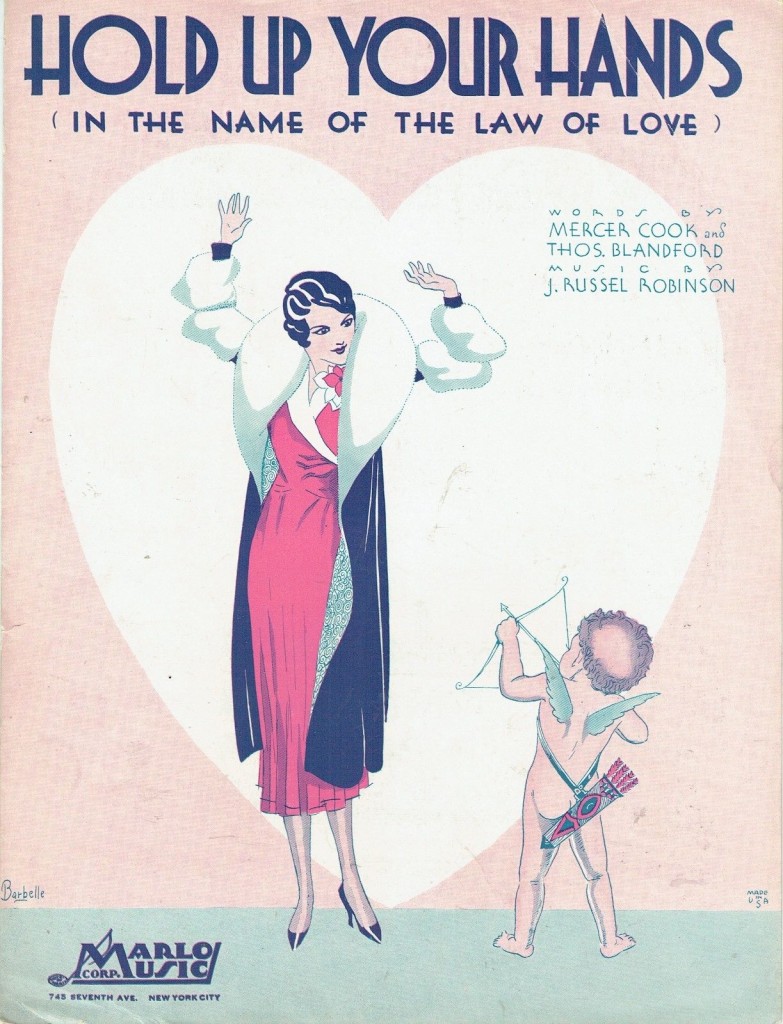
“Hold Up Your Hands (In the Name of the Law of Love).” Words by Mercer Cook and Thomas Blandford, music by J. Russel Robinson (1932). Recorded by Elsie Carlisle and Sam Browne on March 3, 1933. Decca F. 3504 mx. GB5634-2.

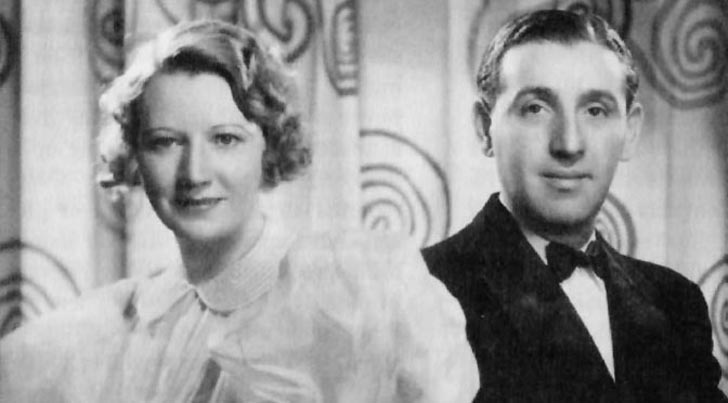
Elsie Carlisle & Sam Browne – “Hold Up Your Hands (In the Name of the Law of Love)” (1933)

“Hold Up Your Hands (In the Name of the Law of Love)” was written by American songwriters Mercer Cook, Thomas Blandford, and J. Russel Robinson in 1932; that year they also wrote the very successful “Is I in Love? I Is,” as well as “Stop the Sun, Stop the Moon,” which Elsie Carlisle recorded with Ray Starita and His Ambassadors. This duet involves a fanciful metaphor in which it is not clear whether Sam Browne is an agent of “the law” he keeps invoking (viz. the law of love or of Cupid) or a robber carrying out a holdup; he seems to entertain both notions. At any rate, Elsie seems to acquiesce to his demands that she “put up [her]  lips, and hold up [her] hands” with little resistance. 1933 was the second year of Sam and Elsie’s recording duets together, and “Hold Up Your Hands” is fairly representative of their duetting style (when they are not bickering, of course).

“Hold Up Your Hands” had been recorded in America in September 1932 by Victor Arden, Phil Ohman, and Their Orchestra (with vocals by Frank Luther). It was also recorded in 1933 in Britain by Maurice Winnick and His Band (with vocalist Louis Spiro).

"Hold Up Your Hands" original sheet music

"The Idol of the Radio." British dance band singer of the 1920s, 1930s, and 1940s.