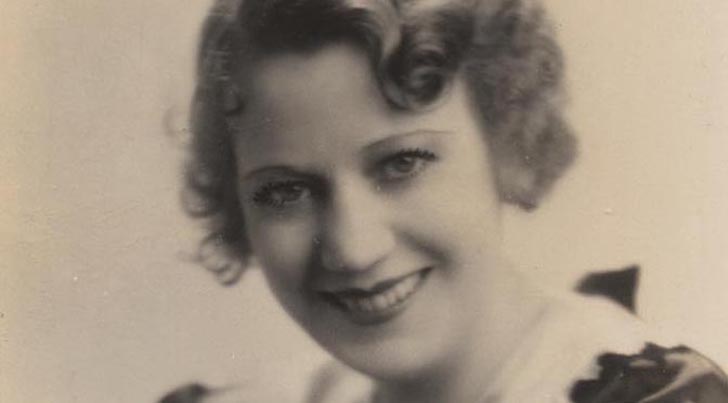
It seems almost a misnomer to speak of Elsie Carlisle “solo” recordings, for she always had accompanists. What I here call “solo” recordings are records on which her name is featured, rather than that of a band, and usually only when the accompanists cannot be safely identified.
“Gee-Oh! Gosh – Gosh-Oh! Gee – I Want Somebody to Cuddle Me” sheet music
I have not found any evidence of Elsie Carlisle’s having recorded “I Want Somebody to Cuddle Me”; she must have sung it on the radio. There is a very nice version of the song (going under an alternate title) by Nat Shilkret and His Orchestra, with Belle Mann on the vocals:
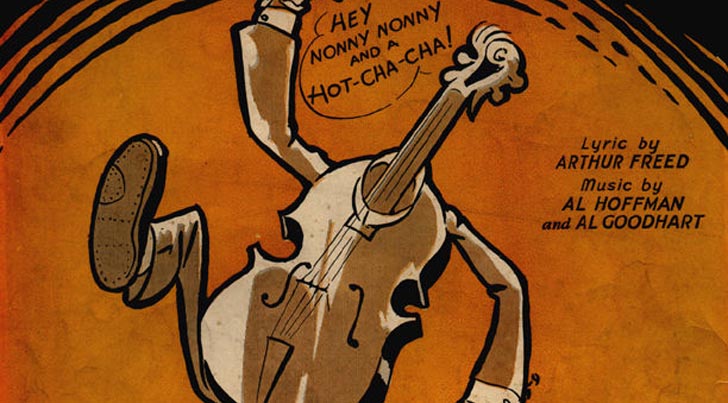
“Fit as a Fiddle.” Words by Arthur Freed, music by Al Hoffman and Al Goodhart (1932). Recorded by Elsie Carlisle with orchestral accompaniment on January 13, 1933. Decca F. 3411 mx. GB5467-2.
The lyrics of “Fit as a Fiddle (and Ready for Love),” penned by Arthur Freed, are an ecstatic expression of a happy anticipation of marriage somewhat in the mold of the classic 1925 Henderson/Lewis/Young song “I’m Sitting on Top of the World” (made popular by Al Jolson). “Fit as a Fiddle,” however, is marked by its peculiarly infectious rhythm and its reliance on nonsense words. “Hi, diddle, diddle” and “Hey nonny nonny and a hot-cha-cha!” stand out, although Elsie Carlisle apparently could not get the latter colloquialism quite right, in spite of its being very clearly written on the cover of the sheet music (although “Hainy nainy nonny and a HAH-chah!” is a very cute variant, I will admit). Baby words aside, Elsie’s “Fit as a Fiddle” is nothing if not ebullient, and she is complemented nicely by her band.
“Smoke Gets in Your Eyes.” Composed by Jerome Kern, with lyrics by Otto Harbach, for their musical Roberta (1933). Recorded by Elsie Carlisle in London on October 31, 1934. Decca F-5289 mx. TB-1696-1.
Elsie Carlisle, so often the torch singer, beautifully conveys the pathos of the lyrics of the show tune “Smoke Gets in Your Eyes.” As a veteran of light musical stage drama, Elsie had a voice suited to the song, with its memorable full-octave melodic ascension at the beginning (more reminiscent of European operetta than of popular song). It was perhaps in consideration of this perfect match between her vocal capabilities and the already popular song that Decca had Elsie record “Smoke Gets in Your Eyes” twice in two days, first as a “solo” record, and again the next day with Ambrose and His Orchestra, in an arrangement that is perhaps somewhat less of a tear-jerker and more suited to dancing:
“Smoke Gets in Your Eyes.” Recorded by Ambrose and His Orchestra with vocals by Elsie Carlisle on November 1, 1934. Decca F-5293.
It seems hard to believe, but the perennial favorite “Smoke Gets in Your Eyes” was twice discarded from shows before it actually got used in the Broadway musical Roberta. Jerome Kern originally composed it as a tap dance number to be performed during a scene change in his 1927 hit Showboat, but for one reason or another, it was cut. In 1932 Kern retooled it as a march to be used as the theme song for an NBC radio series which never aired. It was in the light, romantic 1933 drama Roberta that “Smoke Gets in Your Eyes” was finally introduced to the public, this time retooled as a sentimental ballad, either at the suggestion of the producer or of lyricist Otto Harbach. Harbach’s lyrics borrow their tag line “When you’re heart’s on fire, smoke gets in your eyes” from a Russian proverb. The original Broadway production of Roberta starred, amongst others, Bob Hope, Fred MacMurray, Fay Templeton, Ray Middleton, and Sydney Greenstreet, but it was Ukrainian actress Tamara Drasin, playing a Russian princess, who first sang “Smoke Gets in Your Eyes.”
“One Little Kiss.” Written by Bert Kalmar and Harry Ruby for the RKO Radio Film Kentucky Kernels (1934). Recorded by Elsie Carlisle with orchestral accompaniment in London on October 31, 1934. Decca F. 5289 mx. TB1698-2.
Elsie Carlisle’s version of “One Little Kiss” lacks the silliness of its celluloid antecedent, the last vestige of which, perhaps, is the repetition of the phrase “One teeny little, weeny little kiss.” Instead, it is a comparatively serious interpretation of the lyrics which highlights the inherent merits of the catchy melody. As with most popular songs from musical comedies, “One Little Kiss” saw a number of treatments in 1934. In America, there were versions by Cliff Edwards and the Eton Boys, Harry Reser and His Orchestra (with vocals by Tom Stacks), and Ted Weems and His Orchestra (with Gene Glennan as vocalist). In Britain, in addition to Elsie Carlisle’s version, there were recordings of “One Little Kiss” made by Brian Lawrance and His Quaglino’s Quartet in November 1934 and by Kitty Masters and Val Rosing in February 1935.
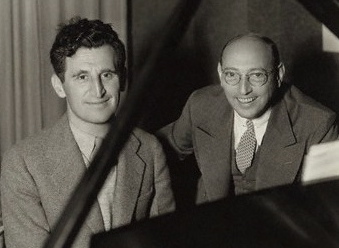
Harry Ruby and Bert Kalmar at the piano
Notes:
See also Erin Elisavet Kozák’s article on “The Marx Brothers’ ‘Everyone Says “I Love You’ in Film and Popular Music.” The Discographer Magazine 3.5 (2016), especially p. 4. ↩
“You’re My Everything.” Words by Mort Dixon and Joe Young, music by Harry Warren (1931). Recorded by Elsie Carlisle with an instrumental trio in Manchester on September 23, 1932. Decca F-3193 mx. KB-135-2.
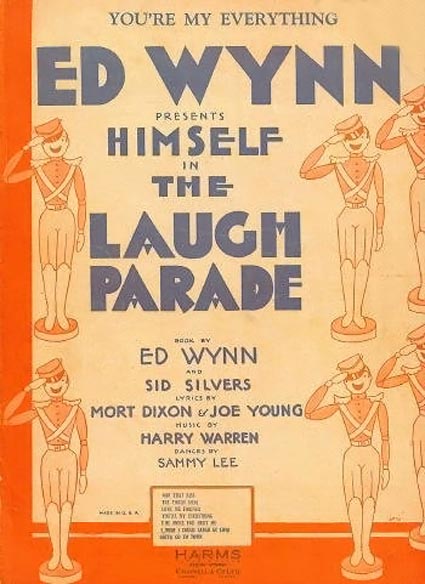
An effusive expression of affection, “You’re My Everything” has its origins as the hit song of of a 1931-1932 two-act Broadway revue entitled The Laugh Parade, produced by and starring Ed Wynn, a comedian who twenty years later would provide the voice for the Mad Hatter in Disney’s Alice in Wonderland. The music for the play was composed by Harry Warren, with lyrics provided by Mort Dixon and Joe Young. It was French actress Jeanne Aubert and American actor Lawrence Gray who introduced the signature tune.
Elsie Carlisle, in her 1932 recording of the song, brings sincerity to its hyperbolic lyrics. Hers is a surprisingly straightforward and touching interpretation of the composition; we find absent the coyness of her torch songs, the levity of her racier music. The band provides a suitably atmospheric accompaniment to her professions of love and awe for the lucky “you” of the song.
Britain produced recordings of “You’re My Everything” later in 1932, with versions by Roy Fox and His Band (with Al Bowlly as vocalist), Syd Lipton (as Sidney Raymond and His Commanders), the Blue Mountaineers (with vocals by Sam Browne), Ray Noble and His New Mayfair Orchestra (as part of a “Paul Jones” medley), Bertini and His Band (with vocals by Tom Barratt), and by Anona Winn and Jack Plant (as “Bob Mackworth”).
“You’re My Everything” sheet music (from “The Laugh Parade,” 1931″)
"The Idol of the Radio." British dance band singer of the 1920s, 1930s, and 1940s.