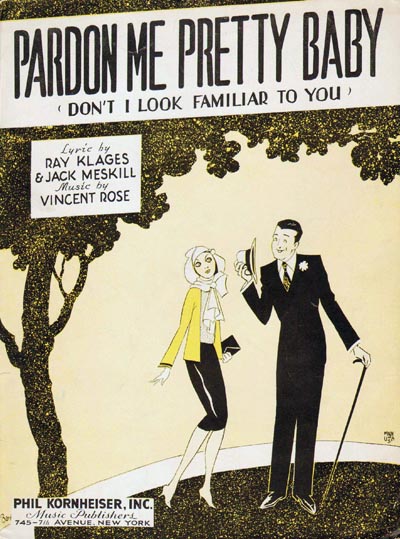
“Pardon Me, Pretty Baby.” Words by Ray Klages and Jack Meskill, music by Vincent Rose. Recorded by Elsie Carlisle under the musical direction of Jay Wilbur in August 1931. Imperial 2532.
Elsie Carlisle recorded this version of the popular “Pardon Me, Pretty Baby” for the Imperial label in August 1931 under the musical direction of Jay Wilbur. It is a light song with a chatty patter representing a persistent but inept attempt at a pickup. The tune is catchy, but a trifle repetitive. Elsie makes the song exciting by alternating between playful singing and exaggerated conversational interjections, a technique which reminds one that she was a veteran of musical theater.
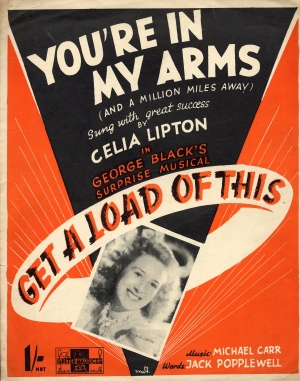
“You’re in My Arms (and a Million Miles Away)” is a beguine from the 1941 musical “Get a Load of This,” written by playwright and lyricist Jack Popplewell and composer Michael Carr. The song was introduced by 17-year-old Celia Lipton (daughter of bandleader Sidney Lipton) and saw treatments in 1941 by Jay Wilbur and His Band (with vocalist Pat O’Regan), Ambrose and His Orchestra (with Anne Shelton), Joe Loss and His Band (Chick Henderson, vocalist), Harry Roy and His Band (with Marjorie Kingsley – though Regal Zonophone rejected the take), and Carroll Gibbons and the Savoy Orpheans (with Anne Lenner). Vera Lynn was to record a version the next year.
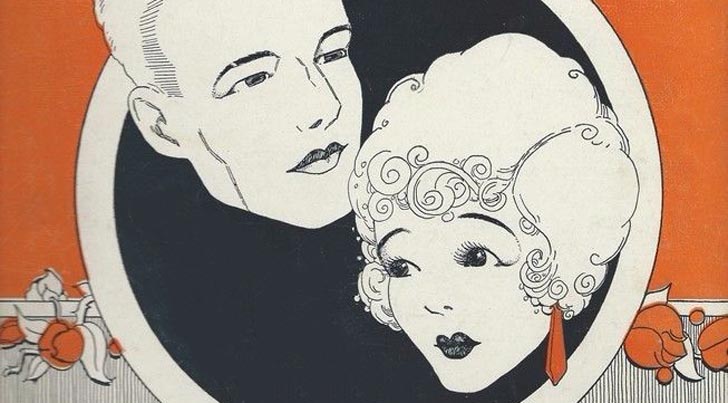
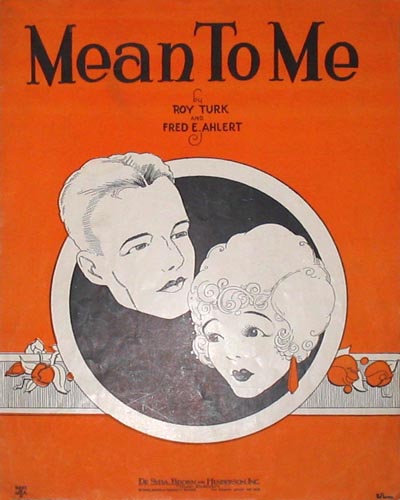
“Mean to Me.” Words by Roy Turk, music by Fred E. Ahlert (1929). Recorded by Elsie Carlisle, accompanied by Jay Wilbur and His Orchestra (uncredited) c. late June 1929. Dominion A-168.
Personnel: Laurie Payne-Jimmy Gordon-cl-as-bar / George Clarkson-cl-as-ts / Norman Cole-vn / vn / vn / Billy Thorburn-p /Dave Thomas or Bert Thomas-bj-g /Harry Evans-sb / Jack Kosky-d
The torch song “Mean to Me” is perhaps the most familiar of the many pieces resulting from the collaboration of composer Fred E. Ahlert and lyricist Roy Turk. Whereas many dance bands’ versions of this comparatively morose song are paradoxically upbeat, Elsie Carlisle’s version is marked by considerable pathos and fidelity to the sentiments of the lyrics. As is often the case with Elsie’s renditions of popular music, there is a dramatic element present in her “Mean to Me” that sets it aside from other recordings.
“Mean to Me” notably appears in the 1932 Betty Boop cartoon Minnie the Moocher (listen for it at 2:53, although be sure not to skip Cab Calloway’s remarkable dancing at the beginning of the short).
Out of the 332 or more recordings that Elsie Carlisle is known to have made between 1926 and 1942, a great deal of attention is paid to her two versions of “My Man o’ War” on Dominion C-307 and Filmophone 143, and rightly so: it is an especially funny, naughty song, brilliantly performed by the “celebrated comedienne.” She recorded other ribald songs that were unsuitable for airplay (“Pu-leeze! Mister Hemingway!” for example), but the Dominion version of “My Man o’ War” is unique in being associated with a supposed legal scandal. The story can be found in its classic form in the account of Brian Rust, who refers to the song as “an obvious piece of recorded pornography”:
It is said that the censors, who were very active in the Lord Chamberlain’s office in those days, vetoed the issue of further copies when the dreadful deed [i.e. the issuing of Dominion C-307] was discovered. The subsequent fine reportedly put Dominion out of business.1
It is worth noting that Rust does not particularly insist on the veracity of this industry rumor, and indeed he goes on to point out that Dominion’s financial position at the time was so poor that it would have collapsed anyway. If the company had been fined, one would expect that there would be a record of the penalty in some government office, but no such evidence has ever surfaced, to my knowledge.2
True or false, this is a story that people like to repeat. They look at their coveted copies of Dominion C-307 with their simple black-and-white or more elaborate red labels (depending on the date of issue) and see them as precious contraband. They take delight in listening to the risqué disc and feel a sudden, intimate connection to a supposedly historical scandal. The suggestion that “My Man o’ War” is not just naughty but criminally transgressive evokes the common motif of the subversive artist taking on a repressive society, and one takes vicarious pleasure in thoroughly enjoying something once forbidden (albeit morally pedestrian in terms of today’s popular music).
I would like to focus on the genuine artistic merits of Elsie Carlisle’s Dominion recording of “My Man o’ War” (and of the Filmophone version that she did over a year later), simply because it is an exceedingly clever composition artfully interpreted by a consummate mistress of comic music. Which is not to say that a pretty girl singing a smutty song is not of perennial fascination.
“My Man o’ War” was composed by Spencer Williams, with words by Andy Razaf, and was published in New York at the beginning of 1930. Razaf, a prolific lyricist (and interestingly also a member of the deposed royal family of Imerina, now Madagascar), helped to write other songs that Elsie Carlisle sang, including “Ain’t Misbehavin’,” “The Porter’s Love Song,” and “My Handy Man,” the latter being almost as sexually suggestive as “My Man o’ War” (with which it is paired on Filmophone 143).
The lyrics of “My Man o’ War” involve an extended metaphor in which a woman compares her lover to a soldier and her bedroom to a battlefield. The rhetoric ratchets up quickly from simple comparison (“My flat looks more like an armory”) to sexually suggestive expression (“Takes out his bugle when he sees me”) to raunchy double-entendre (“At night he’s drilling me constantly”).
By the second refrain the assault of word play has become relentless:
He storms my trench and he’s not afraid,
His bayonet makes me cry for aid,
Oh, how he handles his hand grenade…
If I’m retreatin’ he goes around
And gets me in the rear.
He keeps repeatin’ a flank attack
‘Til victory is near…
“My Man o’ War.” Recorded in New York City on January 27, 1930 by Lizzie Miles with pianist Harry Brooks. Victor 23281.
The first recording of “My Man o’ War” features blues singer Lizzie Miles accompanied by Harry Brooks on the piano. Her recording on Victor 23281 was recorded in New York on January 27, 1930, only a few weeks before Elsie Carlisle did her Dominion version. The tempo is slow, almost mournful, but Miles’s voice is powerful, and the attitude that she projects is brazen. It is hard to tell if she is complaining about or rather boasting about her lover’s indefatigable prowess in bed, and the ambiguity contributes to the comic effect.
“My Man o’ War.” Recorded in London c. March 1930 by Elsie Carlisle under the musical direction of Jay Wilbur. Dominion C-307 mx. 1714-R2.
Personnel: Jay Wilbur dir. ?Laurie Payne-?Jimmy Gordon-cl / Eric Siday-vn / Joe Brannelly-g / ?Bert Read-p
Elsie Carlisle made her first recording of the song in March 1930 with Dominion Records, when Jay Wilbur was still musical director there. The differences between her version and Lizzie Miles’s are striking. The latter’s hint of bragging is replaced by Elsie’s girlish persona of mock-innocence and mock-earnestness. The tempo is faster (with more complex orchestration to make up for the lost time), and Elsie’s delivery is more varied. She feigns shock, surprise, and exhaustion; her voice quavers wearily. In short, Elsie’s performance is dramatic in character, and what less would we expect from a veteran of the musical theater who had only a year before introduced the world to Cole Porter’s “What Is This Thing Called Love?” (supposedly at the composer’s own request).3 In “My Man o’ War,” she does not merely sing naughty lyrics beautifully; she projects a persona that suggests innocence but delivers filth, and the incongruity makes the song uproariously funny.
Whether or not there really was a problem with the authorities over this record, Dominion’s finances were in ruins, and in July Jay Wilbur quit his job as musical director to take up a similar position at Crystalate (where Elsie would start recording again the next month). Elsie seems to have gone on a five-month recording hiatus after “My Man o’ War,” but it is clear that she kept busy, even appearing in an experimental Baird Television broadcast in June.
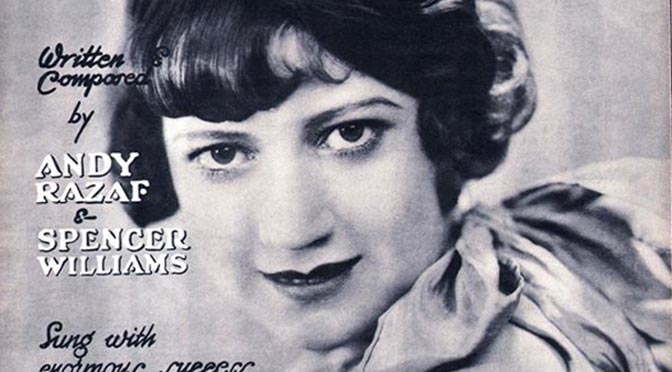
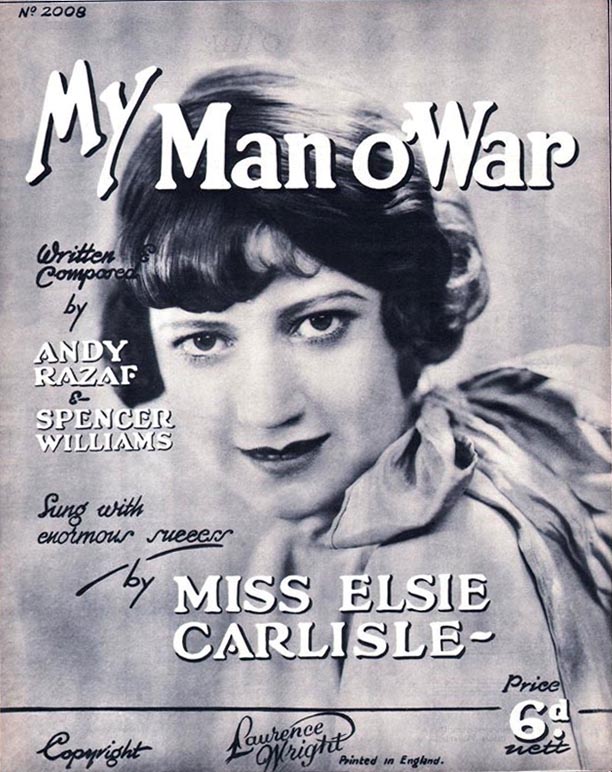
The Dominion recording turns up again over a year later, sometime around November 1931, this time reissued on the physically less friable, decidedly floppier Filmophone 143. Whereas the earlier Dominion record had had Elsie’s rendition of the comparatively respectable “Body and Soul” on its other side, Filmophone 143 is pure impropriety; its reverse side has her singing Razaf’s “My Handy Man,” another example of sexual innuendo (in this one, the singer declares that her man “greases [her] griddle, churns [her] butter, strokes [her] fiddle” — you get the idea). Many, but not all, copies of the Filmophone record have the pseudonym “Amy Brunton” on them, but it is not clear that Elsie was really distancing herself from the song. The Lawrence Wright sheet music of the time features nothing but a striking photograph of her on the cover, and she ultimately recorded a second version of the song that appears on many pressings of Filmophone 143.4
“My Man o’ War.” Recorded in London c. November 1931 by Elsie Carlisle under the musical direction of Jay Wilbur. Filmophone 143 mx. F-1890.
Personnel: Max Goldberg-t / ?Billy Amstell-cl / Eric Siday-vn / ?Bert Read-p / Joe Brannelly-g / Dick Escott-sb
In the second version of “My Man o’ War,” Elsie sounds less naïve, more confident, more mature — in other words, somewhat more in on the joke — and yet the humor is not diminished. It is in fact somewhat enhanced by the addition of Max Goldberg on the trumpet, who introduces comical variations on the idea of a military bugle. The song is punctuated at the end by a collective sigh suggestive of sexual passion subsiding.
Elsie Carlisle was particularly good at singing ribald songs because she combined a beautiful voice with an ability to project a comical persona and a knack for letting her voice quaver or falter dramatically at just the right moment. She could use these talents on occasion to make a song edgier. Whereas the Andrews Sisters’ 1939 version of “Oh Johnny, Oh Johnny, Oh!” suggests a mere teenage crush, Elsie’s 1940 version, with the same lyrics, has so much vocal frustration, urgency, and excitement in it that it seems considerably less innocent.
This ability to add or enhance sexual innuendo with dramatic vocal effects was, however, but one of Elsie Carlisle’s talents. We have seen that “My Man o’ War” on Dominion C-307 is the flip side of Elsie’s moving rendition of “Body and Soul,” and her very next record (Imperial 2318) has her sublimely touching “Exactly Like You” on it. Her tone of vulnerable, bittersweet optimism in her 1932 version of “The Clouds Will Soon Roll By” with Ambrose and His Orchestra (HMV B 6210) provides a further example of the range of passions that she could evoke – but one has to admit that she was rather good at singing a dirty song.
“My Man o’ War” sheet music featuring Elsie Carlisle
Notes:
Brian Rust, The American Record Label Book, New York: The Da Capo Press, 1984, 101. ↩
Richard J. Johnson, “Elsie Carlisle (with a different style). Part Two.” Memory Lane 175 (2012): 40. ↩
It is worth noting that between Elsie’s two versions of “My Man o’ War” there was another recording made in America, this time by Lena Wilson. I did not address it in earlier versions of this article, but it can now be heard online. I find Wilson’s version surprisingly naïve in its style; she sings almost as if she does not know what the song is about. ↩
“A Nightingale Sang in Berkeley Square.” Words by Eric Maschwitz, music by Manning Sherwin (1940). Recorded by Elsie Carlisle under the musical direction of Jay Wilbur on April 11, 1940. Rex 9816.
“A Nightingale Sang in Berkeley Square” is a simple, sentimental love song that recounts the circumstances of the first meeting of two lovers in Berkeley Square, Mayfair, London, which happens to be only five blocks from where Elsie Carlisle lived for decades. On April 11, 1940 she recorded this atmospheric composition for the Rex label to the accompaniment of an electric organ. Hers remains one of the memorable early versions of the piece, which continues to see treatments by popular artists to this day.