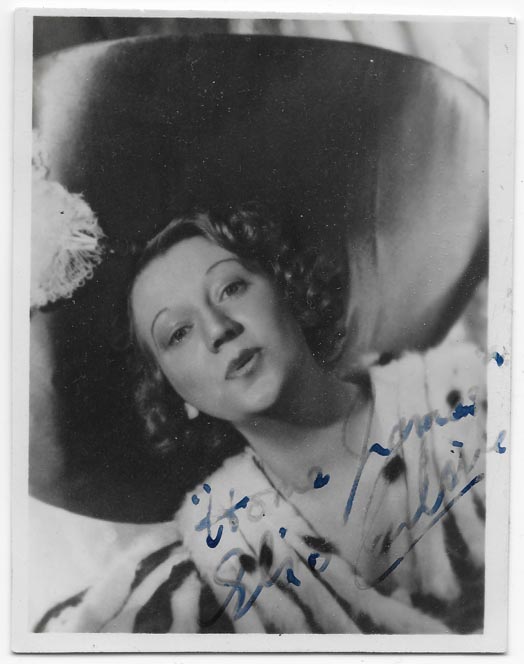
“Just One More.” Words by Stanley Lupino, music by Noel Gay. Composed for the film Sleepless Nights (1932). Recorded by Stanley Lupino and Elsie Carlisle in London on December 1, 1932. Decca F. 3319 mx. GB5275-3.
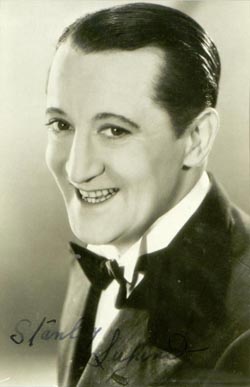
“Just One More” is the flip side of “I Don’t Want to Go to Bed” and is another Stanley Lupino/Noel Gay collaboration for the musical comedy Sleepless Nights. This Decca recording has Stanley Lupino singing a duet with Elsie Carlisle (who did not appear in the movie) and involves some remarkable spoken banter:
– “Hello, Elsie! How did you get on this side of the record?”
– “I came through the hole in the label!”
– “Wonderful! Lovely! Gorgeous!”
– “To what are you referring?”
– “You.”
– “You don’t mean that.”
– “I do!”
– “Oh, you haven’t seen me in the morning!”
– “Oh, may I???”
– “Oh, Mr. Lupino!”
– “I love that curl on the back of your neck.”
– “Do you?”
– “Yes. May I kiss it?”
– “Oh, no.”
– “Ah, yes!
– “Oh, no!”
– “Ah, yes!”
– “Oh, no…”
– “I shall!”
– “You have!“
There is a sound at end of the recording that is especially precious. Listen for it, and Happy New Year!
“I Don’t Want to Go to Bed.” Words by Stanley Lupino, music by Noel Gay (1932). Recorded by Stanley Lupino and Elsie Carlisle on December 1, 1932. Decca F. 3319 mx. GB5274-3.
An anthem praising the nightlife and its frolicking “nightbird company,” “I Don’t Want to Go to Bed” is part of the score of the 1932 movie Sleepless Nights. Its lyrics were penned by comic actor Stanley Lupino (father of Ida Lupino), who was also the star of the film. Elsie Carlisle joins him in a vocal duet in this Decca recording of the song — she did not act in the movie — and while she only sings for fifteen seconds, hers is a memorable contribution. Particularly funny is her perky comment in the debate as to whether the merrymakers will go home or not:
“I appeal to you, Miss Carlisle!”
“Not to me! Tonight, I’m one of the boys!”
“Home, James, and Don’t Spare the Horses.” Words and music by Fred Hillebrand (1934). Recorded by Ambrose and His Orchestra with Elsie Carlisle as vocalist on December 11, 1934. Decca F. 5371 mx. GB6806-2 (also F. 6926; Brunswick A. 81929).
Personnel: Bert Ambrose dir. Max Goldberg-t-mel / Harry Owen-t / t / Ted Heath-Tony Thorpe-tb / Danny Polo-Sid Phillips-Billy Amstell-reeds / Joe Jeannette-as / Ernie Lewis-Reg Pursglove- others?-vn / Bert Barnes-p / Joe Brannelly-g / Dick Ball-sb / Max Bacon-d
“Home, James, and Don’t Spare the Horses” is an expression of pressing urgency that goes back to the mid-nineteenth century, but the statistics on its recorded use skyrocket around the time that Elsie Carlisle recorded the song with Ambrose and His Orchestra. Like the other comedy waltz “No! No! A Thousand Times No!” that Elsie had recorded the previous month (in November 1934), this song is set in the nineteenth century and is rather cartoonish. In it Elsie tells a funny story about a classy lady rebuffing a lover who has paid too much attention to other women. “Home, James, and Don’t Spare the Horses!” she declares at various points in the story as she dashes off in anger. Elsie’s recitative is delivered in an exaggerated upper-crust accent with many a trilled “r” as she describes the heroine and her footman kicking the penurious former lover’s posterior. Elsie would record other such comic songs about high society in the following year, such as Cole Porter’s “Thank You So Much Mrs. Lowsborough-Goodby” and “Algernon Whifflesnoop John.”
The popularity of “Home, James” is attested to by its being mentioned as particularly successful on the backs of 1934 and 1935 cigarette cards. Elsie would issue a record of medleys in late 1937 that featured “Home, James” along with its comedy waltz partner “No, No, a Thousand Times No!” (HMV BD 476).
“I’m Gonna Wash My Hands of You.” Words by Eddie Pola, with music by Franz Vienna (a.k.a. Franz Steininger). Recorded by Ambrose and His Orchestra, with vocal chorus by Sam Browne and Elsie Carlisle on November 20, 1934. Decca F. 5318 mx. GB6777-1.
Personnel: Bert Ambrose dir. Max Goldberg-t-mel / Harry Owen-t / t / Ted Heath-Tony Thorpe-tb / Danny Polo-reeds / Sid Phillips-reeds / Joe Jeannette-as / Billy Amstell-reeds / Bert Barnes-p / Joe Brannelly-g / Dick Ball-sb / Max Bacon-d
This foxtrot of vituperation is particularly suited to Sam Browne and Elsie Carlisle, who had convincingly played the part of the bickering couple in “Seven Years With the Wrong Woman” in 1932. “I’m Gonna Wash My Hands of You” has lyrics by Eddie Pola, who co-wrote other songs that Elsie recorded, such as “My Canary Has Circles Under His Eyes,”“I Wish I Knew a Bigger Word Than Love,” and “Till the Lights of London Shine Again.” As the flip side to “No! No! A Thousand Times No!” “I’m Gonna Wash My Hands of You” is a suitably dramatic complement. It involves somewhat more genuine singing and somewhat less booming, mock-thespian declamation; moreover, it includes more opportunities for the instrumental excellence of Ambrose’s band to be heard. For this author, however, the high point of the song is when Elsie sings “You cheat, you! I wish you were a gong so I could beat you!” and Sam replies “You wanna beat me, huh?” This song’s excellence lies in its fundamental goofiness.
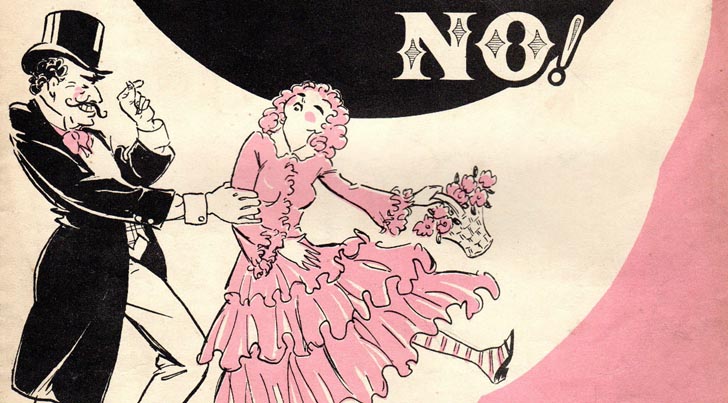
“No! No! A Thousand Times No!” Words and music by Al Sherman, Al Lewis, and Abner Silver (1934). Recorded by Ambrose and His Orchestra on November 20, 1934, with vocal chorus by Sam Browne and Elsie Carlisle. Decca F-5318 mx. GB-6772-2.
Personnel: Bert Ambrose dir. Max Goldberg-t-mel / Harry Owen-t / t / Ted Heath-Tony Thorpe-tb / Danny Polo-reeds / Sid Phillips-reeds / Joe Jeannette-as / Billy Amstell-reeds / Ernie Lewis-Reg Pursglove-others?-vn / Bert Barnes-p / Joe Brannelly-g / Dick Ball-sb / Max Bacon-d
In “No! No! A Thousand Times No!” Sam Browne and Elsie Carlisle evoke the spirit of Victorian stage melodrama with its stock heroes: the damsel in distress, the villain, the hero. By 1934 melodrama risked seeming hackneyed and passé, and this novelty waltz accordingly treats the genre as a source of bathetic farce. The orchestra serves as a competent background to a long series of dramatic lines almost belted out, or even shouted out, rather than sung, with Sam and Elsie employing strangely exaggerated pronunciations to emphasize their ridiculously stylized sentiments.
“No! No! A Thousand Times No!” seems to have made quite an impression on the public. The 1934 Wills’s and 1935 Ardath Elsie Carlisle cigarette card reverse sides suggest it as one of Elsie’s two most popular songs, which is interesting, as she sang quite a few memorable songs in those years, including other very good ones with Sam Browne. That this comical waltz had staying power is attested to by its appearing in Elsie’s top-two list in her 1977 London Times obituary.
“No! No! A Thousand Times No!” was recorded in America by Harry McDaniel and His Orchestra in November 1934. It seems to have been more popular with British artists, however, with versions done in late 1934 and early 1935 by the New Mayfair Dance Orchestra (under the direction of Percival Mackey, with vocals by Bobbie Combier), Jan Ralfini and His Band, Phyllis Robins and Pat O’Malley, and Leslie Sarony and “Girl Friend” (identity unknown). In May 1935 Max Fleischer released a Betty Boop short film featuring the themes and music of “No! No! A Thousand Times No!” under the same title.
The National Portrait Gallery has three photographs of Sam Browne with Elsie Carlisle at the 1935 Radio Olympia Exhibition, in two of which they appear to be in costume for this very number (NPG x224380 and NPG x224381).
I discuss this song in greater detail in my article “Elsie Carlisle’s Top Hits, Then and Now” in the December 2014 issue of the Discographer Magazine.
"The Idol of the Radio." British dance band singer of the 1920s, 1930s, and 1940s.