Bands & Directors

“Thank You So Much, Missus Lowsborough-Goodby” (1935)

“Thank You So Much, Missus Lowsborough-Goodby.” Words and music by Cole Porter (1934). Recorded by Ambrose and His Orchestra with Elsie Carlisle on February 6, 1935. Decca F-5448.

Personnel: Bert Ambrose dir. / Max Goldberg-t-mel / Harry Owen-t / Ted Heath-Tony Thorpe-Lew Davis-tb / Danny Polo-cl-as-bar / Sid Phillips-cl-as-bar / Joe Jeanette-as / Billy Amstell-cl-ts / Ernie Lewis-Reg Pursglove-vn / Bert Barnes-p / Joe Brannelly-g / Dick Ball-sb / Max Bacon-d

Ambrose and His Orchestra – Thank You So Much, Mrs. Lowsborough-Goodby – 1935

Video by Martin Schuurman (YouTube)

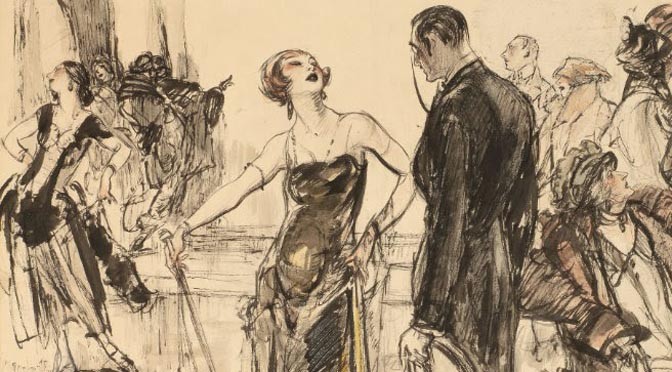
“Thank You So Much,  Missus Lowsborough-Goodby” is a 1934 Cole Porter composition whose lyrics convey sarcasm dished up by a dissatisfied high-society house guest.The speaker fantasizes about the sort of thank-you letter that the host deserves to receive after a weekend of apparently sub-par entertaining; there follows an epistolary monologue “thanking” her by way of backhanded compliments for what are presumably overstated deficits in her hospitality (e.g. “For the ptomaine I got from your famous tinned salmon, / For the fortune I lost when you taught me backgammon…”). Cole Porter recorded the song himself on October 26, 1934, accompanying himself on the piano, and published the music in December. It is likely that “Missus Lowsborough-Goodby” was originally written for the 1934 hit musical Anything Goes, as a typescript of it was found amongst other material discarded from that project.1

Ambrose’s February 1935 version of the song benefits from an arrangement whose orchestral component highlights the musical merits of the piece independent from the funny acerbity of its lyrics. Elsie Carlisle’s contribution is the impersonation of a particularly snarky lady of the smart set. In the Decca recording, Elsie has just over two minutes in which to introduce and develop her character, and the result is a perfect picture of ridiculous ill will. A comparable mocking of the presumably petty concerns and silly pretensions of high society can be heard in her versions of “Home James, and Don’t Spare the Horses” and “Algernon Whifflesnoop John,” both recorded with Ambrose at around the same time.

“Thank You So Much, Mrs. Lowsborough-Goodby” had been recorded in late January by Carroll Gibbons and the Savoy Hotel Orpheans, with Brian Lawrance as their vocalist. There was also a version by Lew Stone and His Band, with Lew Stone doing the singing himself, in his own arrangement of the songJohn Tilley recorded it as a “Humorous Monologue” spoken, not sung, over slight piano accompaniment; Fred Astaire would give it a similar treatment a quarter of a century later on television with considerable comic success.

Notes:

  1. The Complete Lyrics of Cole Porter, ed. Robert Kimball, p. 274.

“Whisper Sweet” (1935)

“Whisper Sweet.” Words and music by James P. Johnson, Jo Trent, and Horatio Nicholls (a.k.a. Lawrence Wright). Recorded by Elsie Carlisle, probably with the Embassy Rhythm Eight, on February 1, 1935. Decca F. 5436.

“Whisper Sweet” – Elsie Carlisle

Transfer by Clive Hooley (YouTube)

The names James P. Johnson and Horatio Nicholls (a pseudonym of composer, music publisher, and impresario Lawrence Wright) are well known, that of Jo Trent considerably less so, and the origin of their song “Whisper Sweet” is comparatively obscure. Legendary stride pianist James P. Johnson composed many classic jazz tunes, including the original “Charleston.” Jo Trent was a lyricist who worked with many of the great composers, including Johnson; in 1931, for example, the two of them collaborated on the songs “Fooling Around with Love,” “Hanging Around Yo’ Door,” and “Hot Harlem,” but Trent appears to have avoided the spotlight; it has even been uncertain whether he was a man or a woman (he was the former, it seems:  Joseph H. Trent).  Lawrence Wright used his own name when publishing and sometimes even writing music, but he used the pseudonym Horatio Nicholls solely on compositions. There is sheet music for “Whisper Sweet” featuring a photograph of Eve Becke that credits Jo Trent and James P. Johnson as having written the words and music, with no mention of “Nicholls” at all (although the music was published by Lawrence Wright and bears that trademark). It might be asked if Lawrence Wright made some contribution to the arrangement that Elsie Carlisle sang. For what it is worth, I can find no fundamental difference between the arrangement that Elsie used and the one used by Bob Howard the next day in New York.

As with the flip side “Dancing with My Shadow,” it is assumed that Elsie’s accompanists for “Whisper Sweet” were the Embassy Rhythm Eight, as the matrices of Decca F. 5436 and two recordings that the Rhythm Eight did on February 1 and 5 form an interlacing sequence. “Whisper Sweet” is considerably livelier than “Dancing with My Shadow,” and its theme more upbeat. Elsie’s simple, sweet interpretation is suited to the dreamy lyrics, which focus primarily on the subtle outward signs of the beginning of romantic attraction.

The day after Elsie Carlisle recorded “Whisper Sweet,” Bob Howard and His Orchestra did a version in New York. Later in January there were London recordings by Carroll Gibbons and the Savoy Hotel Orpheans (with singer Brian Lawrance) and by Pat Hyde. In April Valaida Snow sang it for Parlophone, again in London. Sometime that year Eve Becke must have both broadcasted and recorded it, something which is asserted by the cover of the Lawrence Wright sheet music, but I have not identified an actual disc.

“Dancing with My Shadow” (1935)

“Dancing with My Shadow.” Composed by Harry Woods for the British musical comedy Thank You So Much. Recorded by Elsie Carlisle, probably with the Embassy Rhythm Eight, on February 5, 1935. Decca F-5436.

Personnel: Max Goldberg-t / Lew Davis-tb / Danny Polo-cl / Billy Amstell-ts / Bert Barnes-p / Joe Brannely-g / Max Bacon-d

Elsie Carlisle – “Dancing with My Shadow” (1935)

Transfer by Clive Hooley (YouTube)

A song about the loneliness of lovers drawn apart, “Dancing with My Shadow” encapsulates its theme of longing in its refrain:

Dancing with my shadow,
Feeling kind of blue,
Dancing with my shadow
And making believe it’s you.

This slow foxtrot was composed by Harry Woods for the British musical comedy Thank You So Much. Woods wrote other notable songs that Elsie Carlisle recorded; one thinks particularly of “The Clouds Will Soon Roll By.” The song also notably appeared in Alfred Hitchcock’s 1935 film adaptation of The 39 Steps. Elsie Carlisle, veteran torch singer, interprets the lyrics masterfully on this record, which she appears to have recorded with the Embassy Rhythm Eight, who went uncredited; this identification is strengthened by an examination of the sequence of matrices on the records they recorded with Decca on the same day.

“Dancing with My Shadow” had been recorded in the United States the previous year by Richard Himber and His Ritz-Carlton Orchestra and by Joe Reichman and His Orchestra (with vocalist Paul Small). In Britain in early 1935 there were versions by Billy Cotton and His Band (with Alan Breeze), Harry Roy and His Orchestra (Ivor Moreton, vocalist), the Piccadilly Hotel Band (with vocalist Jack Plant), the New Grosvenor House Band, Joseph Swindin and His Boys (Frank Gough, vocalist), and Harry Leader and His Band. The song was even popular in Swedish and Danish translations.

“Body and Soul” (1930)

“Body and Soul.”  Lyrics by Edward Heyman, Robert Sour, and Frank Eyton, with music by Johnny Green (1930).  Recorded by Elsie Carlisle under the musical direction of Jay Wilbur in London c. March 1930.  Dominion C-307 mx. 1713-1.

Elsie Carlisle – “Body and Soul” (1930)

In 1929, American composer Johnny Green got together with lyricists Edward Heyman, Robert Sour, and Frank Eyton to write a number of songs for British actress Gertrude Lawrence to sing on the London stage.  One of them, “Body and Soul,” was to become a jazz standard par excellence.  Lawrence, to her credit, recognized the inherent merit of the song and bought a share in it before going on to introduce it on the London stage and sing it on the radio, where it was heard by British dance band greats Jack Hylton and Bert Ambrose.  Their renditions caught the attention of the public and of bandleaders, singers, and instrumentalists alike.  After a spring fever of “Body and Soul” in London, recording of the infectious tune subsided for the summer and then resurged in America.  In mid-October the song appeared as part of the Broadway revue Three’s a Crowd and was performed and later recorded by Libby Holman.

Elsie Carlisle sang many torch songs early in her recording career; unrequited love was a theme as much in vogue then as it is now, and Elsie’s delicate, sometimes quavering voice was a suitable vehicle for conveying pathos.  Her March 1930 “Body and Soul” stands out from the rest because of her especially touching rendering of its mesmerizingly sad motifs.  It might seem amusing that this recording is paired on its flip-side with the ribald “My Man O’ War,” which is a sort of sublime, extended series of sexual double entendres, but there is something a little gritty, too,  about the lyrics of “Body and Soul” and the intensity with which Elsie expresses them.

“Body and Soul” had been recorded in early February 1930 by Jack Hylton and His Orchestra (with vocalist Pat O’Malley, in a Billy Ternent arrangement).  Later that month Hylton’s group would do a longer “concert arrangement” of “Body and Soul,” also with O’Malley.  Soon after, Ambrose and His Orchestra recorded two takes of the song with Sam Browne; Ambrose and Browne would go on to issue two more versions of “Body and Soul” in 1933.  The Four Bright Sparks made a recording with singer Betty Bolton that was never issued, but their take with Lou Abelardo was.  Other February versions were done by Arthur Roseberry and His Dance Band (Harry Bentley, vocalist) and Bidgood’s Broadcasters (with vocalist John Thorne).

In March, in addition to that of Elsie Carlisle, there were British renditions of “Body and Soul” by Spike Hughes, Jack Payne and His Band (an unissued take with vocalist Jack Plant), Hal Swain and His Band, Marie Burke, Herman Darewski and His Famous Melody Band, and Gracie Fields.  As the spring went on, versions were made by Pete Mandell and His Rhythm Masters (three takes, including two with Jack Plant), Carroll Gibbons (on the piano, accompanied by violin and saxophone), Nat Star (as Bert Maddison and His Dance Orchestra, with vocalist Sam Browne), Jack Leon’s Dance Band (Jimmy Allen, vocalist), and Alfredo’s Band (with Sam Browne).

From America, starting in September 1930, we have an unissued take of “Body and Soul” by Helen Morgan.  Leo Reisman appears to have been quite fond of the song, and issued three recordings, one with Don Howard, one with Frank Luther and horn player Bubber Miley, and one with Frances Maddux. There were also records by Fred Rich and His Orchestra, Ruth Etting, Annette Hanshaw, Ozzie Nelson and His Orchestra, Louis Armstrong and His Sebastian New Cotton Club Orchestra, Paul Whiteman and His Orchestra (with vocalist Jack Fulton), Seger Ellis, Libby Holman, and Vee Lawnhurst (accompanying herself on the piano, of course).

“My Kid’s a Crooner” (1935)

“My Kid’s a Crooner.” Composed by Marion Harris and Reg Montgomery. Recorded by Ambrose and His Orchestra, with Elsie Carlisle as vocalist, on January 3, 1935. Decca F. 5393.

Personnel: Bert Ambrose dir. Max Goldberg-t-mel / Harry Owen-t / t / Ted Heath-Tony Thorpe-tb / Danny Polo-Sid Phillips-Billy Amstell-reeds / Joe Jeannette-as / Ernie Lewis-Reg Pursglove-others?-vn / Bert Barnes-p / Joe Brannelly-g / Dick Ball-sb / Max Bacon-d

Elsie Carlisle – My Kid’s A Crooner (1935)

Video by Clive Hooley (YouTube)

“My Kid’s a Crooner,” a song whose subtitle is, naturally, “(Boo-Boo-Boo-Boo),” was written by British composer Reg Montgomery and American songstress Marion Harris, who had relocated to London in the early 1930s and had retired there. It involves a mother who is concerned about her infant child’s future, seeing as he mostly makes the sound “boo-boo-boo-boo” (and occasionally “ah-cha-cha!”). Concluding that he aspires to be a crooner, she resolves to contact Bing Crosby for advice. Elsie Carlisle takes this song, which is inherently very silly, and makes it even funnier by sounding almost genuine in her mock-maternal concern — yet not so much so as to let her quavering voice overwhelm her rather cute, moderately infantile, and decidedly Crosbyesque boo-boo-booing.

“My Kid’s a Crooner” was also recorded in London in December 1934 by Pat Hyde (accompanied by Edgar Jackson and His Orchestra) and in early 1935 by Harry Roy and His Orchestra (with vocals by Harry Roy himself), the New Mayfair Dance Orchestra under the direction of Carroll Gibbons (with vocals by Frances Day and five-year-old Sybil Jackson, the latter of whom is surprisingly not that bad), Lou Preager and His Romano’s Restaurant Dance Orchestra (with Pat Hyde), and Billy Cotton and His Band (with vocalist Harold “Chips” Chippendall). There were other 1935 recordings by Phyllis Robins, Kitty Masters, and Eve Becke, and an apparently unissued take of Helen Raymond singing “My Kid’s a Crooner” is extant.

"The Idol of the Radio." British dance band singer of the 1920s, 1930s, and 1940s.