“The Little Boy That Santa Claus Forgot.” Composed by Michael Carr, Tommy Connor, and Jimmy Leach. Recorded by Jack Harris and His Orchestra, with Elsie Carlisle as vocalist, on November 1, 1937. HMV BD-5290 mx. OEA 5120-1.
Personnel: Jack Harris-vn dir. Alfie Noakes-Doug Holman-t / Lewis Davis-Don Binney-tb / Harry Karr-cl-as-f / Freddy Williams-Harry Smith-reeds / George Glover-bar / Max Jaffa-Bill Sniderman-vn / Bert Read-Jack Penn-p / Cyril Halliday-Joe Brannelly-g / Alf Gray-d
“The Little Boy That Santa Claus Forgot” is a secular Christmas song concerning a boy who receives no visit from Santa Claus and therefore gets no Christmas gifts. He feels out of place when he considers the treasured argosies awaiting other children. The song reveals that the boy is fatherless, and suddenly we see things from an adult perspective: since we know that it is parents who play the role of the mythical jolly gift-giver, the lack of a father could mean missing out on a common seasonal joy. In the end, the song changes its focus from a fictional character to the absent father who would normally impersonate him, and the boy’s unfortunate situation is revealed to be year-round, not seasonal. Jack Harris’s band lends a rich tone to this sad composition, and although the song’s lyrics have the potential to be cloying, Elsie Carlisle’s singing emphasizes their more poignant aspects.
“The Little Boy That Santa Claus Forgot” has been recorded countless times since its composition in 1937. Vera Lynn’s version of it, recorded with Ambrose and His Orchestra six days before Elsie Carlisle did hers with Jack Harris, notably appears in the opening sequence of Pink Floyd’s 1982 movie The Wall, the relevance of its inclusion being that the father of Pink Floyd band member and screenwriter Roger Waters (and that of the fictional character that he based on himself) was killed fighting in the Second World War when Waters was only an infant.
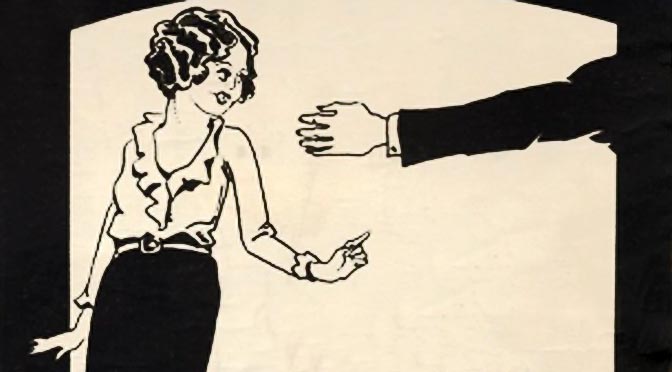
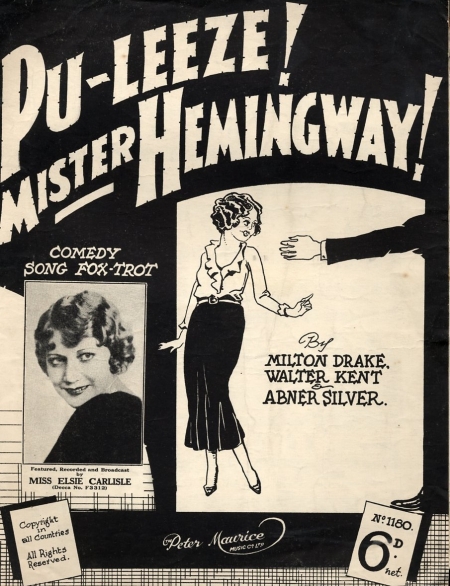
“Pu-leeze! Mister Hemingway!” Words and music by Milton Drake, Walter Kent, and Abner Silver (1932). Recorded by Ambrose and His Orchestra with Elsie Carlisle as vocalist on November 22, 1932. Regal Zonophone MR-769.
Personnel: Bert Ambrose dir. Max Goldberg-Harry Owen-t / Ted Heath-tb / Danny Polo-Joe Jeannette-Billy Amstell-reeds / Harry Hines-as / Bert Read-p / Joe Brannelly-g / Don Stutely-sb / Max Bacon-d / Freddie Bretherton-a
“Pu-leeze! Mister Hemingway” is a composition by notable songwriters Milton Drake (also known for “Java Jive” and “Mairzy Doats”), Walter Kent (most famous for “I’ll Be Home for Christmas” and “The White Cliffs of Dover”), and Abner Silver (who would co-write “No! No! A Thousand Times, No!” — another Elsie Carlisle hit). Elsie recorded “Pu-leeze! Mister Hemingway” five times in November and December of 1932, more times than any other song in her career: first “solo,” then with Ambrose and His Orchestra (by far her best-known version), then in two takes with Rudy Starita and His Band (one on Sterno, the other on Four-in-One), and finally with Harry Hudson and His Melody Men.
“Pu-leeze! Mister Hemingway!” remains one of Elsie’s most popular songs, most likely on account of her impeccable comic delivery of its risqué lyrics — indeed, it is outdone in sexual suggestiveness only by her two recordings of “My Man O’ War” (perhaps “My Handy Man” would also qualify in this regard). It is the complaint of an attractive woman who admits to liking a bit of flirtation but who has apparently met someone who takes it too far: a certain “Mr. Hemingway.” As the song progress, her description of his impertinent advances escalates, with Mr. Hemingway’s behavior sounding increasingly physically rough. The culmination is justly famous:
And I don’t mind your osculations,
But my dear, my operation!
Oh, pu-leeze! Mister Hemingway!
Two days before she recorded the version with Ambrose and His Orchestra, Elsie had committed to shellac a “solo” recording:
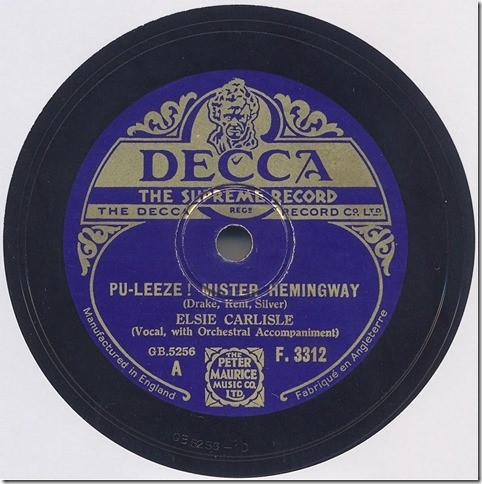
“Pu-leeze! Mister Hemingway!” Recorded by Elsie Carlisle on November 28, 1932. Decca F. 3312.
Personnel: probably Max Goldberg-t / t / tb / 2cl / as / 2 or 3 vn / Claude Ivy-p / g / sb / d
This version is at a slightly slower tempo, and Elsie’s delivery is more conversational. The arrangement is surprisingly similar to the one that Freddie Bretherton produced for Ambrose.
The last version of “Pul-eeze! Mister Hemingway” that Elsie would record was with Harry Hudson and His Melody Men:
“Pu-leeze! Mister Hemingway!” Recorded by Harry Hudson and His Melody Men (as Rolando and His Blue Salon Orchestra) with Elsie Carlisle as vocalist on December 20, 1932. Edison Bell Winner 5536.
Here the arrangement is a little different, and the orchestra is given a little more time to itself at the end. Elsie’s delivery is chatty, but perhaps not as much as in her solo recording.
There were a number of other artists recording “Pu-leeze! Mister Hemingway!” in late 1932. One problem they ran into was how to have a male singer deliver the song, which was risqué but not entirely unconventional in its sexuality. In America, George Olsen and His Music had male singer Fran Frey recount hearing a woman speak the lyrics, while Gene Kardos and His Orchestra (as Bob Causer and His Cornellians) had Dick Robertson rebuff a certain Mrs. Hemingway! In Britain there were versions by Billy Cotton and His Band, Carroll Gibbons and the Savoy Hotel Orpheans (with vocals by the Caryle Cousins, using the original lyrics), Ann Suter, Jay Wilbur and His Band (as Phil Allen’s Merrymakers, with vocalist Les Allen), and Jack Hylton and His Orchestra (in a Billy Ternent arrangement, with singer Pat O’Malley). Interestingly, the last two bandleaders mentioned did not seem to be bothered by having their male singers complain about being pestered by Mr. Hemingway! Gracie Fields recorded a version of the song that was only released in Australia, and Albert Whelan made one for Panachord accompanied by Harry Hudson’s Melody Men, but I have not been able to discover much about it.
Two final points need to be addressed. People often ask me if it is Ernest Hemingway that Elsie is singing about. I see no particular reason to identify the fictional masher with the American novelist. An open letter addressed to Ernest Hemingway entitled “Please, Mr. Ernest Hemingway” appeared in the American Criterion in 1935, but the addition of Hemingway’s first name would suggest that the letter’s author did not consider the song title that he was citing in jest to be originally about Ernest Hemingway.
“Let’s Make Love.” Words By Stanley J. Damerell, music by Tolchard Evans (1934). Recorded by Ambrose and His Orchestra with vocals by Sam Browne and with Elsie Carlisle in a speaking role on November 1, 1934. Decca F. 5297 mx. TB 1704-1.
Personnel: Bert Ambrose dir. Max Goldberg-t-mel / Harry Owen-t / Ted Heath-Tony Thorpe-tb / Danny Polo-reeds / Sid Phillips-reeds / Joe Jeannette-as / Billy Amstell-reeds / Ernie Lewis-Reg Pursglove-others?-vn / Bert Barnes-p / Joe Brannelly-g / Dick Ball-sb / Max Bacon-d
“Let’s Make Love (In Spring, Summer, Autumn and Winter)” is a light waltz written by British songwriters Stanley J. Damerell and Tolchard Evans, who collaborated on such notable songs as “Lady of Spain” (1931) and “If (They Made Me a King)” (1934). There seems to be a general rule that whenever Damerell and Evans have collaborated on a song, Elsie Carlisle ends up with a speaking role. That would appear to be the case in the Ambrose recording of “Hyde Park Corner” (Hargreaves-Damerell-Evans; 1933), in which Sam Browne sings and Elsie and drummer Max Bacon have speaking parts, as well as in the Maurice Winnick version of “Da-Dar-Da-Dar” (also Hargreaves-Damerell-Evans; 1933), in which Sam Browne sings and Elsie is a mere interlocutor. So it is in this Damerell-Evans piece, “Let’s Make Love.”
Jack Payne and His Band had made, in late October 1934, a version of “Let’s Make Love” that relied for its entertainment value largely on comical Northern and Cockney voices provided by Jack Payne and Charlie Asplin; there was yet another version of “Let’s Make Love” in November by Jay Wilbur and His Band, with Fred Latham on the vocals. After an impressive instrumental introduction, the Ambrose recording has Sam Browne sing just the refrain and the first verse of the song. He then proceeds repeatedly to try to sing the first few words of the refrain (or something like them) in foreign accents which are intentionally abysmally done. His try at a Russian accent (“Letsky makesky loveskevitch”) is perhaps the least embarrassing. I cannot say whether his announcing the Russian lover a second time and then correcting himself to “a Spanish lover” is a feigned mistake or a real one. The cannibalistic Zulu with his war cry “Yum, yum, yum!” is awkward at best, as is the shivering Eskimo.
Elsie Carlisle, for her part, merely interjects on occasion that Sam’s “impressions are lousy,” or the like. Sam and Elsie had already played bickering lovers in the 1933 Maurice Winnick recording of “Seven Years with the Wrong Woman,” and it was only weeks after recording “Let’s Make Love” that they would berate each other in “I’m Gonna Wash My Hands with You” with Ambrose and His Orchestra. In “Let’s Make Love,” by contrast, it is not apparent that Sam really means it when he repeatedly sings “Let’s Make Love” to Elsie, nor that her rebuffing of him is anything more than a negative review of his talent. What is clear is that this song is one of the silliest things Sam and Elsie ever collaborated on in their years of working for Ambrose.
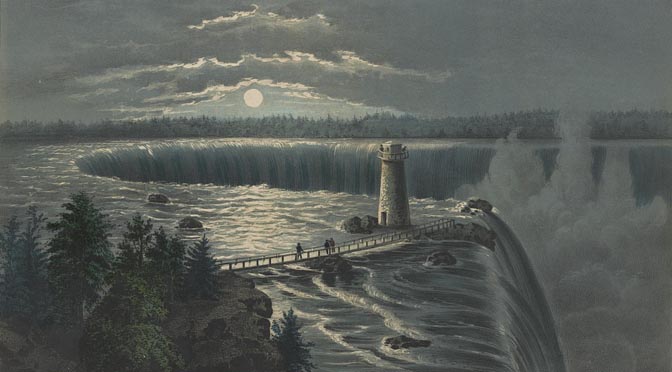
“Moonlight on the Waterfall.” Words and music by Jimmy Kennedy and Wilhelm Grosz (the latter employing the pseudonym “Hugh Williams”). Recorded by Jack Harris and His Orchestra with Elsie Carlisle as vocalist on October 25, 1937. HMV B.D. 5290 mx. OEA 5108-1.
Personnel: Jack Harris-vn dir. Alfie Noakes-Doug Holman-t / Lewis Davis-Don Binney-tb / Harry Karr-cl-as-f / Freddy Williams-cl-as / Harry Smith-cl-as-ts / George Glover-bar / Max Jaffa-Bill Sniderman-vn / Bert Read-cel-a / Cyril Halliday-Joe Brannelly-g / Alf Gray-d
A composition by the prolific songwriter Jimmy Kennedy (collaborating with the exiled Austrian composer Wilhelm Grosz, who worked in Britain under the name Hugh Williams), “Moonlight on the Waterfall” associates the image of an lovely outdoor setting with the memory of a lost lover. The lyrics do not have any claim to being particularly profound, but Elsie Carlisle does justice to the song’s melancholy beauty with the sweetness of her delivery. This recording is the product of Elsie’s brief but productive collaboration with the band of American-born bandleader Jack Harris.
“He’s a Good Man to Have Around.” Composed by Milton Ager, with lyrics by Jack Yellen, for the 1929 film Honky Tonk. Recorded by Elsie Carlisle (as “Sheila Kay”), with Cecil Norman and His Band, in London, October 16, 1929. World Echo A. 1013.
Personnel: Lloyd Shakespeare-t / Ben Oakley-tb / Les Norman-as / vn / Cecil Norman-p / __ Stanley-bb
“He’s a Good Man to Have Around” is a torch song fashioned loosely after the model of Mistinguett’s “Mon homme” or its English adaptation “My Man” (introduced by Fanny Brice in the 1921 Ziegfeld Follies). The singer catalogues her “man’s” various faults and insists that she loves him in spite of them. One lyrical advantage that “He’s a Good Man to Have Around” has over comparable songs (such as “Hangin’ On to That Man”) is that the man’s moral deficits creep up comically in intensity; at first one expects the song to remain light, insofar as the man’s faults are merely not being good-looking, being a poor dancer and a poor speaker, and occasionally being mildly irritating. Indeed, the lyrics as used in Elsie’s August 23, 1929 recording of the song with Philip Lewis and His Dance Orchestra (a.k.a. the Rhythm Maniacs)1 stop at this point; they complement the comparatively upbeat instrumental interpretation nicely. In the October 16 Worldecho recording, however, Elsie sings the whole song, including the parts about how her lover is untrustworthy, unfaithful, and apparently such a dangerous fellow as to warrant her having bought a pistol — which she won’t use, for “He’s a Good Man to Have Around!” Elsie Carlisle recorded this record and three others with Worldecho under the name “Sheila Kay”; as she was recording under her own name for the Dominion label at the time, it may be that contractual obligations necessitated the use of the pseudonym.
“He’s a Good Man to Have Around” was recorded in 1929 in Britain by Florence Oldham (accompanied by Len Fillis on the guitar and by Sid Bright on the piano), Lily Lapidus, the Rhythmic Eight (with vocals by Maurice Elwin), The Picadilly Players (Eddie Collis, vocalist), Mabel Marks, Belle Dyson, the Blue River Band (with vocalist Sybil Jason), and Mabel Lawrence.
Notes:
It is incidentally amusing to hear take one of this Decca recording, in which Elsie gets a couple of notes wrong! ↩
"The Idol of the Radio." British dance band singer of the 1920s, 1930s, and 1940s.