Videos

“I’m a Little Prairie Flower” (1937)

“I’m a Little Prairie Flower.” Composed by Leslie Sarony and Leslie Holmes (1937).  Recorded by Jack Harris and His Orchestra with Elsie Carlisle as vocalist on October 25, 1937. HMV BD-5289 mx. 0EA-5109-1.

Personnel: Jack Harris-vn dir. Alfie Noakes-Doug Holman-t / Lewis Davis-Don Binney-tb /Harry Karr-cl-as-f / Freddy Williams-cl-as / Harry Smith-cl-as-ts / George Glover-bar / Max Jaffa-Bill Sniderman-vn / Bert Read-Jack Penn-p-a / Cyril Halliday-Joe Brannelly-g / Alf Gray-d

Elsie Carlisle (w. Jack Harris) – “I’m a Little Prairie Flower” (1937)

“I’m a Little Prairie Flower” was composed by Leslie Holmes and Leslie Sarony in 1937, although the refrain is taken from an older song (anthologized by E. O. Harbin in 1927), with possibly some connection to the 1925 Jack Gardner tune “I’m a Little Prairie Flower (I’m Wild, I’m Wild).” It is a silly song that bases its comic effect on an extended but distracted botanical metaphor. The Two Leslies recorded it themselves in 1937:

The Two Leslies – I’m a Little Prairie Flower

They even performed it in a 1938 short (probably filmed at Pathé Studios in London), with Leslie Holmes singing at the piano and Leslie Sarony dancing and gesticulating:

The Two Leslies (1938)

British Pathé Video (YouTube)

Elsie Carlisle made her recording of “I’m a Little Prairie Flower” on October 25, 1937 with Jack Harris and His Orchestra, with altered lyrics. There were also versions done in November 1937 by Billy Cotton and His Band (with Alan Breeze as the vocalist) and by Jack Jackson and His Orchestra (with vocals by Helen Clare, Jackie Hunter, Jack Jackson, and Jack Cooper).

Elsie recorded five other songs with Jack Harris and His Orchestra in late 1937 and did radio broadcasts with them in 1938. Harris was an American bandleader who moved to England in 1927 and was an important figure in British dance band music through the 1930s. He even co-owned Ciro’s Club for a while with Ambrose. When war broke out in Europe, however, he went back to America, and was not able to return to Britain for want of safe passage.
“You’re My Everything” (1932)

“You’re My Everything.” Words by Mort Dixon and Joe Young, music by Harry Warren (1931). Recorded by Elsie Carlisle with an instrumental trio in Manchester on September 23, 1932. Decca F-3193 mx. KB-135-2.

Elsie Carlisle – “You’re My Everything” (1932)

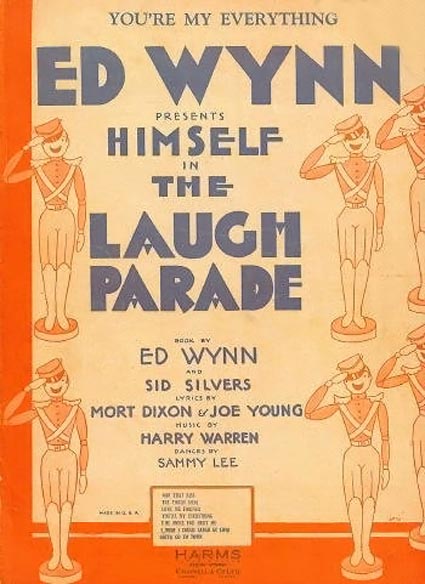
An effusive expression of affection, “You’re My Everything” has its origins as the hit song of of a 1931-1932 two-act Broadway revue entitled The Laugh Parade, produced by and starring Ed Wynn, a comedian who twenty years later would provide the voice for the Mad Hatter in Disney’s Alice in Wonderland. The music for the play was composed by Harry Warren, with lyrics provided by Mort Dixon and Joe Young. It was French actress Jeanne Aubert and American actor Lawrence Gray who introduced the signature tune.

Elsie Carlisle, in her 1932 recording of the song, brings sincerity to its hyperbolic lyrics. Hers is a surprisingly straightforward and touching interpretation of the composition; we find absent the coyness of her torch songs, the levity of her racier music. The band provides a suitably atmospheric accompaniment to her professions of love and awe for the lucky “you” of the song.

“You’re My Everything” was recorded in September 1931 by the Arden-Ohman Orchestra (with vocals by Frank Luther) and in October by Abe Lyman and His Orchestra (Dick Robertson, vocalist). In 1932 America heard versions by Russ Columbo, Ben Selvin and His Orchestra (Helen Rowland, vocalist), Jack Miller and the New Englanders,

 Britain produced recordings of “You’re My Everything” later in 1932, with versions by Roy Fox and His Band (with Al Bowlly as vocalist), Syd Lipton (as Sidney Raymond and His Commanders), the Blue Mountaineers (with vocals by Sam Browne), Ray Noble and His New Mayfair Orchestra (as part of a “Paul Jones” medley), Bertini and His Band (with vocals by Tom Barratt), and by Anona Winn and Jack Plant (as “Bob Mackworth”).

"You're My Everything" sheet music (from "The Laugh Parade," 1931")
“You’re My Everything” sheet music (from “The Laugh Parade,” 1931″)

“We Just Couldn’t Say Goodbye” (1932)

“We Just Couldn’t Say Goodbye.” Words and music by Harry Woods (1932). Recorded by Elsie Carlisle with an instrumental trio in Manchester on September 23, 1932. Decca F. 3193 mx. KB-134-1.

Elsie Carlisle – “We Just Couldn’t Say Goodbye” (1932)

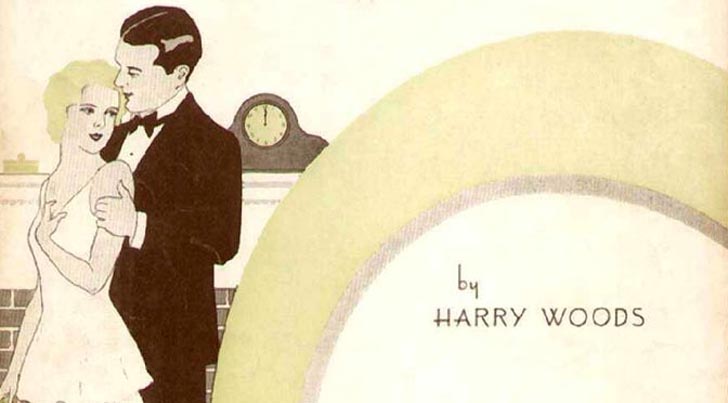
A light, romantic song about two lovers’ reconciliation, Harry Woods’s “We Just Couldn’t Say Goodbye” is noteworthy for its fanciful personification of pieces of furniture. When the couple is on the verge of parting, a chair and a sofa cry. A smiling clock expresses its feelings about the situation and brings the two people back together again, at which point the room in which everything happens sings and dances. Elsie Carlisle’s delivery of the lyrics is varied; it starts out somber, almost plodding, and becomes more upbeat as the relationship between the lovers improves. She engages in a sort of call and response with the clarinet at one point and almost whispers the final “I tell you confidentially.” Elsie’s is not exactly a lively take on the tune; it is, rather, a very deliberate interpretation of the sense of the lyrics, and of the other versions of the song recorded that year, it most closely resembles that of the American-born but London-based Layton and Johstone.

In America in 1932 there were versions of “We Just Couldn’t Say Goodbye” recorded by Guy Lombardo and His Royal Canadians, Chick Bullock and His Levee Loungers (with vocals by Chick Bullock), Ralph Bennett and His Seven Aces, The Dorsey Brothers Orchestra (with the Boswell Sisters), Paul Whiteman and His Orchestra (Mildred Bailey, vocalist), and Freddy Martin and His Orchestra. Annette Hanshaw sang it on a record and August 1932 and would go on to sing it in a film (the 1933 Captain Henry’s Radio Show). Even Shirley Temple sang it, in the 1933 film Kid in Hollywood, which is as cute as it is cacophonous.

In Britain, 1932 saw recordings of “We Just Couldn’t Say Goodbye” by the Blue Mountaineers, the Savoy Hotel Orpheans (with vocals by Jack Plant), Ambrose and His Orchestra (Sam Browne, vocalist), Billy Cotton and His Band (Cyril Grantham, vocalist), Jack Hylton and His Orchestra (with vocals by Pat O’Malley), Nat Star (as Bernie Blake and His Band, with Les Allen as vocalist), Jay Wilbur and His Band (vocalist Tom Barratt), and Jack Plant (as Jack Gordon). Notable duets were recorded by, as I have noted, Layton and Johnstone, and also by Hardy and Hudson.

"We Just Couldn't Say Goodbye" sheet music
“We Just Couldn’t Say Goodbye” sheet music

“On a Dreamy Afternoon” (1932)

“On a Dreamy Afternoon.” Lyrics by Robert Hargreaves and Stanley J. Damerell, with music by Montague Ewing (1932). Recorded by Ray Starita and His Ambassadors’ Band on September 15, 1932, with vocals by Elsie Carlisle. Four-in-One 7.

Personnel: Ray Starita-cl-ts dir. Nat Gonella-t / t / tb / prob. Chester Smith-cl-as-bar-o / Nat Star-cl-as / George Glover-cl-ts-vn / George Hurley-vn / Harry Robens-p / George Oliver-bj-g / Arthur Calkin-sb / Rudy Starita-d-vib-x

Ray Starita and His Ambassadors w. Elsie Carlisle – “On A Dreamy Afternoon” (1932)

“On a Dreamy Afternoon” was composed by Montague Ewing, who was known for his light music. The lyricists Hargreaves and Damerell (who sometimes used the joint pseudonym “Erell Reaves”) more frequently collaborated with composer Tolchard Evans, turning out such popular tunes as “Lady of Spain” and “If.”

Ray Starita’s version of “On a Dreamy Afternoon” was made in 1932, the last year of his recording career and one of the best, when his band included such greats as Nat Gonella and Nat Star. It was also the only year he used Elsie Carlisle as a vocalist, though he did so quite a bit, turning out excellent recordings of “Kiss by Kiss,” “Let That Be a Lesson to You,” and “I Heard,” amongst others. “On a Dreamy Afternoon” has music and lyrics that are mellow and atmospheric and showcase nicely the sweet quality of Elsie’s voice — this is definitely not one of her torch songs, and there is nothing particularly naughty in it — it is soothingly beautiful and romantic.

The recording in the YouTube video above is one of two takes of the song recorded by Ray Starita with Elsie Carlisle that day; the other appears on Sterno 1026:


Other versions of this song were recorded in October 1932 by Arthur Lally (Maurice Elwin, vocalist), Jack Hylton and His Orchestra (with vocals by Pat O’Malley; hear the unissued take 3 on jackhylton.com), and Carroll Gibbons and the Savoy Hotel Orpheans, with Cavan O’Connor singing).

“He’s My Secret Passion” (1930)

“He’s My Secret Passion.” Composed by Arthur Young, with lyrics by Val Valentine (1930). Recorded by Elsie Carlisle with orchestral accompaniment (probably under the musical direction of Jay Wilbur) c. September 3, 1930. Imperial 2333.

Personnel:  ?Jay Wilbur dir. Jack Miranda-cl-ts / Eric Siday-vn / Harry Jacobson-p-cel / Len Fillis-g

Elsie Carlisle – “He’s My Secret Passion” (1930)

“He’s My Secret Passion” was written for a British crime drama called “Children of Chance” (1930) starring Elissa Landi and John Stuart. Elsie Carlisle’s September 1930 versions of the song appear on Imperial 2333 mx. 5464 with the take numbers -3, -4, and -5, and discographers Richard Johnson and Ross Laird have deduced from the high take numbers that recording spanned over more than one session. Elsie had begun to record for Imperial, where Jay Wilbur was musical director, the previous month after a four-month hiatus following the closing of Dominion Records (whose music Wilbur had also supervised).

One might reasonably call “He’s My Secret Passion” a torch song, insofar as it involves a longing lament over an unrealized romance, but the lyrics involve enough amorous boasting (e.g. “I’ll burn him up when I sit on his knee”) that perhaps the song transcends the genre. Elsie conveys her yearning with a slightly quavering voice, and her delivery becomes more confident as the argument of the lyrics becomes stronger. The studio band plays in a subdued and mellow fashion, nicely showcasing Elsie’s voice.

1930 saw British versions of “He’s My Secret Passion” (often turned into “She’s My Secret Passion,” as suggested in the original sheet music, when sung by male vocalists) by the Rhythm Maniacs (vocalist Ella Logan), Ambrose and His Orchestra (Sam Browne, vocalist), the Four Bright Sparks (vocalist Queenie Leonard, with Arthur Young on the piano), Harry Bidgood’s Broadcasters (Tom Barratt, vocalist), Bert Madison and His Dance Orchestra (Nat Star, again with Tom Barratt doing the singing), Len Fillis’s Phantom Players (vocalist Al Bowlly), and Jay Wilbur and His Band (with Les Allen as vocalist).

In America, the song was recorded in 1930 by Doris Robbins, Danny Yates and His Orchestra (with vocals by Smith Ballew), Lee Morse and Her Blue Grass Boys, Marion Harris, and in February 1931 by McKinney’s Cotton Pickers (with vocals by Donald King).

"The Idol of the Radio." British dance band singer of the 1920s, 1930s, and 1940s.