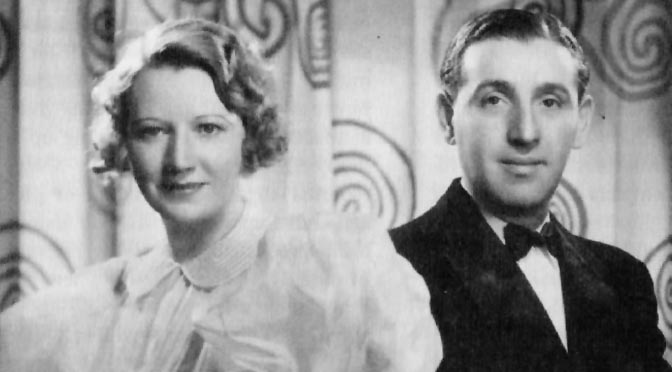
Sam Browne Articles

“Da-Dar-Da-Dar” (1933)

“Da-Dar-Da-Dar (Da-Dar-Da-Dee).” Words by Robert Hargreaves and Stanley J. Damerell, music by Tolchard Evans. Recorded on May 16, 1933 by Maurice Winnick and His Orchestra, with vocal refrain by Sam Browne (and with Elsie Carlisle in a speaking part). Panachord 25529 mx. GB5875-2.

Personnel: Maurice Winnick-vn dir. Charles Price-another-t / 2tb /Harry Hayes-Harry Turoff-as / Percy Winnick-cl-ts-o /Bert Whittam-p / Bill Herbert-g / Tiny Stock-sb / Stanley Marshall and possibly Max Bacon-d

Maurice Winnick and His Orchestra – “Da-Dar-Da-Dar” (1933)

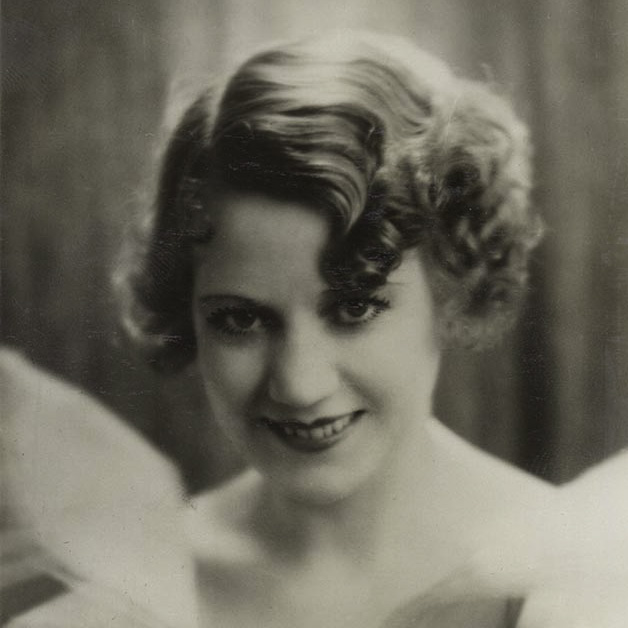
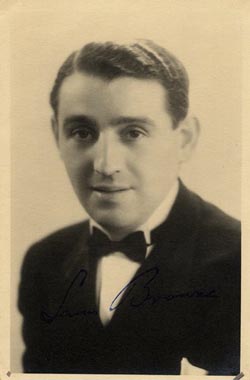
“Da-Dar-Da-Dar” features Elsie Carlisle in only the tiniest speaking role (for eight seconds at 1:56, when she says, “Oh, d-d-d-darling!” and “Oh, d-d-d-dearest!”), but I include it in this collection for the sake of completeness and because it is a very good comic waltz with a vocal refrain by Elsie’s long-term singing partner Sam Browne. Elsie’s sole recording session with Maurice Winnick and His Orchestra yielded up a second comic waltz with Sam that was issued on Panachord 25527, “Seven Years with the Wrong Woman.” But whereas that song involves disgruntled married people, “Da-Dar-Da-Dar” involves the complications that young people face in arranging a tryst, what with the omnipresence of parents.  Indeed, its scenario includes a complication involving a younger brother whom Sam must pay off to get some time alone with his girlfriend (voiced by Elsie).1 The overall idea of the awkwardness of youthful rendezvous is comparable to that produced by the song “Sittin’ in the Dark,” of which Sam and Elsie had recorded three versions in March 1933. One might also be reminded of Elsie’s 1928 and 1930 versions of “Dada! Dada!” but the name of that song refers to the father who is listening in on his youthful daughter’s first encounter with the opposite sex — really a very different idea entirely, and much less wholesome, for the song title “Da-Dar-Da-Dar” is meant only to imitate the rhythm of a waltz, and Elsie’s father, we are grateful to hear from Sam, is not present.

“Da-Dar-Da-Dar” was also recorded in 1933 by Sydney Lipton’s New Grosvenor House Band (v. Sam Browne), the BBC Dance Orchestra (directed by Henry Hall, with vocal refrain by Les Allen, in a Ronnie Munro arrangement), and Syd Roy and His R.K. Olians (vocalists Bill Currie, Ivor Moreton, and chorus).

Notes:

  1. It is not clear who impersonates the brother. Perhaps drummer and comedian Max Bacon, who did funny voices in “Seven Years with the Wrong Woman” at the same recording session, or even Sam Browne himself?

“Hold Up Your Hands (In the Name of the Law of Love)” (1933)

“Hold Up Your Hands (In the Name of the Law of Love).” Words by Mercer Cook and Thomas Blandford, music by J. Russel Robinson (1932). Recorded by Elsie Carlisle and Sam Browne on March 3, 1933. Decca F. 3504 mx. GB5634-2.

Elsie Carlisle & Sam Browne – “Hold Up Your Hands (In the Name of the Law of Love)” (1933)

“Hold Up Your Hands (In the Name of the Law of Love)” was written by American songwriters Mercer Cook, Thomas Blandford, and J. Russel Robinson in 1932; that year they also wrote the very successful “Is I in Love? I Is,” as well as “Stop the Sun, Stop the Moon,” which Elsie Carlisle recorded with Ray Starita and His Ambassadors. This duet involves a fanciful metaphor in which it is not clear whether Sam Browne is an agent of “the law” he keeps invoking (viz. the law of love or of Cupid) or a robber carrying out a holdup; he seems to entertain both notions. At any rate, Elsie seems to acquiesce to his demands that she “put up [her]  lips, and hold up [her] hands” with little resistance. 1933 was the second year of Sam and Elsie’s recording duets together, and “Hold Up Your Hands” is fairly representative of their duetting style (when they are not bickering, of course).

“Hold Up Your Hands” had been recorded in America in September 1932 by Victor Arden, Phil Ohman, and Their Orchestra (with vocals by Frank Luther). It was also recorded in 1933 in Britain by Maurice Winnick and His Band (with vocalist Louis Spiro).

"Hold Up Your Hands" original sheet music

“My Dog Loves Your Dog” (1934)

“My Dog Loves Your Dog.” Music by Ray Henderson, lyrics by Jack Yellen and Irving Caesar for the film George White’s Scandals (1934). Recorded by Elsie Carlisle and Sam Browne with orchestral accompaniment on June 22, 1934. Decca F. 5079.

Elsie Carlisle & Sam Browne – “My Dog Loves Your Dog” (1934)

The various annual installments of George White’s Scandals, a famed series of Broadway revues which ran from 1919-1939, were responsible for introducing the world to countless people who would eventually become Hollywood stars, as well as to the early music of George Gershwin. In 1934 the music of the stage show was combined with a somewhat more robust plot and made into a feature film, George White’s Scandals (1934), starring Alice Faye, Rudy Vallée, Cliff Edwards, and Jimmy Durante. One long scene in that movie involves the male characters walking dogs in tandem with the female characters and engaging in lengthy observations about canine amorousness that always lead to the conclusion “If our doggies love each other, why can’t we?” Foremost among the singers of “My Dog Loves Your Dog” is Jimmy Durante, who at one point is shown in a dog collar, with his head in a woman’s lap, having his famously protuberant “schnozz” petted.

In June, Elsie Carlisle and Sam Browne would tackle the song themselves, but with less than three minutes to sing it — including an instrumental interlude — they present a considerably abbreviated version. Their male-female duet adds flavor to the song, though, and ultimately allows the entrance of the element of strife between lovers that one would expect in a Sam-and-Elsie bit. When Sam first accosts Elsie and begins to observe the growing familiarity of their respective dogs, she responds, “Yes.  Someone mentioned it today. You can see it in their eyes” in a stilted delivery that must either betoken haughtiness on the part of Elsie’s character or perhaps exhaustion on the part of Elsie herself! Either way, I find her awkward beginning intensely funny. Some very nice singing ensues, but Elsie’s observations about the dogs ultimately serve as a riposte to Sam’s advances. The dogs begin to fight, and the two singers conclude “And if our doggies bite each other, why can’t we?” — a comic twist not present in the movie.

“My Dog Loves Your Dog” was also recorded that year by the Dorsey Brothers Orchestra (as Bob Snyder and His Orchestra, with vocalist Kay Weber), by Cliff Edwards, one of the stars of the original movie sequence, Victor Young and the Brunswick Studio Orchestra, and Harry Roy and His Orchestra (with vocals by Bill Currie). Jay Wilbur and His Band did a medley based on the Scandals in which Mona Brandon and Sam Browne sing “My Dog Loves Your Dog.”

“Mr. Magician” (1934)

“Mr. Magician (Won’t You Bring My Honey Back to Me?).” Words and music by Charles O’Flynn, James Cavanaugh, and Frank Weldon (1934). Recorded by Elsie Carlisle and Sam Browne with orchestral accompaniment on June 22, 1934. Decca F. 5079.

Elsie Carlisle and Sam Browne – “Mr. Magician” (1934)

O’Flynn, Cavanaugh, and Weldon were prominent Tin Pan Alley songwriters, but their 1934 “Mr. Magician” does not appear to have inspired many recordings. It may have seemed outrageously corny even by the standards of the time (consider the lines of the refrain: “Hocus, pocus, Mr. Magician, won’t you bring my honey back to me?”). All the same, this melodramatic arrangement (complete with an anonymous carnival barker, with Sam Browne as a grandiose, boasting circus magician, and with Elsie Carlisle as an earnest girl who wants to “find [her] man somehow”) has a certain appeal. Elsie plays the Dorothy to Sam’s Great Oz with a comical insistence; the whole piece is cartoonish, funny, and sweet.

New York-based Sam Robbins and His Orchestra had done a catchy version of the song in January, 1934, followed by Ozzie Nelson and His Orchestra (with vocalists Ozzie Nelson and Harriet Hilliard) in February). In Britain Harry Roy and His Orchestra had recorded it with vocals by Bill Currie in mid-May; the latter version includes the following priceless exchange:

— “I say, Mr. Magician, won’t you bring my baby back to me?

— “Sorry, I need her for myself!”

“Seven Years with the Wrong Woman” (1933)

“Seven Years with the Wrong Woman.”  Words and melody by Bob Miller (1932).  Recorded by Maurice Winnick and His Orchestra, with vocals by Sam Browne and Elsie Carlisle, on May 16, 1933.  Panachord 25527.

Personnel: Maurice Winnick-vn dir. Charles Price-another-t / 2tb / Harry Hayes-Harry Turoff-as / Percy Winnick-cl-ts-o / Bert Whittam -p / Bill Herbert-g / Tiny Stock-sb / Stanley Marshall-d / Max Bacon-sp (possibly -d also)

Seven Years With The Wrong Woman – Maurice Winnick & his Orchestra 1933

Transfer and video by Peter Wallace (YouTube)

“Seven Years with the Wrong Woman,” a comic hillbilly waltz by Memphis-born but New York-based Bob Miller, is the lament of an unhappily married man.  The henpecked husband and the shrewish wife are perennial stock sources of mirth, and Miller’s encapsulation of the sentiments of the former attracted the attention of such American artists as Cliff Carlisle, Parker & Dodd, Frank Luther, Mac & Bob, and Jess Hillard.  The success of the song  is attested to by Miller’s having released a second song, “Seven Years with the Wrong Man,” a year later, in which he presented the same situation from the point of view of the fairer sex.

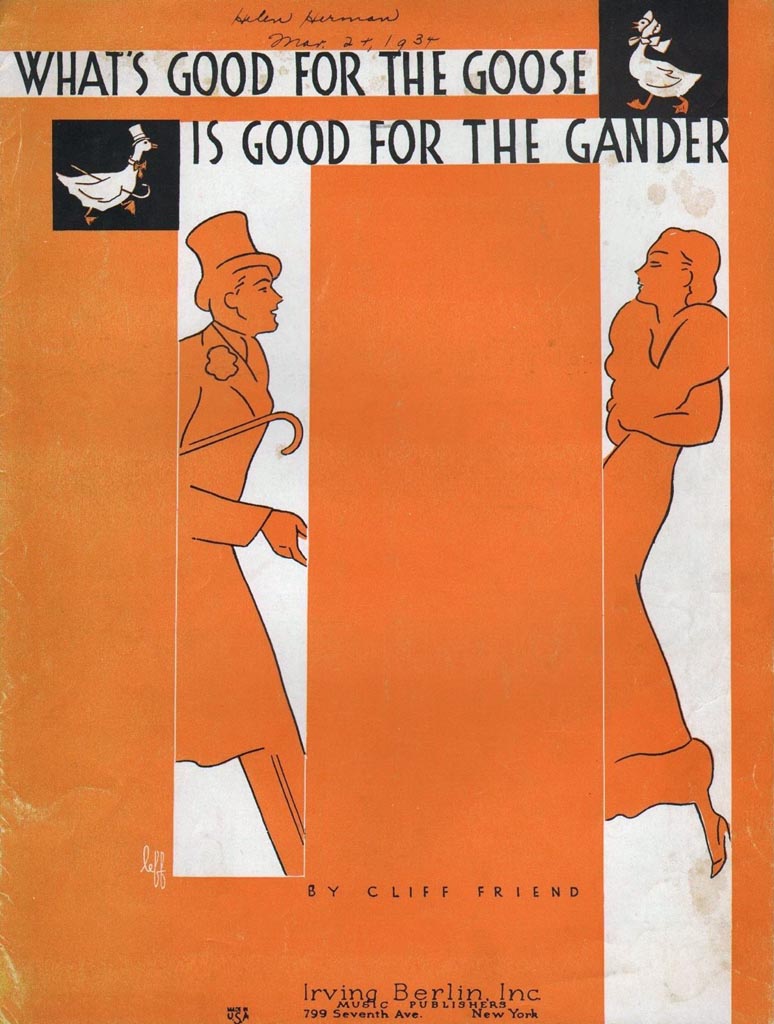
Sam Browne and Elsie Carlisle’s duet in Maurice Winnick’s recording of “Seven Years with the Wrong Woman” is an early example of the sort of song of bickering and vituperation for which they became well known (consider also the 1934 songs “What’s Good for the Goose Is Good for the Gander” and “I’m Gonna Wash My Hands of You”).  The verses of the song are interspersed with spoken comic vignettes.  The arrangement is whimsical, and it includes a bit of Rachmaninoff’s “Prelude in C Sharp Minor.”1  The comedy is at times rather dark (“Prisoner at the bar, you are accused of striking this woman with your fist.  Why did you strike her with your fist?”  “Because I couldn’t find a hammer”).  The third speaker is Ambrose drummer Max Bacon, who liked to do comedy in a stereotypical Jewish accent whenever the chance presented itself.2

In 1933 there were other British treatments of “Seven Years with the Wrong Woman” by Jimmy Campbell and His Paramount Band (in a medley, with vocals by the Three Ginx),  Roy Fox and His Band (with vocalists Jack Plant and Sid Buckman), Ray Noble and His Orchestra (with Al Bowlly), Billy Cotton and His Band (Alan Breeze, vocalist), Syd Roy and His R.K.Olians (with Ivor Moreton), and Jack Payne and His Band (with vocalists Billy Scott-Coomber, Bob Busby, Bob Manning, and Jack Payne himself).

Notes:

  1. For a considerably more elaborate British dance band treatment of Rachmaninoff’s prelude, listen to Teddy Joyce’s recording of a Bob Busby arrangement of the piece.
  2. Many thanks to Fred Finnigan for drawing my attention to Bacon’s considerable work as an independent comedian, and not just as Britain’s premier drummer.

"The Idol of the Radio." British dance band singer of the 1920s, 1930s, and 1940s.