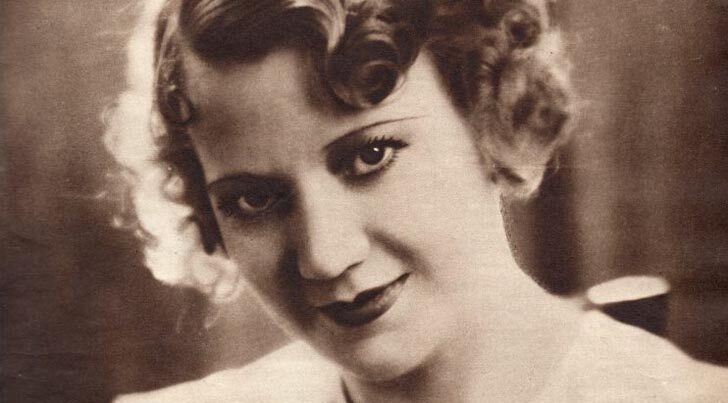
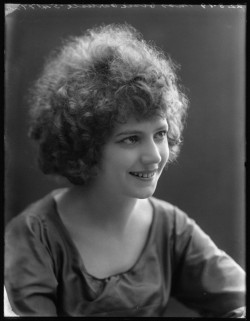
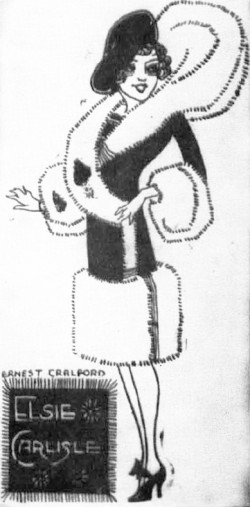
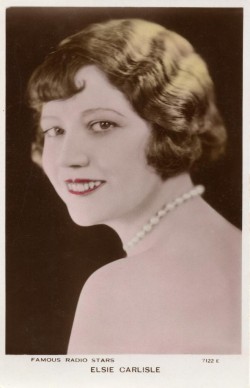
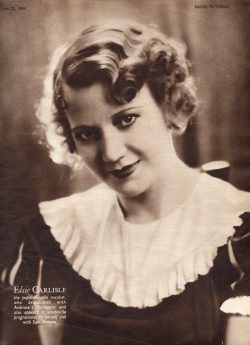
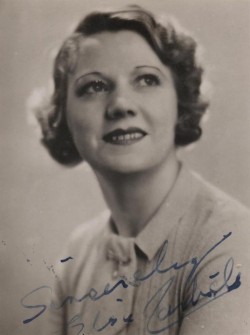
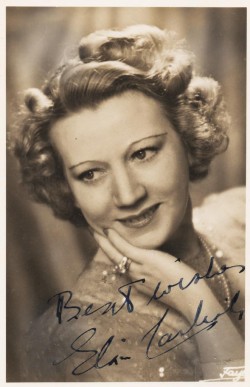
Elsie Carlisle’s 128th Birthday

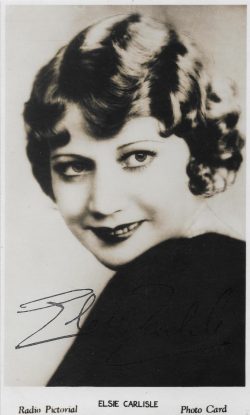
Elizabeth Carlisle was born on January 28, 18961 in Manchester, England to James Carlisle and Mary Ellen Carlisle (née Cottingham). Elsie was not the only member of her family to show a knack for show business; her brothers James (“Jim”) and Albert (“Tim”) were both singers who worked with the great composer, publisher, and impresario Lawrence Wright. By her own account, Elsie was encouraged to learn singing by her mother, who paid for her to have lessons when she was only a small girl.2 It was her brother Jim who got her her first theatrical role at the age of 12,3 and by the time of her marriage in 1914 she could be described as a “musical hall artiste” on the wedding certificate. By 1919 she was appearing in the West End in a show whose cast included Betty Bolton, and the next year she merited her own show, entitled Elsie Carlisle – With a Different Style, in which she performed as a solo vocalist.

How “different” her style was would quickly be made known to larger and larger audiences. Her stage career grew, only to be eclipsed, starting in 1926, by her broadcasting and recording efforts. Elsie’s recordings made with Ambrose and His Orchestra between 1932 and 1935 are among the best remembered, but one should remember that she recorded at least 332 record sides between 1926 and 1942 — a prolific output. The British public would have known her better still from her broadcasts on the BBC and Radio Luxembourg. She was often billed as the “Idol of the Radio,” a well-earned epithet. By the mid-1930s she was ranked amongst the top vocalists who could be heard on the British airwaves, and she had film and television credits to her name as well. Her dulcet delivery of themes both comic and plaintive continues to attract listeners well over a century after her first performance in a Manchester music hall, and the world is much richer for her having lived in it.

Notes:

  1. January 28, 1896 is the date that Elsie Carlisle’s mother provided when she registered her daughter’s birth on March 3, 1896. The same birthday appears on Elsie’s baptismal certificate, which is dated April 15, 1896, so the date “21 January 1897” found on Elsie’s death certificate must be erroneous. People are not generally baptized before they are born, and one would assume that Elsie’s mother was a better source of information regarding her own daughter’s birth than Elsie’s son Wilfred, the informant for the death certificate.
  2. Ralph Graves. “Radio Sweetheart No. 1.” Radio Pictorial 251 (November 4, 1938): 8.
  3. According to Richard J. Johnson in “Elsie Carlisle (with a different style).” Memory Lane 174 (2012): 25.

A Decade with Elsie Carlisle

Exactly ten years ago — on December 31, 2013, at 7:44 p.m. Pacific Standard Time — I created the Elsie Carlisle page on Facebook. At the time I did not know exactly where my newfound passion would take me. All I had to start with was an earworm.

If you are not familiar with that term, I am sure you are acquainted with the phenomenon it describes. You are exposed to some particularly catchy music, and it resonates so much with you that it is on long-term repeat in your head. It is like an itch, and the only way to scratch it is to play the song again — which of course embeds the earworm even more inextricably in your brain. Sometimes the only way to exorcise an earworm is to become infected with a new one.

So far, what I have described would appear to be an experience familiar to most people, but I seem to fall into a smaller subspecies: people who take pleasure from hearing a good song played repeatedly — twenty to forty times in a row. It has to be the right song, of course, but for a few of us there does not appear to be too much of a good thing. I am happy to say that my peculiar taste in music repetition has not driven people away from me — rather, it would appear that the similarly afflicted are drawn to each other.

I remember, when I was a postgraduate in Cambridge, playing Mary Martin singing “My Heart Belongs to Daddy” (with Eddy Duchin’s orchestra) at least thirty times in a row one evening. But I must have had five friends over, and they all seemed just as dedicated to hearing it played again and again as I did — I am sure I let people take turns hitting the “previous track” button. We reconvened regularly, no doubt to enjoy the collective pleasure of hearing the song for the hundredth time.

Many years later, in late 2013, my earworm was Elsie Carlisle’s 1930 “Exactly Like You.” After a month of listening to the song on repeat, I began to branch out and listen to other of her hits, such as “The Clouds Will Soon Roll By” and “You’ve Got Me Crying Again.” I grew more and more intrigued. This was my favorite singer — ever. But there were not really that many of her songs available to the casual (or even fanatical) listener at the time — a handful were available in easily obtained digital collections. I did not really know what I was getting into, but I made it perhaps my only New Year’s resolution ever to start a Facebook page for Elsie Carlisle and to learn as I went along how to find out more about her and how to share my appreciation of her art.

January 28, 2014 was the first time I celebrated Elsie Carlisle’s birthday. I descended upon the Facebook groups The Golden Age of British Dance Bands and Female Singers (I would soon afterwards become an administrator of the latter) and spent well over twenty-four hours sharing favorite songs and making new friends — most of whom I have gotten to know much better in the years since. I was impressed by their knowledge of interwar music, as well as of the technical aspects of playing and digitally transferring shellac 78 rpm discs.

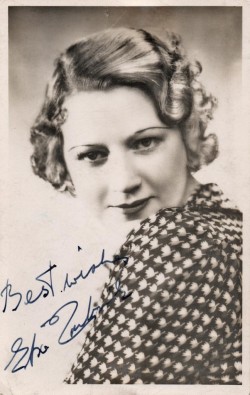
The discs began to arrive in the mail, mostly from England, mostly from eBay. There were lovely autographed photographs and postcards, too. I was fortunate to have begun collecting in 2014, as a lot of records and memorabilia were for sale at that time which I have seldom seen since.

Meanwhile, it seemed as if in time, there might be things worth saying about Elsie Carlisle’s songs or periods of her life that would be better consigned to a more permanent and accessible part of the Internet than a mere Facebook page, so in early February 2014 I launched this blog, elsiecarlisle.com, and I began to use it as a place to play around with writing primarily about individual songs, with the occasional biographical piece here and there.

As I grew more comfortable doing digital transfers — which can be extraordinarily challenging, especially when you’re dealing with a 1930s Imperial with uncommonly wide grooves, or an earlier Dominion which was described as sounding merely “OK” by the reviewers when it was new, before it had been scraped a hundred times by steel needles — I started to upload to my own YouTube account. Over the years, I have uploaded some things that I was particularly proud of, especially “What Is This Thing Called Love?” — a song introduced originally by Elsie Carlisle on stage at Cole Porter’s request. Collectors can estimate how scarce that record is.

The years went by, and the blog grew. I was asked to write a few articles on Elsie Carlisle for Discographer Magazine (now unfortunately defunct). But it was really with the beginning of the pandemic that my activities exploded. Stuck at home and with extra time on my hands, I resolved to address the need for a new Elsie Carlisle discography.

When I had started, I had no complete discography to work with. I had Ross Laird’s admirable 1995 Moanin’ Low, which attempts to tabulate all popular female vocalist recordings up through 1933 — but Elsie Carlisle continued recording through 1942 (as I would eventually discover). A helpful person shared Edward Walker’s 1974 Elsie Carlisle — With a Different Style with me. It was groundbreaking when it came out — and still useful — and yet, with the passage of so much time, its incompleteness and inaccuracy are fairly obvious. It took me years to find a copy of Richard Johnson’s 1994 Elsie Carlisle with a Different Style, which remains unsurpassed in its attempts to nail down which instrumentalists might have been present — even at Carlisle’s solo sessions — and yet even it was not complete enough for my purposes. I had developed a discography of my own over time, but I had never shared it. About a month into the pandemic, I published it here as Croonette: An Elsie Carlisle Discography.

I am sure that I am not the only person whose record collection began to grow considerably during the pandemic. In fact, mine was growing so quickly in 2020 that I had to up my game by improving, not just how I transferred records, but how I simply played them — the turntable was spinning nearly all day long at this point. By the summer of 2020, I had released 78curves, a library of equalization curves (and related filters) for playing 78 rpm records through a computer in real time, accurately equalized so as to reproduce the sound of the original performance (as much as possible).

Since then, I have tried to begin replicating my successes on elsiecarlisle.com by launching similar projects involving British vocalists Maurice Elwin (mauriceelwin.com) and Anne Lenner (annelenner.com), both of which are accompanied by biographies and discographies (the Elwin discography, Monarch of the Microphone, being the most daring project yet — I have documented well over 2,000 recordings by Elwin, and I continue to update the 271-page digital tome regularly).

I cannot begin to tell you how many “sidequests” I have had along the way. I have gained more than one client for website design and maintenance because someone admired my sites. And, in order to navigate the filesystems of those websites and efficiently develop and update their various components, I have created a number of free command-line software projects, one of which now has possibly hundreds of thousands of users.

I still have much to do, on this website and on others; much collecting to do; more records to discover and document. But I feel that I can be happy today if I have in any way made Elsie Carlisle’s music more accessible to the non-collector, or if I have had any success in sharing my love of her art.

And may I say what a profound pleasure it has been to make so many hundreds of friends along the way? Even if I am seldom in the same room as you, I feel as if I am always in very good company with music lovers. I hope that our next ten years can be at least as profitable and enjoyable as the last ones.

Happy New Year!

A. G. Kozak

“Little Man, You’ve Had a Busy Day” (two versions; 1934)

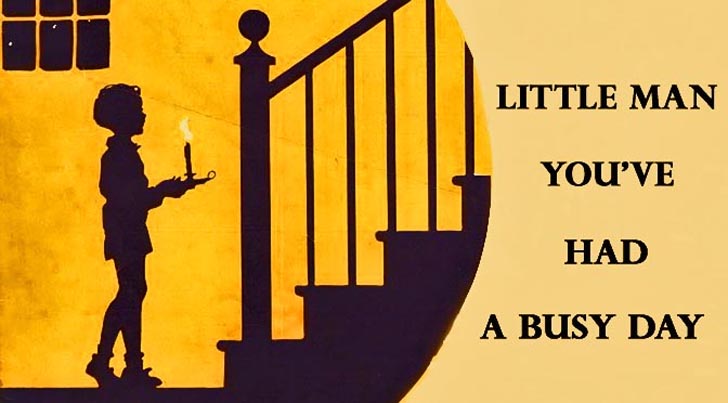
If risqué elements constitute one of the primary attractions of interwar Anglophone popular music for modern audiences (think “Pu-leeze! Mister Hemingway”), perhaps the sentimental might be seen as the ingredient most likely to repel us. Lullabies and songs about nursery rhymes abound, especially in the 1930s: even in Elsie Carlisle’s repertoire, we have “This Little Piggie Went to Market,” “Who Made Little Boy Blue?” “Up the Wooden Hill to Bedfordshire,” and “Little Drummer Boy” — among the more obvious examples. And yet there are very good recordings of these kinds of songs that explore the compelling potential of childhood themes. For me, perhaps, the most moving examples are Carlisle’s two recordings of “Little Man, You’ve Had a Busy Day,” one done with an anonymous studio orchestra, the other with Ambrose.

“Little Man, You’ve Had a Busy Day.”  Words by Maurice Sigler and Al Hoffman, music by Mabel Wayne (1934).  Recorded by Elsie Carlisle with orchestral accompaniment on May 18, 1934.  Decca F-3990 mx. TB-1258-2.

Elsie Carlisle – “Little Man, You’ve Had a Busy Day” (1934)

Because of its “solo” format, Elsie Carlisle’s Decca recording of “Little Man, You’ve Had a Busy Day” has a complete set of lyrics and some additional maternal bedside chatter. This is clearly not a recording aimed at a child audience, however; its evocation of feminine tenderness is the sort of thing that would appeal to grown-ups. Incidentally, the anonymous Decca studio band is particularly good in this number; they achieve memorable instrumental moments without ever upstaging Carlisle.

“Little Man, You’ve Had a Busy Day.” Recorded in London on June 12, 1934 by Ambrose and His Orchestra with vocalist Elsie Carlisle. Brunwick 01790 mx. TB-1295-3.

Personnel: Bert Ambrose dir. Max Goldberg-t-mel / Harry Owen-t / Ted Heath-Tony Thorpe-tb / Danny Polo-Sid Phillips-cl-as-bar / Joe Jeanette-as / Billy Amstell-cl-ts / Ernie Lewis-Reg Pursglove-sometimes others-vn / Bert Barnes-p / Joe Brannelly-g / Dick Ball-sb / Max Bacon-d / Elsie Carlisle-v

Ambrose and His Orchestra (v. Elsie Carlisle) – “Little Man, You’ve Had a Busy Day”

Ambrose’s version of “Little Man” benefits from a particularly sophisticated arrangement and a predictably elegant execution. Carlisle’s vocal refrain is incredibly precious and memorable. I would have imagined this record was a best-seller if I did not know how hard it was to find it! Admittedly, that seems to be a general problem with Ambrose’s Brunswick issues.

Elsie Carlisle does appear to have succeeded in being linked in the public’s mind with “Little Man, You’ve Had a Busy Day,” as it appears in her 1937 Elsie Carlisle Medley, which functions as a sort of “greatest hits” compilation.

In America that year, “Little Man” was made popular by the Pickens Sisters, Isham Jones and His Orchestra (with vocals by Eddie Stone),  Connee Boswell, and Paul Robeson.  Interpretations by British orchestras include those by Roy Fox and His Band (with vocals by Denny Dennis, in a Jack Nathan arrangement; they would revisit the song later in the year in a “Fox Favourites” medley), Billy Cotton and His Band (with vocalist Alan Breeze), Ray Noble and His Orchestra (with Al Bowlly), Jack Payne and His Band (with Jack Payne providing the vocals), The Casani Club Orchestra (directed by Charlie Kunz, with vocalist Dawn Davis)The BBC Dance Orchestra (directed by Henry Hall, with vocals by Kitty Masters, in a Phil Cardew arrangement), Harry Leader and His Band, and Eddie Wood and His Band.  Other British vocalists who recorded “Little Man” that year include Phyllis Robins, Gracie Fields, and Donald Peers.

Anniversary of Elsie Carlisle’s Death

Elsie Carlisle passed from this world on September 5, 1977, dying of cancer at the age of 81 in the Royal Marsden Hospital, Chelsea, London. The informant who signed the death certificate was Wilfred “Willie” Ypres Carlisle, one of her two sons, who gave as his own address the same one that she had been living at for the previous four decades, 8 Deanery Street, in the posh Mayfair district. She is described in the document as “A Theatrical Artist (retired)” and “Widow of Wilfred Malpas.”

The era of British dance band music was long over, and she had lived in great privacy for many years. It was four days before the London Times took notice of Elsie Carlisle’s death, when they printed an abbreviated eulogy:

Elsie Carlisle, who was a notable crooner of the 1930s, has died. Born in Manchester she was an established name by the time she was 16. She appeared in many Royal Command performances, among her song title hits being “No, no, a Thousand Times, No!” and “Little Drummer Boy”. For four years she was partnered by Sam Brown [sic] but they split up in 1935.

By contrast, during the interwar years the praise showered upon Elsie’s talent and winning personality was far more effusive. In 1921, almost five years before Elsie made her first radio broadcast, she earned the following review from the Angus Evening Telegraph for her performance in a Dundee production of the play French Beans:

An ideal Cupid is Elsie Carlisle, who entertains as much with her bewitching personality as with her charming voice. She has a knack of getting to the heart of her audience, and it seemed as though she were not to be allowed to make her bow last night.

In 1926, Elsie began both to sing on the radio and to make records, and her increasingly nationally recognized celebrity attracted ever more fanciful epithets. In 1927 she was a “charming microphone personality.” By 1934 she had become “the champion mezzo-soprano crooner” and “Your Radio Favourite.” In 1936, surveys showed her to be the public’s favorite female radio singer, and she earned the oft-repeated title “Idol of the Radio,” a status she enjoyed for several years. In November 1939, Radio Pictorial famously dubbed her “Radio Sweetheart No. 1,” and in 1941, the penultimate year of her making records, the Hull Daily Mail was still calling her “the charming songstress of the radio.”

Elsie was not only known for her solo work, of course. Her name is closely associated with the elite Ambrose Orchestra (with whom she recorded the still-popular songs “The Clouds Will Soon Roll By,” “Pu-leeze! Mister Hemingway!” and “You’ve Got Me Crying Again”), but some of her best work was done with other bands, such as the Rhythm Maniacs (under the direction of Arthur Lally), Ray Starita and His Ambassadors’ Band, and Jack Harris and His Orchestra. She was also frequently paired with the singer Sam Browne, with whom she  recorded duets in the early 1930s.

In 1940-1941, nearing the end of her professional career, Elsie toured the country with a troupe of younger entertainers. The draw that her name exerted is attested by the fact that the group called itself “The Carlisle Express.” She stopped making records in 1942, but she was still  on stage and continued making broadcasts through 1945. After this point she almost completely dropped out of the public eye, but it is worth noting that that was true of most dance band personalities; the genre did not really survive the war. Her attention shifted to business ventures, including a ballroom in London and an inn in Berkshire.

It was not only for stage, broadcasting, and recording that Elsie was known; she also worked in other media. In addition to making short but amusing appearances singing in a number of films, Elsie was an early television star, appearing first on the crude Baird system in 1930, and she continued to pop up on TV as the technology improved during the 1930s. In the early 1950s, she did a television interview accompanied by Ambrose and then disappeared utterly from public view until 1973, when she appeared on the Denis Norden program Looks Familiar. She was to return to that show in 1975.

An erstwhile child actress who rose to striking celebrity and dominated the airwaves for nearly twenty years, Elsie Carlisle ended her days in comparative obscurity, but those who had worked with her remembered her not just as a great musical talent, but as a warm, fun, and charitable person. In the words of accompanist Bert Read, writing in the months following her death: “I shall always retain the warmest memories of a fine artiste and a gentle, compassionate, woman.  R.I.P.”

Elsie Carlisle in America

I have been postponing writing about Elsie Carlisle’s 1923-1924 stay in America for eight and a half years now, nearly the entire time that I have been running this website. Originally, I hesitated to comment simply because I was not sure the trip had happened. Later, it became clear that she had spent a few months in the United States, but I could not confidently name a single thing that she did here. There were rumors that she had made the journey to conceal her having a third child.

I am now prepared to clear the matter up a little.

Carlisle’s personal life was admittedly marked by subterfuge. She spent nearly half a century married to Wilfred Malpas, and yet she liked to pose as a single woman, passing off her two sons as her brothers. It is perhaps natural that people researching her life and her family expect to find more examples of secrecy and potential scandal.

I was first tipped off to the possibility of Carlisle’s having visited America by a gracious correspondent who was doing some genealogical research. American immigration records showed that a certain artist named Elsie Carlisle, born in Manchester, England in 1899 and based out of London, had arrived in New York on the steamer Franconia on August 26, 1923. The birth date was incorrect by three years — but might she not have been gilding the lily by making herself three years younger? My correspondent theorized about a secret trip to hide a pregnancy, which I supposed was possible. What turned me off was the final destination. This Elsie Carlisle was on her way to Memphis, Tennessee to visit Mrs. Ernest [sic] Taylor of Poplar Ave. The whole thing seemed so outlandish — what possible connection could the Elsie Carlisle we know have with Tennessee? I dismissed the whole matter as a probable confusion of persons. “Elsie Carlisle” must have been a common enough name, after all.

But soon I would find references in newspapers and trade journals to the famous Elsie Carlisle taking a trip to New York at exactly that time. I reconstructed her movements as follows. As late as August 8, 1923, an advertisement was run in The Era suggesting that Carlisle could still be seen on the London stage in Fred Karno’s revue “1923.”1 By September 5, she was in America:

We hear that Elsie Carlisle, who recently concluded her second season’s engagement in Fred Karno’s “1922-3,” is spending a holiday in America.2

Carlisle had, then, arrived on the Franconia on August 26 and told immigration that she was going to visit Mrs. Taylor in Tennessee. The Era continued to give British readers updates as to her activities:

Elsie Carlisle, who was last seen here in that successful revue, “1923,” opens this week on the Keith Circuit, New York. Elsie went over a few weeks ago for a holiday, but has evidently been prevailed upon to play there during her stay.3

What startled me was the following comment in the U.S.-based journal Variety:

Elsie Carlisle, English, recently arriving in New York will return to London without making an appearance in New York.4

Had there been some ruse? When Elsie really did get back to England — on March 4, after a six-month stay — the press was under the impression that she had been on stage and had been well received:

Elsie Carlisle, who was a principal in Fred Karno’s “1922” and “1923” revues, arrived in England on the “Ansonia” on Tuesday [March 4, 1924] after a six months’ successful tour on the Keith Circuit.5

With the London press suggesting that Carlisle was on stage in the United States but with U.S.-based Variety having her prepare to return to England without appearing in New York, I was beginning to think that perhaps her journey did have an ulterior motive. At this point I compared notes with researcher Terry Brown, who had noticed many of the same references in the press to Carlisle’s American trip. Terry informed me that he had also heard a theory that she had gone to America for privacy while pregnant with a third son (he did not himself take a position on the likelihood of that scenario), one Arthur Davies.

I let some more time pass, but of course I did not forget the intriguing rumor. Finally this month, while pulling together some biographical notes about Elsie Carlisle, I discovered the source of the confusion (which has made its way into a couple of family trees on ancestry.com, I see): there is an Arthur Davies, born either August 4 or September 4, 1923, whose mother was apparently named Elizabeth Malpas — Elsie Carlisle’s legal name. I say “apparently” because Davies’s mother’s last name was almost certainly “Malpass”, with two s’s, and it was her maiden name — I have seen the wedding certificate. She was an entirely different person.

I shared the results of my research with Terry, and he surprised me with some of his own: a clipping from the American publication Billboard (November 8, 1923):

Elsie Carlisle sang several songs in the second spot, affecting a naive style of delivery coupled with an appealing soprano voice. All of her songs are in a rather low key, so low as to make the performance monotonous. Miss Carlisle seemed to have a weakness for rolling her eyes toward an upper box and on two or three occasions while singing she burst into laughter, apparently at her own funny catch lines, or some incident that she happened to think of at that time. Probably it was all in the act, but if it was, she failed to follow it up and receive the full benefit of it, for she closed rather weak.6

So Carlisle was on stage, and in New York, at that! Variety had been misinformed. And the American reviewer had given Carlisle by far the worst review I have ever seen of her.

So the facts fall into place. Elsie Carlisle went to America in 1923 and ended up staying into 1924. I do not think that she could have secretly had a child in either of those years; she would have been on stage enough for people to notice. At least one reviewer thought her U.S. show was unmemorable, but whoever was promoting her career back in London was keen to assert that her performances had been “fully successful.” It is worth noting that The Era first described Elsie’s absence from London as a mere “holiday” or vacation, but it  seems to have turned into a professional opportunity soon afterwards.

But what do we do with the Taylors in Memphis, Tennessee, Elsie Carlisle’s supposed hosts while staying in the States? Mr. Emmett Taylor of 1071 Poplar Avenue was a cotton buyer, according to censuses, and he and his wife Elizabeth were prominent enough citizens to be listed in the social register.7 Their teenage daughter, Elizabeth Scott Taylor, made trips to Europe; a passport application has her leaving New York on the Leviathan on July 28, 1923, the first such trip of hers that I know of. That does not give her much time to become bosom friends with Carlisle, but she could definitely have arranged an invitation.

Did Elsie Carlisle, however, actually get as far as Memphis? Your guess is as good as mine.

Notes:

  1. “Elsie Carlisle – With a Different Style – ‘1923’ 2nd Season L.T.V. Tour,” The Era, August 8, 1923, 15, British Newspaper Archive.
  2. “The Variety World,” The Era, September 5, 1923, 12, British Newspaper Archive.
  3. “The Variety World,” The Era, October 10, 1923, 12, British Newspaper Archive.
  4. “Editorial,” Variety, November 8, 1923, 11.
  5. “Variety Gossip,” The Stage, March 6, 1924, 13, British Newspaper Archive; see also “The Variety World,” The Era, March 26, 1924, 12, British Newspaper Archive, where Carlisle is described as having been “fully successful.”
  6. “B. S. Moss’ Regent, N. Y.” Billboard, October 27, 1923, 18. https://worldradiohistory.com/Archive-All-Music/Billboard/20s/1923/Billboard-1923-10-27-List-Number.pdf.
  7. Social Register of Memphis. Memphis, Tennessee: Penn-Renshaw, 1925, 105.