Sam Browne

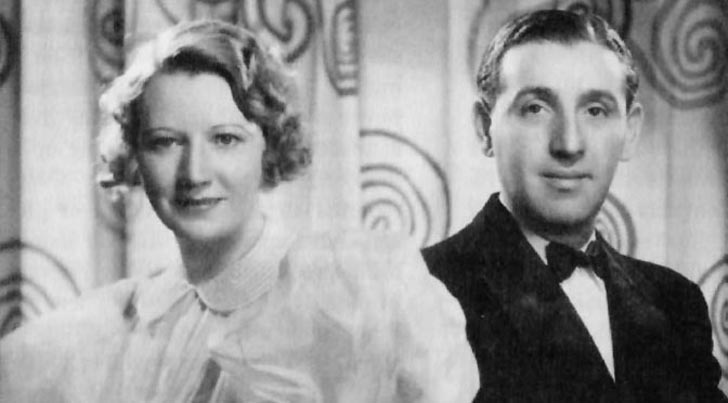
Quintessential British dance band vocalist Sam Browne was often Elsie Carlisle’s recording partner from 1932-1937. He continued to tour and broadcast with her after that, and even appeared with her on television.

Sam Browne – Wikipedia

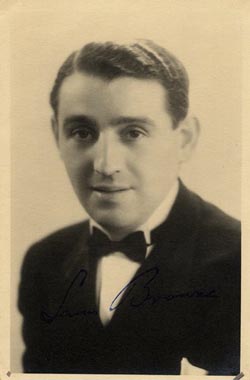
Sam Browne
Sam Browne

“What’s Good for the Goose Is Good for the Gander” (1934)

“What’s Good for the Goose Is Good for the Gander.” Lyrics and music by Cliff Friend (1934). Recorded by Sam Browne and “Girl Friend” (i.e. Elsie Carlisle) with piano accompaniment by Eddie Carroll and Bobby McGhee in London on March 2, 1934. Regal Zonophone MR 1254.

Sam Browne & Elsie Carlisle – “What’s Good for the Goose Is Good for the Gander” (1934)

In “What’s Good for the Goose,” Sam Browne and Elsie Carlisle take on the roles of a man and a woman who clearly have a history together. As each contemplates the possibility that the other is seeing other people, they begin to engage in an extended threat of tit-for-tat reciprocity by way of commonplace expressions, many involving barnyard animals (“What’s good for the goose is good for the gander”; “the little red hen”; “till the cows come home”). Sam and Elsie were famed for their songs of vituperation during this period (compare “I’m Gonna Wash My Hands of You”), leading the comedian B. C. Hilliam (“Mr. Flotsam”) to write in Radio Magazine

A crooner named Elsie Carlisle
Is a girl with a very nice stisle;
But the cheek that she gets
From Sam Browne in duets —
Now how can this chap be so visle?”

Songwriter Cliff Friend was a productive Tin Pan Alley composer remembered particularly for “My Blackbirds Are Bluebirds Now” and “The Merry-Go-Round Broke Down,” which provided the theme for Looney Tunes.

“What’s Good for the Goose” was recorded in February 1934 in New York by Chick Bullock, by Ozzie Nelson (as Owen Fallon and His Californians, with vocals by Ozzie Nelson and Harriet Hilliard), and by Dick Robertson. In London there were also versions done by the B.B.C. Dance Orchestra under the direction of Henry Hall (with vocals by Len Burmon), Harry Roy and His Orchestra, Jack Jackson and His Orchestra, and Howard Flynn and His Orchestra.
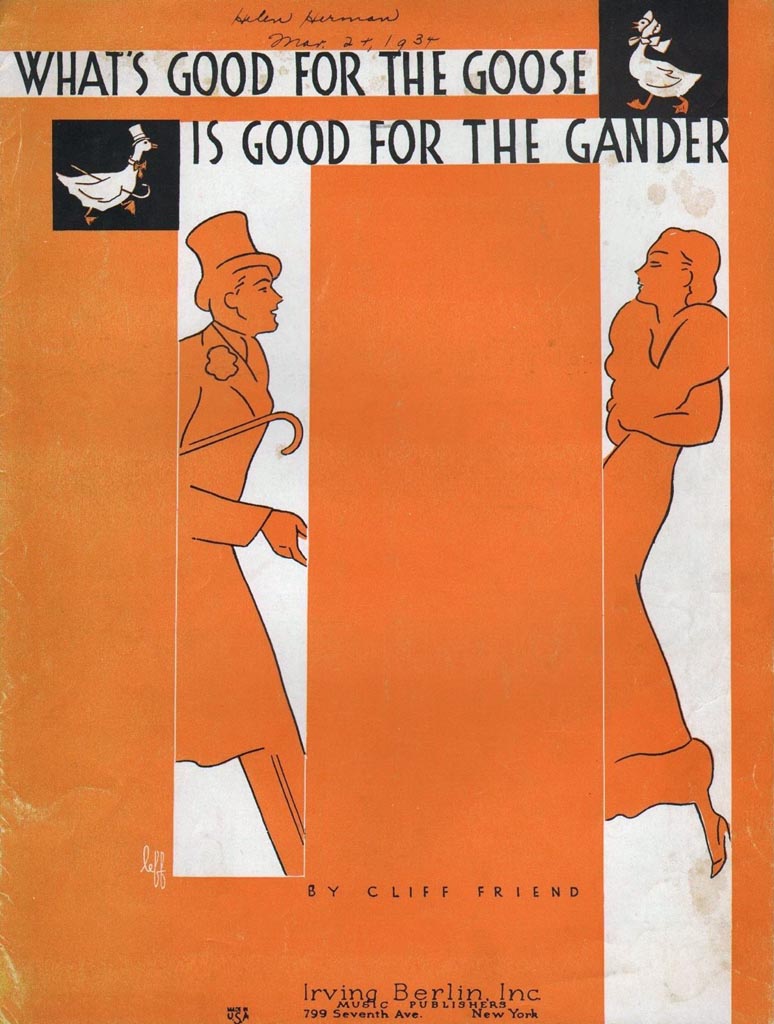
"What's Good for the Goose Is Good for the Gander" sheet music
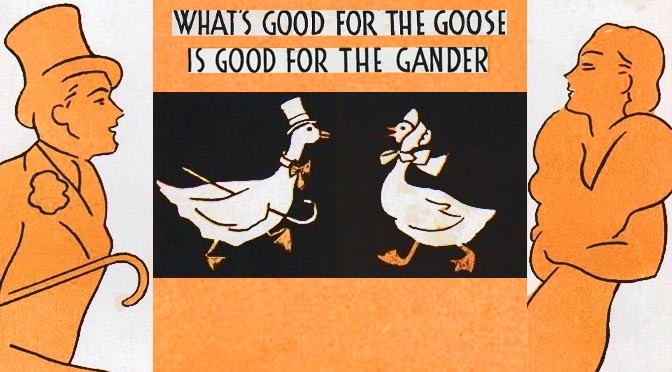
“What’s Good for the Goose Is Good for the Gander” sheet music

“Gee, Oh Gosh, I’m Grateful!” (1934)

“Gee, Oh Gosh, I’m Grateful!” Words by Michael Carr, music by Max and Harry Nesbit (1934). Recorded by Sam Browne and “Girl Friend” (i.e. Elsie Carlisle), accompanied on the piano by Eddie Carroll and Bobbie McGhee, in London on March 2, 1934. Regal Zonophone MR-1254 CAR-2593-1.

Sam Browne & Elsie Carlisle – “Gee, Oh Gosh, I’m Grateful!” (1934)

“Gee, Oh Gosh, I’m Grateful!” was a collaboration between composer Michael Carr, who wrote other songs that Elsie Carlisle recorded, including “The Little Boy That Santa Claus Forgot” and “You’re in My Arms,” and the music hall comedian brothers Max and Harry Nesbit. In this 1934 Regal Zonophone recording, the song is a duet between “Sam Browne & Girl Friend.” The identification of “Girl Friend” as Elsie Carlisle is universally accepted on the strength of aural evidence, and the pair performs “What’s Good for the Goose is Good for the Gander” on the other side of the record.

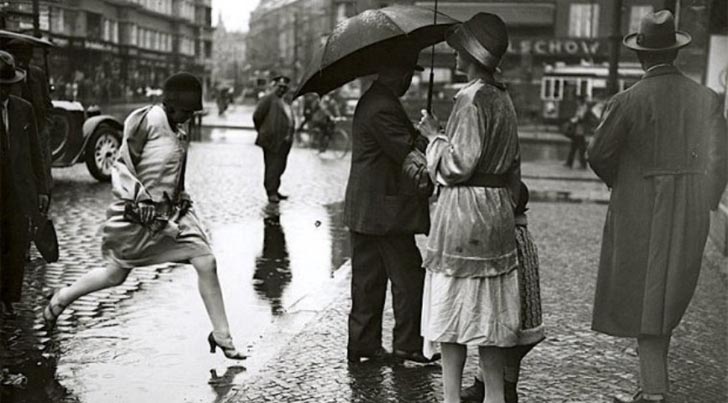
The scenario laid out in the lyrics of “Gee, Oh Gosh, I’m Grateful!” is a light and simple one: a bachelor and a single woman are out walking when their sudden attraction to one another coincides with a rainy downpour. No sooner has the chivalrous man shared his umbrella with the woman than…they are married with a house and baby — a quick and amusing transition. A comparable use of weather to bring potential lovers together can be found in the following year’s “Isn’t This a Lovely Day (To Be Caught in the Rain)?” sung by Fred Astaire in the Irving Berlin musical film Top Hat.

“Gee, Oh Gosh, I’m Grateful” was recorded soon afterwards by Ambrose and His Orchestra (v. Sam Browne) and by Roy Fox and His Band, with Denny Dennis as vocalist.

“I’m Gonna Wash My Hands of You” (1934)

“I’m Gonna Wash My Hands of You.” Words by Eddie Pola, with music by Franz Vienna (a.k.a. Franz Steininger). Recorded by Ambrose and His Orchestra, with vocal chorus by Sam Browne and Elsie Carlisle on November 20, 1934. Decca F. 5318 mx. GB6777-1.

Personnel: Bert Ambrose dir. Max Goldberg-t-mel / Harry Owen-t / t / Ted Heath-Tony Thorpe-tb / Danny Polo-reeds / Sid Phillips-reeds / Joe Jeannette-as / Billy Amstell-reeds / Bert Barnes-p / Joe Brannelly-g / Dick Ball-sb / Max Bacon-d

Ambrose & His Orchestra (w. Sam Browne & Elsie Carlisle) – “I’m Gonna Wash My Hands of You” (1934)

This foxtrot of vituperation is particularly suited to Sam Browne and Elsie Carlisle, who had convincingly played the part of the bickering couple in “Seven Years With the Wrong Woman” in 1932. “I’m Gonna Wash My Hands of You” has lyrics by Eddie Pola, who co-wrote other songs that Elsie recorded, such as “My Canary Has Circles Under His Eyes,” “I Wish I Knew a Bigger Word Than Love,” and “Till the Lights of London Shine Again.” As the flip side to “No! No! A Thousand Times No!” “I’m Gonna Wash My Hands of You” is a suitably dramatic complement. It involves somewhat more genuine singing and somewhat less booming, mock-thespian declamation; moreover, it includes more opportunities for the instrumental excellence of Ambrose’s band to be heard. For this author, however, the high point of the song is when Elsie sings  “You cheat, you!  I wish you were a gong so I could beat you!” and Sam replies “You wanna beat me, huh?” This song’s excellence lies in its fundamental goofiness.

Nat Gonella made a particularly “hot” recording of “I’m Gonna Wash My Hands of You” in January 1935, and Billy Cotton followed suit the following month (with Teddy Foster as vocalist). The French group “Patrick et son orchestre de danse” (directed by Guy Paquinet, with Django Reinhardt on the guitar) turned out a pretty version in June 1935, with suitably sinister-sounding vocals by Maurice Chaillou. That year Pathé released a film short of “The Radio Three,” a female close-harmony group made up of Joy Worth, Kay Cavendish, and Ann Canning, singing a version of “I’m Gonna Wash My Hands of You” that recalls the style of the Boswell sisters.

“No! No! A Thousand Times No!” (1934)

“No! No! A Thousand Times No!” Words and music by Al Sherman, Al Lewis, and Abner Silver (1934). Recorded by Ambrose and His Orchestra on November 20, 1934, with vocal chorus by Sam Browne and Elsie Carlisle. Decca F-5318 mx. GB-6772-2.

Personnel: Bert Ambrose dir. Max Goldberg-t-mel / Harry Owen-t / t / Ted Heath-Tony Thorpe-tb / Danny Polo-reeds / Sid Phillips-reeds / Joe Jeannette-as / Billy Amstell-reeds / Ernie Lewis-Reg Pursglove-others?-vn / Bert Barnes-p / Joe Brannelly-g / Dick Ball-sb / Max Bacon-d

Ambrose & His Orchestra (w. Sam Browne & Elsie Carlisle) – “No! No! A Thousand Times No!”

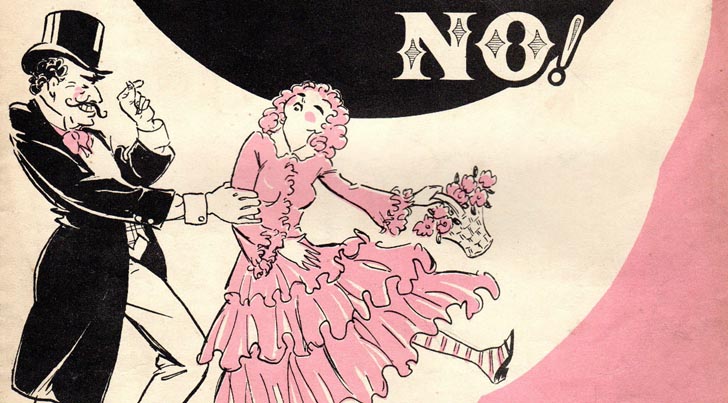
In “No! No! A Thousand Times No!” Sam Browne and Elsie Carlisle evoke the spirit of Victorian stage melodrama with its stock heroes: the damsel in distress, the villain, the hero. By 1934 melodrama risked seeming hackneyed and passé, and this novelty waltz accordingly treats the genre as a source of bathetic farce. The orchestra serves as a competent background to a long series of dramatic lines almost belted out, or even shouted out, rather than sung, with Sam and Elsie employing strangely exaggerated pronunciations to emphasize their ridiculously stylized sentiments.

“No! No! A Thousand Times No!” seems to have made quite an impression on the public. The 1934 Wills’s and 1935 Ardath Elsie Carlisle cigarette card reverse sides suggest it as one of Elsie’s two most popular songs, which is interesting, as she sang quite a few memorable songs in those years, including other very good ones with Sam Browne. That this comical waltz had staying power is attested to by its appearing in Elsie’s top-two list in her 1977 London Times obituary.

“No! No! A Thousand Times No!” was recorded in America by Harry McDaniel and His Orchestra in November 1934. It seems to have been more popular with British artists, however, with versions done in late 1934 and early 1935 by the New Mayfair Dance Orchestra (under the direction of Percival Mackey, with vocals by Bobbie Combier), Jan Ralfini and His Band, Phyllis Robins and Pat O’Malley, and Leslie Sarony and “Girl Friend” (identity unknown). In May 1935 Max Fleischer released a Betty Boop short film featuring the themes and music of “No! No! A Thousand Times No!” under the same title.

The National Portrait Gallery has three photographs of Sam Browne with Elsie Carlisle at the 1935 Radio Olympia Exhibition, in two of which they appear to be in costume for this very number (NPG x224380 and NPG x224381).

I discuss this song in greater detail in my article “Elsie Carlisle’s Top Hits, Then and Now” in the December 2014 issue of the Discographer Magazine.

A Limerick from “Radio Magazine” (June, 1934)

A limerick about Elsie Carlisle and Sam Browne:

A crooner named Elsie Carlisle
Is a girl with a very nice stisle;
But the cheek that she gets
From Sam Browne in duets —
Now how can this chap be so visle?”

– B. C. Hilliam, the “Mr. Flotsam” of the musical comedy duo “Flotsam and Jetsam”

Ambrose & His Orchestra (w. Sam Browne & Elsie Carlisle) – “I’m Gonna Wash My Hands of You” (1934)

"The Idol of the Radio." British dance band singer of the 1920s, 1930s, and 1940s.