Bands & Directors

“Fare Thee Well, Annabelle” (1935)

“Fare Thee Well, Annabelle.”  Words by Mort Dixon, music by Allie Wrubel (1934).  Recorded on June 20, 1935 by Ambrose and His Orchestra, with vocals by Donald Stewart, Elsie Carlisle, and the Rhythm Brothers.  Decca F. 5590.

Personnel: Bert Ambrose dir. Max Goldberg-t-mel / Harry Owen and 1 unknown-t / Ted Heath-Lew Davis-tb / Danny Polo-cl-as-bar / Sid Phillips-cl-as-bar / Joe Jeannette-as / Billy Amstell-cl-ts / Ernie Lewis-Reg Pursglove-vn / Bert Barnes-p /Joe Brannelly-g /Dick Ball-sb /Max Bacon-d

Ambrose and his Orchestra – “Fare Thee Well, Annabelle” (1935)

Transfer by Charles Hippisley-Cox

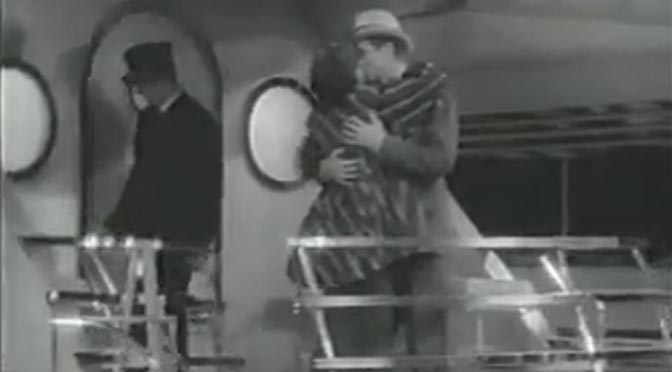
Mort Dixon and Allie Wrubel wrote “Fare Thee Well, Annabelle” in 1934; it was introduced in 1935 by Rudy Vallée and Ann Dvorak in the film Sweet Music.  The Ambrose Orchestra’s version does justice to this admirable example of the “train song” genre; it lacks the lollapalooza tap dancing sequence of the film, but its simulated train sounds evoke the original context of the song nicely, and Donald Stewart and Elsie Carlisle make suitable stand-ins for the movie actors.

Notable Americans to record “Fare Thee Well, Annabelle” that year were Glen Gray and the Casa Loma Orchestra (with Pee Wee Hunt as vocalist), Charlie Barnet (with singer Marion Nichols), Ted Fio Rito and His Orchestra (with vocals by Muzzy Marcellino and The Debutantes), Chick Bullock and His Levee Loungers, Wingy Manone, and the Boswell Sisters (recording in London).

In 1935 Britain would hear other recordings of “Fare Thee Well, Annabelle” by the Debroy Somers Band (with Brian Lawrance as vocalist), Billy Merrin and His Commanders (Ken Crossley, vocalist), Harry Roy and His Orchestra (Bill Currie, vocalist), Sidney Kyte and His Piccadilly Hotel band (with Norman Phillips singing), and Joe Loss and His Radio Band.
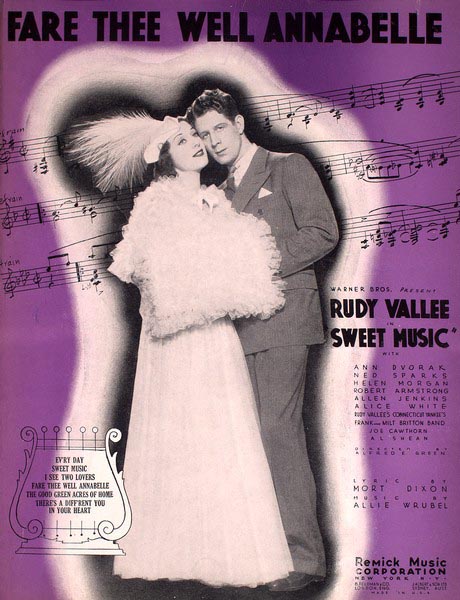
"Fare Thee Well, Annabelle" sheet music featuring Rudy Vallée and Ann Dvorak
“Fare Thee Well, Annabelle” sheet music featuring Rudy Vallée and Ann Dvorak

“Let That Be a Lesson to You” (1932)

“Let That Be a Lesson to You.”  Words and music by Isham Jones (1932).  Recorded by Ray Starita and His Ambassadors with vocals by Elsie Carlisle on June 15, 1932.  Sterno 985.

Personnel: Ray Starita-cl-ts dir. Sid Buckman-Nat Gonella-t / tb / ?Chester Smith-cl-as-bar-o / Nat Star-cl-as / George Glover-cl-ts-vn / George Hurley-vn / Harry Robens-p / George Oliver-bj-g / Arthur Calkin-sb / Rudy Starita-d-vib-x

Let That Be a Lesson to You – Ray Starita and his Ambassadors (w. Elsie Carlisle)

Transfer by Charles Hippisley-Cox

“Let That Be a Lesson to You” has a long instrumental introduction that is mellow but catchy, and one might almost expect it to lead up to a conventional love song. The vocal refrain, however, consists of Elsie Carlisle scolding her love for being unfaithful and returning to her in disgrace. In spite of this theme, the sound of the piece somehow fits in nicely with Elsie’s other work with Ray Starita’s band in 1932, the only year of their collaboration. It is light and dreamy; one might compare its atmosphere to “Leave Me Alone With My Dreams” or “On a Dreamy Afternoon.”

In 1932 “Let That Be a Lesson to You” was recorded in America by the Isham Jones Orchestra and by the Coon-Sanders Orchestra.  In Britain, in addition to the Starita recording with Elsie Carlisle, there were versions by the Savoy Hotel Orpheans (with Chick Endor and Charlie Farrell as vocalists), by Jay Wilbur and His Band (with vocals by Tom Barratt), and by Sam Browne and Eve Becke (under the pseudonyms “Jack and Jill”).

R.I.P. Bob Hoskins

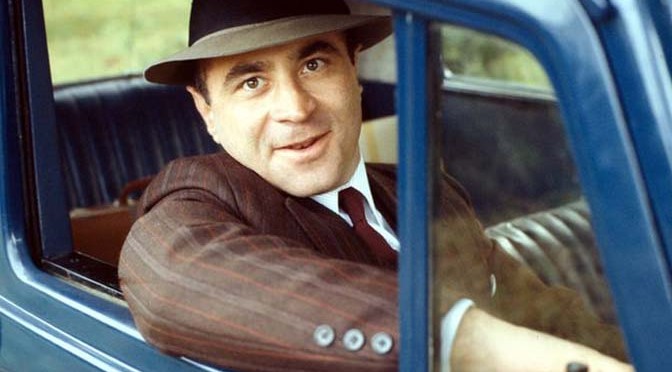
English actor Bob Hoskins passed away today at the age of 71. His thespian accomplishments are too numerous to mention, although this writer particularly recommends seeing him in Terry Gilliam’s Brazil (1985) and in Mermaids (1990). I mention him here, however, because of his starring role in Dennis Potter’s 1978 television mini-series “Pennies from Heaven” as Arthur Parker, a traveling sheet music salesman, for which he won a BAFTA TV Award for Best Actor. That show reintroduced a younger generation to the British dance band music of the 1930s, and has notable actors miming original recordings, one of which is featured here for obvious reasons.

Bob Hoskins as Elsie Carlisle, singing “The Clouds Will Soon Roll By”:

Dennis Potter’s ‘Pennies From Heaven’ – ‘The Clouds Will Soon Roll By’

Video from songanddanceman1234 (YouTube)

Her Majesty the Baby

On April 15, 1896, Elsie Carlisle was baptized in the parish of St. James’, Collyhurst, in Greater Manchester. The parish registry gives the date of the baptism and lists her birth as having occurred earlier in the same year, on January 28. Her parents’ names were James and Mary Ellen. They lived at 7 Whitehead St., and her father was described as a greengrocer.

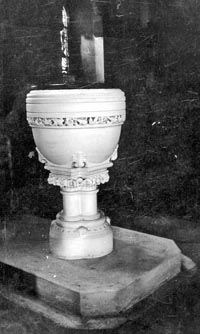
The baptismal font in use in St. James', Collyhurst in 1971
The baptismal font in use in St. James’, Collyhurst in 1971

And now, for a semi-topical musical interlude:

“His Majesty the Baby.” Music by Mabel Wayne, words by Neville Fleeson and Arthur Terker (1935). Recorded by Elsie Carlisle with Ambrose and His Orchestra on January 11, 1935. Decca F. 5379.

His Majesty The Baby. Ambrose & His Orchestra. 1935.

Video by 85scampi (YouTube)

Elsie recorded the song again the next day without Ambrose. Other versions made the very same month were by Henry Hall, Billy Merrin, the New Mayfair Dance Orchestra, Lou Preager, Harry Roy, Jay Wilbur, and Eddie Wood.

“She Had Those Dark and Dreamy Eyes”

Clive Hooley has given us quite a treat: an Elsie Carlisle song recorded 73 years ago that was not previously on the Internet and is on no vinyl album or CD that I have ever seen. It is a wartime tune on the flip side of the album with the famous “Hut Sut Song.” Copyrighted in 1941, “She Had Those Dark and Dreamy Eyes” appears to have its roots in older sea shanties, and recurs in a truly filthy form in the doggerel of WWII airmen.1

“She Had Those Dark and Dreamy Eyes.” Music and words by Jimmy Hughes and Ted Douglas (1941). Recorded by Elise Carlisle on July 4, 1941. Rex 10021.

She Had Those Dark and Dreamy Eyes, Elsie Carlisle, 1941

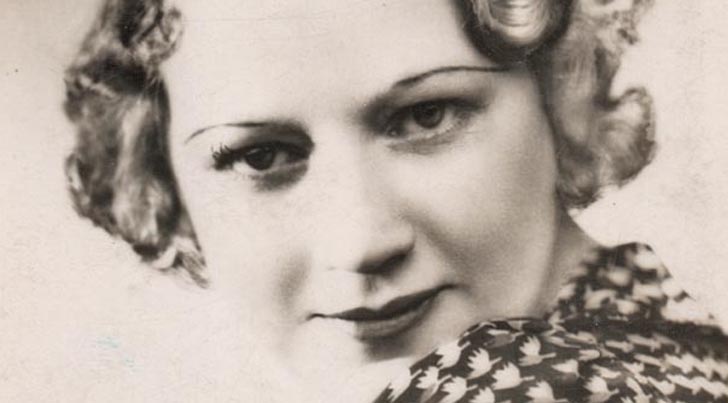
"The Idol of the Radio." British dance band singer of the 1920s, 1930s, and 1940s.