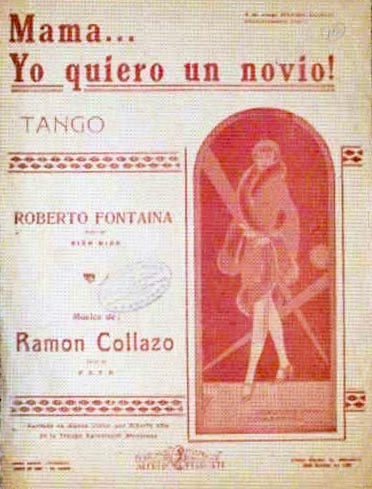
“Mama, I Long for a Sweetheart.” Music by Ramón Collazo; original Spanish lyrics by Roberto Fontaina; English translation by Carol Raven. Recorded by Elsie Carlisle with orchestral accompaniment on June 20, 1935. Decca F. 5586.
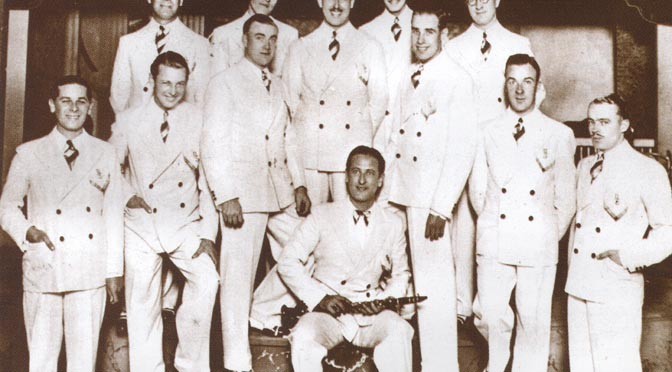
This popular 1928 tango by Uruguayan composer Ramón Collazo saw new life in a 1934 English translation by American lyricist Carol Raven. It was recorded that year by the Dorsey Brothers Orchestra, whose version was distributed on both sides of the Atlantic. Elsie Carlisle is not usually associated with the tango genre, but she executes the piece convincingly. It is, perhaps, worth comparing the overall effect of her version to the 1929 recording of the Spanish-language original by the Orchestra Argentina Bachicha.
“Let That Be a Lesson to You.” Words and music by Isham Jones (1932). Recorded by Ray Starita and His Ambassadors with vocals by Elsie Carlisle on June 15, 1932. Sterno 985.
Personnel: Ray Starita-cl-ts dir. Sid Buckman-Nat Gonella-t / tb / ?Chester Smith-cl-as-bar-o / Nat Star-cl-as / George Glover-cl-ts-vn / George Hurley-vn / Harry Robens-p / George Oliver-bj-g / Arthur Calkin-sb / Rudy Starita-d-vib-x
“Let That Be a Lesson to You” has a long instrumental introduction that is mellow but catchy, and one might almost expect it to lead up to a conventional love song. The vocal refrain, however, consists of Elsie Carlisle scolding her love for being unfaithful and returning to her in disgrace. In spite of this theme, the sound of the piece somehow fits in nicely with Elsie’s other work with Ray Starita’s band in 1932, the only year of their collaboration. It is light and dreamy; one might compare its atmosphere to “Leave Me Alone With My Dreams” or “On a Dreamy Afternoon.”
In 1932 “Let That Be a Lesson to You” was recorded in America by the Isham Jones Orchestra and by the Coon-Sanders Orchestra. In Britain, in addition to the Starita recording with Elsie Carlisle, there were versions by the Savoy Hotel Orpheans (with Chick Endor and Charlie Farrell as vocalists), by Jay Wilbur and His Band (with vocals by Tom Barratt), and by Sam Browne and Eve Becke (under the pseudonyms “Jack and Jill”).
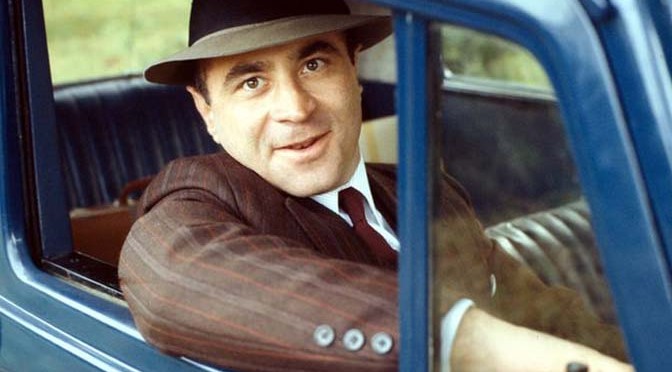
English actor Bob Hoskins passed away today at the age of 71. His thespian accomplishments are too numerous to mention, although this writer particularly recommends seeing him in Terry Gilliam’s Brazil (1985) and in Mermaids (1990). I mention him here, however, because of his starring role in Dennis Potter’s 1978 television mini-series “Pennies from Heaven” as Arthur Parker, a traveling sheet music salesman, for which he won a BAFTA TV Award for Best Actor. That show reintroduced a younger generation to the British dance band music of the 1930s, and has notable actors miming original recordings, one of which is featured here for obvious reasons.
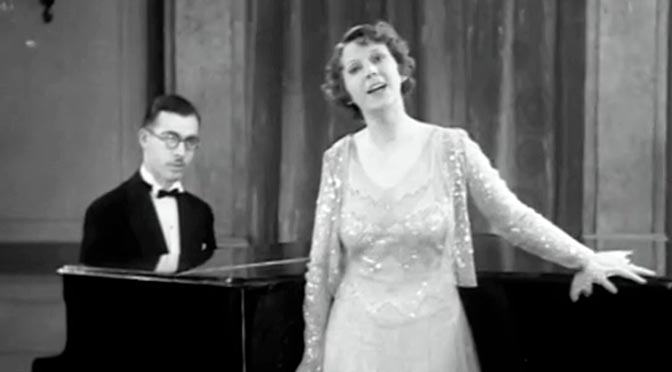
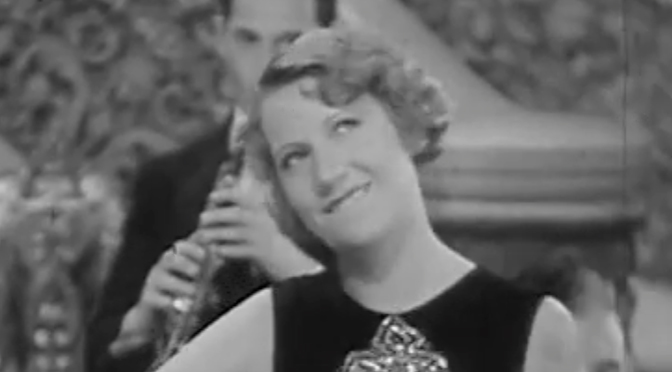
This 1931 Pathétone film clip shows Elsie Carlisle, accompanied by Harry Rubens at the piano, singing “Alone and Afraid” and “My Canary Has Circles Under His Eyes.”
“Alone and Afraid.” Music by Jack Trent, words by Stan Leigh (1931). Recorded the same year by Jerry Hoey and His Band (Joe Leigh, vocalist), Jack Payne, and Arthur Lally (Maurice Elwin and Cavan O’Connor, vocalists). This song would be part of the soundtrack of the Stanley Lupino movie “The Love Race.”
Radio Parade (1933) is a variety film featuring such stars of the time as Clapham and Dwyer, Gert and Daisy, Reginald Gardiner, Florence Desmond, and Roy Fox, but it is most notable for showing, in reel 2,
ELSIE CARLISLE SINGING ON FILM FOR NEARLY EIGHT MINUTES!
Elsie sings such numbers as “It’s Great to Be in Love,” “He Raised His Hat,” “The Girl Next Door,” “Here Am I (Brokenhearted)” and “You’ve Got Me Crying Again,” and ends with a reprise of “It’s Great to Be in Love.” She descends stairs from a balcony wearing a fur-lined stole, engages in occasional banter with her nattily dressed band, sits on the piano and rocks back and forth fetchingly (fiddling constantly with a black silk scarf), takes off the stole, sings to a portrait (which she ultimately veils with the scarf), and ultimately returns to the balcony.
Radio Parade (1933) Reel 2 could justly be considered the Citizen Kane of Elsie Carlisle film shorts (of which there are four extant, to my knowledge). It is a precious reminder that Elsie was not just a consummately talented recording artist and radio celebrity; she was also the accomplished stage actress whom Cole Porter personally chose to sing “What Is This Thing Called Love?”1
UPDATE: Peter Wallace and Charles Hippisley-Cox note that personnel are Joe Brannelly on the guitar, Don Stutely on the string bass, Max Goldberg on the trumpet, Billy Amstell and Joe Jeannette on the clarinet, and Bert Read on the piano. The latter wrote a moving tribute to Elsie shortly after her death. Christopher Stone is the announcer at the beginning of the short.
Notes:
Richard J. Johnson, “Elsie Carlisle (with a different style). Part Two.” Memory Lane 175 (2012): 40 ↩
"The Idol of the Radio." British dance band singer of the 1920s, 1930s, and 1940s.