“Oh, My Bundle of Love” (1926)

“Oh, My Bundle of Love.” Words by George Price, music by Abner Silver. Recorded by Elsie Carlisle with piano accompaniment by Carroll Gibbons on October 6, 1926. Zonophone 2829.
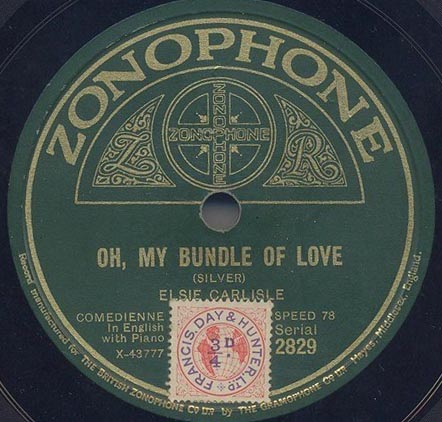
Elsie Carlisle's "Oh, My Bundle of Love" on Zonophone 2829 (label). Image courtesy of Erik Høst.
Elsie Carlisle’s “Oh, My Bundle of Love” on Zonophone 2829. Image courtesy of Erik Høst.

Elsie Carlisle – “Oh, My Bundle of Love” (1926)

Original 78 rpm transfer by Erik Høst

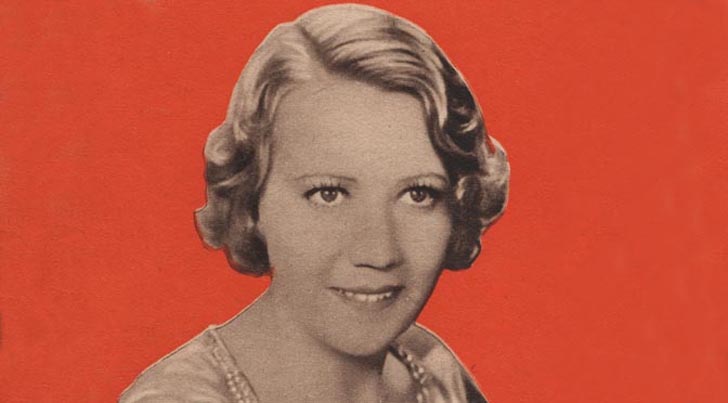
Elsie Carlisle sang “Oh, My Bundle of Love”1 at her third recording session, for her third record, accompanied, as she always would be that year, by a 23-year-old Carroll Gibbons on the piano. The composition has a bubbly energy typical of the dance music of its period, and the lyrics express the goofy enthusiasm of a young lover by way of precious, cutesy colloquialisms (e.g. “sweetie-sweet”). For this song, Elsie dons a persona of somewhat mindless ebullience that reminds me of her 1930 version of “Wasn’t It Nice?”; she is the picture of pure, giggly fun. The recording is also a good example of Carroll Gibbons’s developing piano virtuosity (he would not be known as a band leader for another year).

“My Bundle of Love” was recorded in America in 1925 by Gene Austin (accompanied by Jack Shilkret on the piano) and by Cliff “Ukulele Ike” Edwards. In 1926 there were versions by Mal Hallett and His Orchestra, Emerson Gill and His Castle of Paris Orchestra (with vocals by Pinkey Hunter), Ben Bernie and His Hotel Roosevelt Orchestra, The Southerners (with vocalist Jack Kaufman), and Nick Lucas.  There is a piano roll of the song from that year by Ralph Reichenthal (a.k.a Ralph Rainger), the composer of “Moanin’ Low,” amongst other successful tunes.

Elsie Carlisle’s 1926 recording of “Oh, My Bundle of Love” was preceded that year in Britain by a take by Jay Whidden and His New Midnight Follies Band (rejected by Columbia) and by a version by Jack Hylton and His Orchestra.

Notes:

  1. “Oh, My Bundle of Love” more commonly has the simpler title of “My Bundle of Love,” and why not? The expression “Oh, My Bundle of Love” does not occur in the song.

“A Place in Your Heart” (1934)

“A Place in Your Heart.” Words and music by Sam Coslow. Recorded by Elsie Carlisle with orchestral accompaniment on June 14, 1934. Decca F-5071 mx. TB-1320-2.

Elsie Carlisle – “A Place in Your Heart” (1934)

“A Place in Your Heart” is a comparatively conventional love song whose lyrics feature the singer’s professed wish to inhabit a metaphorical dwelling place in her lover’s heart (“Some secret little corner where I’d stay, / Lock the door and throw the key away….”). The tune is pleasant and catchy, but the strongest point of Elsie Carlisle’s version of the song is her passionate yet sincere interpretation of its themes. The extent to which she made the song her own can be gauged by comparing her version to that of composer Sam Coslow himself.

“A Place in Your Heart” was also recorded that year in Britain by Ambrose and His Orchestra (with vocalist Sam Browne), the BBC Dance Orchestra (under the direction of Henry Hall, with vocals by Les Allen, in a Van Phillips arrangement — at a recording session which also featured vocals by composer Sam Coslow himself, singing another of his songs, “Cupid”), The Masterkeys (vocals by Leslie Douglas), Jack Payne and His Band (with Ronnie Genarder), and Louis Freeman and His Playhouse Band.

“Coming Thro’ the Cornfield” (1926)

“Coming Thro’ the Cornfield.” Words and music by Horatio Nicholls (a.k.a. Lawrence Wright). Recorded by Elsie Carlisle with piano accompaniment  by Carroll Gibbons on June 21, 1926 at the Gramophone Company’s Studio B at Hayes in Middlesex. Zonophone 2772 mx. Yy8563-2.

Elsie Carlisle – “Coming Thro’ the Cornfield” (1926)

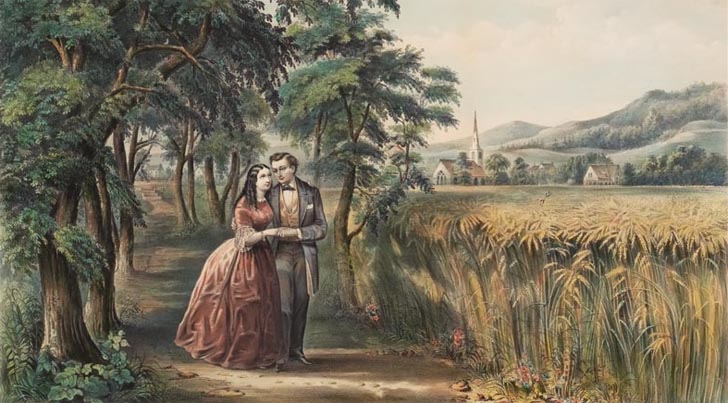
Elsie Carlisle sang “Coming Thro’ the Cornfield” at her second recording session for what was to be her second record, accompanied by pianist Carroll Gibbons, who would soon become the famed director of the Savoy Hotel Orpheans. The song was written by performer, music publisher, impresario, and composer Lawrence Wright, who tended to use the pseudonym “Horatio Nicholls” on his own original compositions. Elsie handles this effusive expression of love in a rustic setting with her usual sweetness, and the pairing with “I Love My Baby” on the other side of the record allows her to adopt the personae of two very different girls in love.

“Coming Thro’ the Cornfield” was recorded two days later by the Savoy Havana Band, in late July 1926 by Bert Firman’s Dance Orchestra, and again in late September by Bert Firman’s band (as “Newton Carlisle’s Dance Orchestra” on Homochord and as “Dan Frederick and His Dance Orchestra” on Sterno).

“My Dog Loves Your Dog” (1934)

“My Dog Loves Your Dog.” Music by Ray Henderson, lyrics by Jack Yellen and Irving Caesar for the film George White’s Scandals (1934). Recorded by Elsie Carlisle and Sam Browne with orchestral accompaniment on June 22, 1934. Decca F. 5079.

Elsie Carlisle & Sam Browne – “My Dog Loves Your Dog” (1934)

The various annual installments of George White’s Scandals, a famed series of Broadway revues which ran from 1919-1939, were responsible for introducing the world to countless people who would eventually become Hollywood stars, as well as to the early music of George Gershwin. In 1934 the music of the stage show was combined with a somewhat more robust plot and made into a feature film, George White’s Scandals (1934), starring Alice Faye, Rudy Vallée, Cliff Edwards, and Jimmy Durante. One long scene in that movie involves the male characters walking dogs in tandem with the female characters and engaging in lengthy observations about canine amorousness that always lead to the conclusion “If our doggies love each other, why can’t we?” Foremost among the singers of “My Dog Loves Your Dog” is Jimmy Durante, who at one point is shown in a dog collar, with his head in a woman’s lap, having his famously protuberant “schnozz” petted.

In June, Elsie Carlisle and Sam Browne would tackle the song themselves, but with less than three minutes to sing it — including an instrumental interlude — they present a considerably abbreviated version. Their male-female duet adds flavor to the song, though, and ultimately allows the entrance of the element of strife between lovers that one would expect in a Sam-and-Elsie bit. When Sam first accosts Elsie and begins to observe the growing familiarity of their respective dogs, she responds, “Yes.  Someone mentioned it today. You can see it in their eyes” in a stilted delivery that must either betoken haughtiness on the part of Elsie’s character or perhaps exhaustion on the part of Elsie herself! Either way, I find her awkward beginning intensely funny. Some very nice singing ensues, but Elsie’s observations about the dogs ultimately serve as a riposte to Sam’s advances. The dogs begin to fight, and the two singers conclude “And if our doggies bite each other, why can’t we?” — a comic twist not present in the movie.

“My Dog Loves Your Dog” was also recorded that year by the Dorsey Brothers Orchestra (as Bob Snyder and His Orchestra, with vocalist Kay Weber), by Cliff Edwards, one of the stars of the original movie sequence, Victor Young and the Brunswick Studio Orchestra, and Harry Roy and His Orchestra (with vocals by Bill Currie). Jay Wilbur and His Band did a medley based on the Scandals in which Mona Brandon and Sam Browne sing “My Dog Loves Your Dog.”

“Mr. Magician” (1934)

“Mr. Magician (Won’t You Bring My Honey Back to Me?).” Words and music by Charles O’Flynn, James Cavanaugh, and Frank Weldon (1934). Recorded by Elsie Carlisle and Sam Browne with orchestral accompaniment on June 22, 1934. Decca F. 5079.

Elsie Carlisle and Sam Browne – “Mr. Magician” (1934)

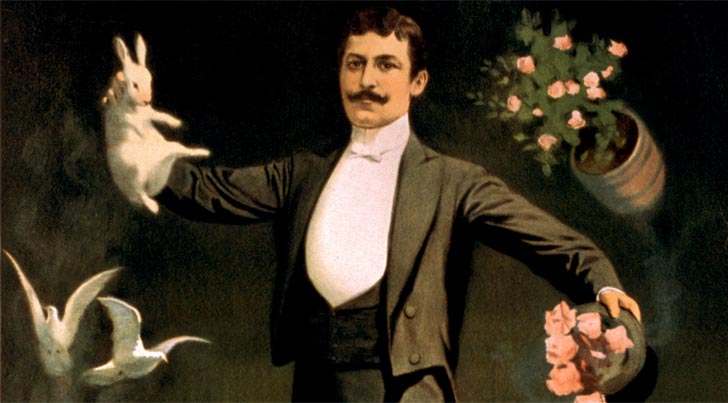
O’Flynn, Cavanaugh, and Weldon were prominent Tin Pan Alley songwriters, but their 1934 “Mr. Magician” does not appear to have inspired many recordings. It may have seemed outrageously corny even by the standards of the time (consider the lines of the refrain: “Hocus, pocus, Mr. Magician, won’t you bring my honey back to me?”). All the same, this melodramatic arrangement (complete with an anonymous carnival barker, with Sam Browne as a grandiose, boasting circus magician, and with Elsie Carlisle as an earnest girl who wants to “find [her] man somehow”) has a certain appeal. Elsie plays the Dorothy to Sam’s Great Oz with a comical insistence; the whole piece is cartoonish, funny, and sweet.

New York-based Sam Robbins and His Orchestra had done a catchy version of the song in January, 1934, followed by Ozzie Nelson and His Orchestra (with vocalists Ozzie Nelson and Harriet Hilliard) in February). In Britain Harry Roy and His Orchestra had recorded it with vocals by Bill Currie in mid-May; the latter version includes the following priceless exchange:

— “I say, Mr. Magician, won’t you bring my baby back to me?

— “Sorry, I need her for myself!”