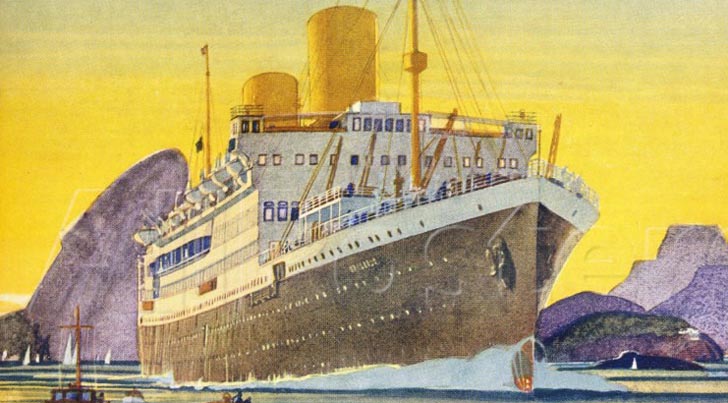
“On a Steamer Coming Over” (1933)

“On a Steamer Coming Over (What Could We Do?)” Words by Joe Goodwin and Henry Bergman, music by Lou Handman. Composed for The Cotton Club Parade of 1933. Recorded by Elsie Carlisle with orchestral accompaniment on December 19, 1933. Decca F-3812 mx. GB-6425-2.

Elsie Carlisle – “On a Steamer Coming Over” (1933)

“On a Steamer Coming Over” originated in The Cotton Club Parade of 1933 (the same New York stage revue that featured “Stormy Weather”). Introduced by Aida Ward, it was also Lena Horne’s first Manhattan solo at a time when the latter was just a chorus girl and understudy.1 The song dramatizes an encounter between a woman and a man on a presumably trans-Atlantic ocean liner (it does not specify which direction they were going). Their romance grows and thrives because the couple has lots of time and nothing else to do, and they seem destined for marriage. The song thus encapsulates a popular twentieth-century motif in which the confinement of a long ocean journey is taken as as a source of happiness, rather than being understood as a modern nuisance.

Listening to Elsie Carlisle’s recording of “On a Steamer Coming Over,” I am first struck by the sound effects. There is an extraordinarily realistic simulated ship’s horn, as well as sounds of splashing ocean water throughout. We have no idea who the instrumentalists are — that is frequently the case with Elsie’s Decca recordings — but they perform admirably, particularly the pianist, who at the end of the song seems to be mimicking on his instrument the sound of the eddying water. Elsie seems to have fully embraced the song’s almost trance-inducing repetitiveness, which, like an ocean voyage, has the potential to go on indefinitely — and perhaps we might like it to. Her vocals are marked by a special sweetness and earnestness.

The only American recorded version that I have found is that of the Meyer Davis Orchestra (with vocalist Charlie Palloy). The song was widely recorded by British artists in December 1933, including the BBC Dance Orchestra (under director Henry Hall, with vocalists Phyllis Robins and Les Allen), Roy Fox and His Band (with vocalist Denny Dennis), Billy Cotton and His Band (with Alan Breeze), Ambrose and His Orchestra (with Sam Browne), Ray Noble and His Orchestra (with Al Bowlly), Howard Flynn and His Orchestra (with vocals by Dan Donovan), Jay Wilbur and His Band (with Phyllis Robins and Sam Browne), and Jack Payne and His Band (with Jack Payne singing the lyrics). In January 1934 there were versions recorded by Charlie Kunz and the Casani Club Orchestra (with vocal refrain by Eve Becke), Harry Leader and His Band (with Sam Browne), Harry Roy and His Orchestra (with Ivor Moreton), Peggy Cochrane, and The Three Ginx.
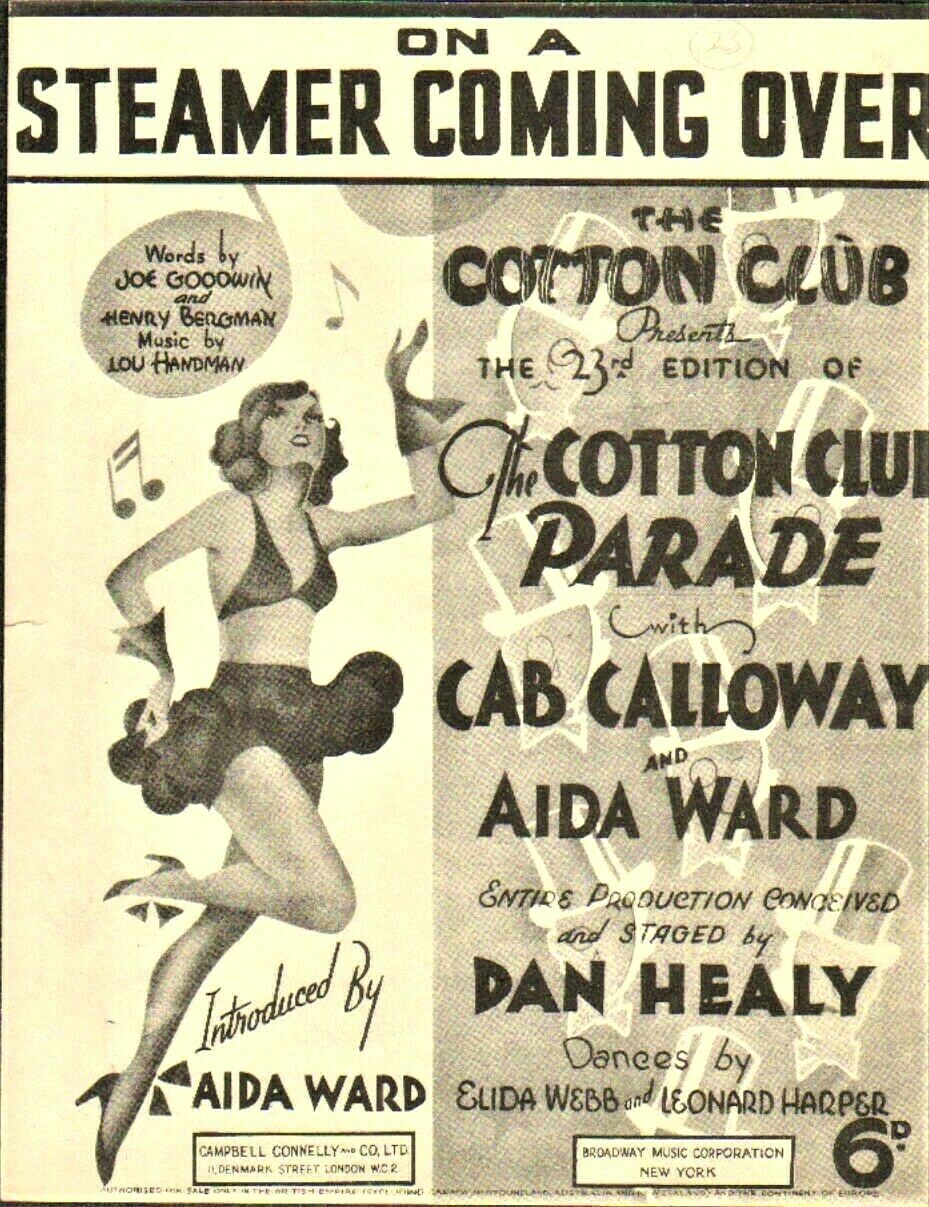
"On a Steamer Coming Over" (1933) sheet music

Notes:

  1. James Gavin, Stormy Weather, United Kingdom: Atria Books, 2009, 39.

“The Gentleman Obviously Doesn’t Believe” (1935)

“The Gentleman Obviously Doesn’t Believe.” Words and Music by Michael Carr and Eddie Pola. Recorded by Elsie Carlisle with orchestral accompaniment on May 28, 1935. Decca F. 5568 mx. GB7167-1.

Elsie Carlisle – “The Gentleman Obviously Doesn’t Believe” (1935)

“The Gentleman Obviously Doesn’t Believe” is a catalogue of traits that a certain attractive, anonymous man lacks: he has no fondness for drinking, smoking, dancing, modern popular music, or, most importantly, romance. Through her complaint about the man’s various deficits, the singer reveals herself to be passionate about all of life’s pleasures, and she encourages her audience to identify with her position (“like me…and you…and you”). We are given the impression of a woman inexplicably drawn to her opposite. Elsie Carlisle brings to this recording a sweet sincerity that convincingly conveys both wonder for and enchantment with the attractively puzzling “gentleman.”

“The Gentleman Obviously Doesn’t Believe” had been recorded the previous month by Lew Stone and His Band, with vocals by Lew Stone himself. Later in 1935 there were American versions by Joe Haymes and His Orchestra (with vocalist Clifford Wetterau) and by the Dorsey Brothers’ Orchestra (with Kay Weber, who sings the introduction, whereas Elsie had merely recited it).

“Waiting for the Lights to Change” (1935)

“Waiting for the Lights to Change.” Composed by Cyril Ray. Recorded by Elsie Carlisle with orchestral accompaniment on May 28, 1935. Decca F. 5568 mx. GB7166-1.

Elsie Carlisle – “Waiting for the Lights to Change” (1935)

“Waiting for the Lights to Change” appears to have been recorded only by Elsie Carlisle. Its composer, Cyril Ray, was in 1935 primarily involved in directing the music for comedy films starring Leslie Fuller, but it is not at all certain that “Waiting for the Lights to Change” was part of a soundtrack. If it had been, one would expect to see the name of the movie printed on the record for marketing purposes.

This languid and melancholy song uses an extended traffic-related metaphor to describe the feeling of being at an impasse in life. At first the gridlock appears to be general, but soon we learn that the singer has encountered a more specific roadblock in her love life: a relationship represented by a street marked “THROUGH” that suddenly presents her with a red light — love thwarted. Elsie Carlisle, veteran torch singer, takes what is fundamentally a very repetitive song and uses it to create a somber atmosphere that is somehow deeply attractive, much as she had done earlier in 1935 with “I’ve Got an Invitation to a Dance.”

“Yes, My Darling Daughter” (1941)

“Yes, My Darling Daughter.” Words and music by Jack Lawrence and Albert Sirmay (1939). Recorded by Elsie Carlisle under the musical direction of Jay Wilbur on May 22, 1941. Rex 9989 mx. R5781-2.

Personnel: Jay Wilbur dir. Alfie Noakes-Chick Smith-t / Paul Fenoulhet or Ted Heath or George Rowe-tb / Frank Johnson-Frank Weir-cl-as / George Smith or Cliff Timms-ts / Matt Heft-p / Jack Simmons-g / Billy Bell-sb / Jack Simpson-d

“Yes, My Darling Daughter” – Elsie Carlisle (1941)

“Yes, My Darling Daughter” was written in New York by American songwriter Jack Lawrence and Albert Sirmay (or Szirmai), a former Hungarian operetta composer who had become an editor for Chappell Music. The tune has its roots, however, in a Ukrainian folk song that dates back to the early nineteenth century, if not earlier, and the modern composition retains a somewhat traditional atmosphere.  The lyrics describe the stages of a love relationship by way of an antiphonal, rapid-fire mother-daughter conversation, with both sides of the argument often delivered by the same singer. Such is the case with Elsie Carlisle, here in the last few months of her recording career. Elsie deftly conveys both sweet innocence on the daughter’s part and mature experience on that of the mother without seeming to take a pause.

“Yes, My Darling Daughter” was introduced to the public in 1940 as a duet between Dinah Shore and Eddie Cantor on the latter’s radio show, and the record she released soon afterwards helped to launch her career. The song was also recorded in America in 1940 by Gene Krupa and His Orchestra (with vocals by Irene Daye), Glenn Miller and His Orchestra (with vocalist Marion Hutton), and Benny Goodman and His Orchestra (with vocalists Helen Forrest, Cootie Williams, and Benny Goodman himself). At the beginning of 1941 there were versions by the Andrews Sisters and Bob Chester and His Orchestra.

There followed British versions by Ambrose and His Orchestra (with vocalists Anne Shelton and Doreen Villiers), Geraldo and His Orchestra (with Dorothy Carless),  Billy Cotton and His Band (with vocals by Alan Breeze), Carroll Gibbons and the Savoy Hotel Orpheans (Anne Lenner, vocalist), Harry Leader and His Band (in a Paul Jones medley), The Witley Court Music Box (with Joyce Head and Joan Bush), and Nat Gonella and His Georgians (with vocalist Stella Moya).

“The Show Is Over” (1934)

“The Show Is Over.” Words and music by Sam Coslow, Con Conrad, and Al Dubin (1934). Recorded by Elsie Carlisle with orchestral accompaniment on May 18, 1934. Decca F. 3990 mx. TB1259-2.

Elsie Carlisle – “The Show Is Over” (1934)

“The Show Is Over” is a “fox trot ballad” in which the singer expresses disappointment and a sense of disillusionment over a love relationship that has been dissolved. It relies on an extended theatrical metaphor: the singer has “played the part of the fool in the play” by being taken in by her former partner, who was “just acting a part in the play” when he pretended to be in love. Realizing that their relationship has been more like acting than real life and that in reality her lover is in love with someone else, the singer suggests that the two put away any pretense of being friends, concluding that “the show is over.”

The song had three songwriters, but I detect most in it the sensibility of Sam Coslow. Elsie Carlisle recorded four songs in 1934 for which Coslow had written words, music, or both, the others being “This Little Piggie Went to Market,” “A Place in Your Heart,” and “My Old Flame.” All are excellent songs, in spite of the fact that they take the risk of being saccharine, sentimental, or overly serious. All four songs, therefore, benefit from Elsie Carlisle’s skills as an actress; even while singing that “the show is over,” she impersonates perfectly the disillusioned lover and lends sincerity to what could otherwise be a somewhat artificial role.

“The Show Is Over” was also recorded in 1934 by the BBC Dance Orchestra (directed by Henry Hall, with songwriter Sam Coslow on the vocals), Harry Roy and His Orchestra (with vocals by Ivor Moreton), Roy Fox and His Band (with singer Peggy Dell), Alex Freer and His Band, Billy Cotton and His Band (with vocal refrain by Alan Breeze and Harold “Chips” Chippendall), Ray Noble and His Orchestra (with Al Bowlly), Jay Wilbur and His Band (with vocalist Leslie Douglas), the Casani Club Orchestra (under the direction of Charlie Kunz, with singer Harry Bentley), Ambrose and His Orchestra (with Sam Browne), Bertini and His Band (with Leslie Douglas), and Larry Brennan and the Winter Gardens Dance Band (with Ken Beaumont singing “The Show Is Over” as part of a medley).