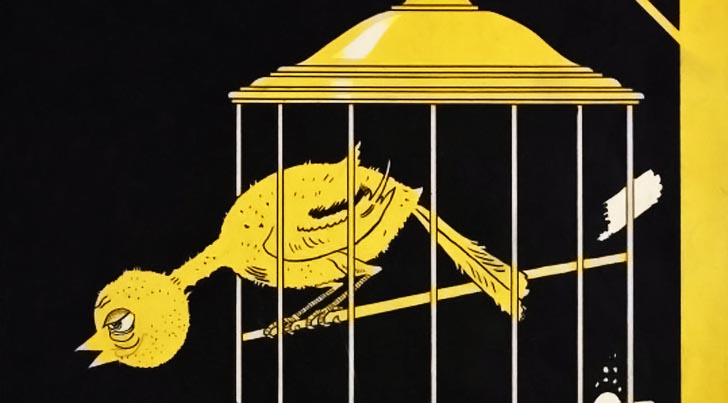
“The Show Is Over” (1934)

“The Show Is Over.” Words and music by Sam Coslow, Con Conrad, and Al Dubin (1934). Recorded by Elsie Carlisle with orchestral accompaniment on May 18, 1934. Decca F. 3990 mx. TB1259-2.

Elsie Carlisle – “The Show Is Over” (1934)

“The Show Is Over” is a “fox trot ballad” in which the singer expresses disappointment and a sense of disillusionment over a love relationship that has been dissolved. It relies on an extended theatrical metaphor: the singer has “played the part of the fool in the play” by being taken in by her former partner, who was “just acting a part in the play” when he pretended to be in love. Realizing that their relationship has been more like acting than real life and that in reality her lover is in love with someone else, the singer suggests that the two put away any pretense of being friends, concluding that “the show is over.”

The song had three songwriters, but I detect most in it the sensibility of Sam Coslow. Elsie Carlisle recorded four songs in 1934 for which Coslow had written words, music, or both, the others being “This Little Piggie Went to Market,” “A Place in Your Heart,” and “My Old Flame.” All are excellent songs, in spite of the fact that they take the risk of being saccharine, sentimental, or overly serious. All four songs, therefore, benefit from Elsie Carlisle’s skills as an actress; even while singing that “the show is over,” she impersonates perfectly the disillusioned lover and lends sincerity to what could otherwise be a somewhat artificial role.

“The Show Is Over” was also recorded in 1934 by the BBC Dance Orchestra (directed by Henry Hall, with songwriter Sam Coslow on the vocals), Harry Roy and His Orchestra (with vocals by Ivor Moreton), Roy Fox and His Band (with singer Peggy Dell), Alex Freer and His Band, Billy Cotton and His Band (with vocal refrain by Alan Breeze and Harold “Chips” Chippendall), Ray Noble and His Orchestra (with Al Bowlly), Jay Wilbur and His Band (with vocalist Leslie Douglas), the Casani Club Orchestra (under the direction of Charlie Kunz, with singer Harry Bentley), Ambrose and His Orchestra (with Sam Browne), Bertini and His Band (with Leslie Douglas), and Larry Brennan and the Winter Gardens Dance Band (with Ken Beaumont singing “The Show Is Over” as part of a medley).

“Da-Dar-Da-Dar” (1933)

“Da-Dar-Da-Dar (Da-Dar-Da-Dee).” Words by Robert Hargreaves and Stanley J. Damerell, music by Tolchard Evans. Recorded on May 16, 1933 by Maurice Winnick and His Orchestra, with vocal refrain by Sam Browne (and with Elsie Carlisle in a speaking part). Panachord 25529 mx. GB5875-2.

Personnel: Maurice Winnick-vn dir. Charles Price-another-t / 2tb /Harry Hayes-Harry Turoff-as / Percy Winnick-cl-ts-o /Bert Whittam-p / Bill Herbert-g / Tiny Stock-sb / Stanley Marshall and possibly Max Bacon-d

Maurice Winnick and His Orchestra – “Da-Dar-Da-Dar” (1933)

“Da-Dar-Da-Dar” features Elsie Carlisle in only the tiniest speaking role (for eight seconds at 1:56, when she says, “Oh, d-d-d-darling!” and “Oh, d-d-d-dearest!”), but I include it in this collection for the sake of completeness and because it is a very good comic waltz with a vocal refrain by Elsie’s long-term singing partner Sam Browne. Elsie’s sole recording session with Maurice Winnick and His Orchestra yielded up a second comic waltz with Sam that was issued on Panachord 25527, “Seven Years with the Wrong Woman.” But whereas that song involves disgruntled married people, “Da-Dar-Da-Dar” involves the complications that young people face in arranging a tryst, what with the omnipresence of parents.  Indeed, its scenario includes a complication involving a younger brother whom Sam must pay off to get some time alone with his girlfriend (voiced by Elsie).1 The overall idea of the awkwardness of youthful rendezvous is comparable to that produced by the song “Sittin’ in the Dark,” of which Sam and Elsie had recorded three versions in March 1933. One might also be reminded of Elsie’s 1928 and 1930 versions of “Dada! Dada!” but the name of that song refers to the father who is listening in on his youthful daughter’s first encounter with the opposite sex — really a very different idea entirely, and much less wholesome, for the song title “Da-Dar-Da-Dar” is meant only to imitate the rhythm of a waltz, and Elsie’s father, we are grateful to hear from Sam, is not present.

“Da-Dar-Da-Dar” was also recorded in 1933 by Sydney Lipton’s New Grosvenor House Band (v. Sam Browne), the BBC Dance Orchestra (directed by Henry Hall, with vocal refrain by Les Allen, in a Ronnie Munro arrangement), and Syd Roy and His R.K. Olians (vocalists Bill Currie, Ivor Moreton, and chorus).

Notes:

  1. It is not clear who impersonates the brother. Perhaps drummer and comedian Max Bacon, who did funny voices in “Seven Years with the Wrong Woman” at the same recording session, or even Sam Browne himself?

“He’s the Last Word” (1927)

“He’s the Last Word.” Lyrics by Gus Kahn, music by Walter Donaldson (1926). Recorded by Elsie Carlisle with accompaniment by piano (Arthur Young) and violin at Studio B, Hayes, Middlesex, on May 6, 1927. HMV B. 2579 mx. Bb10689-2.

Elsie Carlisle – “He’s the Last Word” (1927)

“He’s the Last Word” follows an argument familiar to aficionados of popular music: its singer goes through a catalogue of her “sweet somebody’s” various deficits (insufficient talent at dancing, for example), only to conclude that when it comes to romance, “he’s the last word” — he is the very best. In her recording of the song, Elsie Carlisle is pure enthusiasm, and her frequent nonsensical ejaculations remind us of the fun, popular genre that she is working in. She has excellent accompanists in this recording on the piano and violin. Richard J. Johnson identifies the pianist as Carroll Gibbons and does not attempt to name the violinist.1

Contemporary record reviewer and industry insider Edgar Jackson was under a very different impression as to the identities of the accompanists, writing that

Elsie Carlisle has a thoroughly good vocal record of “He’s the Last Word” [54 at 78] (B2579). She sings tunefully, and is one of the most stylish and rhythmical of all our English comediennes. She has been excellently accompanied by Hugo Rignold (violin) and Arthur Young (piano)—Young does one of the best piano solo choruses I have heard. I wish I could say as much for his effort in “What’s the Use of Crying?” by the same artists on the reverse side.2

As it turns out, the evidence of the Kelly Online Database, which is based on HMV’s ledgers themselves, is that it was Arthur Young on the piano for “He’s the Last Word” (see my discography for further discussion). The suggestion that the violinist is Rignold is interesting. Hugo Rignold was already famous for his exceedingly “jazzy” playing, and certainly the violinist in “He’s the Last Word” gives the impression of being lively and playful, employing double and triple stops.3

Other noteworthy early versions of “He’s the Last Word” include ones by Art Kahn and His Orchestra, Jack Pettis and His Band (with vocalist Billy Hillpot), Ben Pollack and His Californians (with the Williams Sisters), Ben Bernie and His Roosevelt Orchestra (with vocals by Scrappy Lambert), the Broadway Bellhops (with singer Irving Kaufman), Jane Gray, Vaughn de Leath (recording as “Gertrude Dwyer”), The Troubadors, Annette Hanshaw (with Irving Brodsky on the piano), and Jack Linx and His Birmingham Society Serenaders. American Josephine Baker recorded “He’s the Last Word” in Paris accompanied by Jacob’s Jazz, and in August 1927 the Merl Twins (“Syncopating Songsters”) sang it in an early Hollywood Vitaphone short film.

In Britain in 1927, in addition to Elsie Carlisle’s, there were versions of “He’s the Last Word” by The Savoy Orpheans (directed by Carroll Gibbons), Syd Roy’s Lyricals, and Bert Firman’s Dance Orchestra (as Eugene Brockman’s Dance Orchestra).

Notes:

  1. Elsie Carlisle: A Discography. Aylesbury, UK, 1994, p. 6.
  2. The names are emphasized in the original. “The Gramophone Review.” The Melody Maker and British Metronome 2.24 (Dec. 1, 1927): 1273.
  3. See Bret Lowe’s comments below about the violin playing in this recording and his suggestion that the violinist might have been Eric Siday.

“Sweet Flossie Farmer” (1935)

“Sweet Flossie Farmer (The Lovely Snake Charmer).” Words by Mort Dixon, music by Allie Wrubel (1935). Recorded by Elsie Carlisle with orchestral accompaniment on April 18, 1935. Decca F. 5524 mx. GB 7098-2.

Elsie Carlisle – “Sweet Flossie Farmer” (1935)”

“Sweet Flossie Farmer” is a comical song with a circus setting (like Elsie Carlisle’s duet with Sam Browne from the previous year, “Mr. Magician”). The scenario is simple: the title character, “Flossie Farmer,” is a professional snake charmer who is paradoxically attracted to a man repeatedly described as a “snake in the grass.”1 He is an animal trainer, but Flossie cares only for him, not for his animals, whose difficult polysyllabic names Elsie relishes rattling off while dismissing them: “rhinoceroses,” “hippopotamuses,” “sea lionesses” — she appears to give up after the gaffe “kangaroos-a-mooses!” — and the orchestra provides her with a satisfying antiphonal chorus of nonsense sounds. This animal trainer is a very bad man, we are to understand, who is only interested in sex, and he appears to succeed in his lechery, only to be bitten by Flossie’s snakes, who appear to be motivated by both jealousy and loyalty.

“Sweet Flossie Farmer,” like “Fare Thee Well, Annabelle” (which Elsie would record two months later), was composed by Hollywood songwriters Mort Dixon and Allie Wrubel. Newspapers of the time suggest that “Sweet Flossie Farmer” was, like “Fare Thee Well, Annabelle,” introduced in the film Sweet Music by Rudy Vallée and Ann Dvorak, but I cannot find the scene in which it occurs; there may very well be different cuts. In the 1935 Warner Bros. cartoon Hollywood Capers a small female animal sings the song. It was also recorded in America by Ozzie Nelson and His Orchestra, and in Britain it was included in 1936 in a medley by the Bert Feldman Company.

"Sweet Flossie Farmer." Sheet nusic featuring Elsie Carlisle.

Notes:

  1. As a classicist, I would be remiss if I did not point out that this is one of Elsie’s rare references to the Roman poet Virgil (Eclogues 3.93).

“Ten Cents a Dance” (with Jack Payne and His Orchestra; 1931)

“Ten Cents a Dance.” Music by Richard Rodgers, lyrics by Lorenz Hart (1930). Recorded by Jack Payne and His BBC Dance Orchestra, with vocals by Elsie Carlisle. London, March 31, 1931. Columbia CB 249 mx. CA-11275-5.

Personnel: Jack Payne dir. Jack Jackson-Tommy Smith-t / Jesse Fuller-tb-bar / Dave Roberts-cl-ss-as-bar / Frank Johnson-Phil Trix-cl-as-o / William Taylor-cl-as-vn / Bob Eason-cl-ts / Eric Siday-vn / Bert Powell-vl / Bob Busby-p-a / Billly Scott-Coomber-g / Charlie Asplin-bb-sb / Bob Manning-d-x

Jack Payne and His BBC Dance Orchestra (w. Elsie Carlisle) – “Ten Cents a Dance” (1931)

“Ten Cents a Dance” was composed for the 1930 musical “Simple Simon” and was originally supposed to be sung by Lee Morse, but she is said to have shown up drunk to the premiere, and producer Florenz Ziegfeld, Jr. replaced her with Ruth Etting. “Ten Cents a Dance” is the lament of a taxi dancer, a female “dance instructor” who would dance with a male patron in exchange for a ten-cent ticket that he would buy and for which she would earn a small commission. The song inspired the March 1931 film of the same name starring Barbara Stanwyck. Elsie Carlisle recorded two takes of it with Jack Payne that same month that appeared on different issues of Columbia CB249 (Jack Payne did a version with Betty Bolton in between Elsie’s two takes, but it was rejected). The next month Elsie made a solo recording on Imperial 2469.

The song was recorded in America in 1930 by Ruth Etting, The High Hatters (with vocal by Welcome Lewis), June Pursell (listed as “Moya Mack” on Panachord), and Grace Hayes. German singer Greta Keller recorded a noteworthy version in Berlin in October 1930; she would produce yet another the next year in London.

In 1931, in addition to the Jack Payne versions, there were British versions of the song recorded by Roy Fox and His Band (with vocalist Betty Bolton, in a Spike Hughes arrangement), Jerry Hoey and His Band, Jack Hylton and His Orchestra (with vocals by Pat O’Malley)Harry Hudson’s Radio Rhythm Boys (with vocalist Sam Browne), Nat Star and His Dance Orchestra (as Louis Ramel and His Band, with singer Tom Barratt), Jay Wilbur and His Band (with Betty Bolton), and Clive Erard’s Dance Band.