
Terry Brown was kind enough to share these photographs of Elsie in the 1930s with me. Click or tap on any of them to open the gallery:
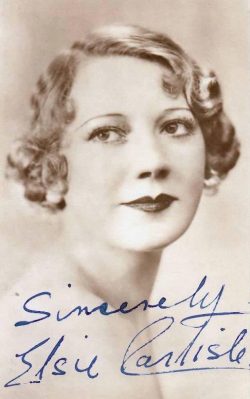


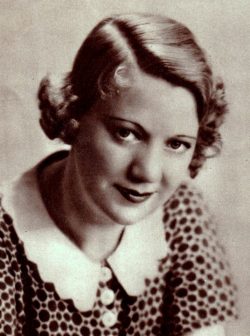
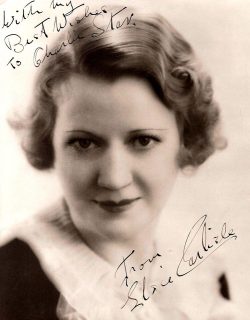

Terry Brown was kind enough to share these photographs of Elsie in the 1930s with me. Click or tap on any of them to open the gallery:
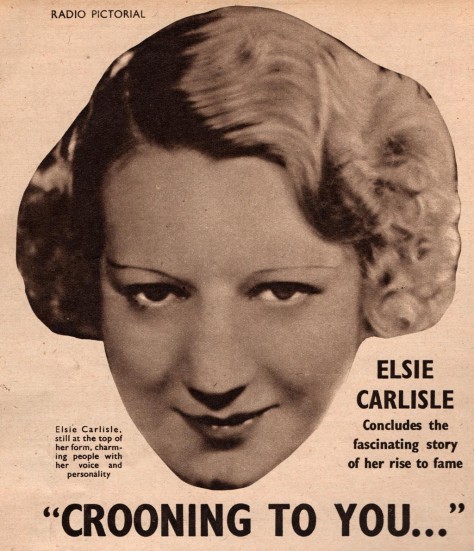
Radio Pictorial, a weekly publication for wireless aficionados, carried in its October 15, 1937 issue the final installment of an interview with Elsie Carlisle entitled “Crooning to You…” House style seems to have demanded that it take the form of redacted answers to suppressed questions; it is Elsie who does all the talking, and she appears to prattle on endlessly without any prompting, which was no doubt the intended effect. One may divine the glorious sort of fluff included in the item from highlights printed in bold at the top of the page:
★ When I Was Electrocuted—But The Show Went On :: Footballs Are SO Hard ! :: My Greyhounds :: Off to America
And who could argue with Elsie regarding the famed hardness of footballs, when — what, electrocuted??? Actually, that was rather a favorite story of Elsie’s, or perhaps of the magazine’s editors, for it would appear again in the 1938 Ralph Graves article “Radio Sweetheart No. 1.”
The salient points of the interview are that
This is a fundamentally very silly article overshadowed by a not-very-flattering disembodied Elsie head — which is to say that it is exceedingly fun! Elsie seems to have been just as good at working the press as she was at singing, and she clearly worked hard to earn such commonly repeated epithets as “Idol of the Radio,” “Radio Sweetheart No. 1,” and, on a rare occasion when she was not feeling up to talking to the press, “Distinguished Woman Invalid” (The Dundee Evening Telegraph, January 4, 1939).
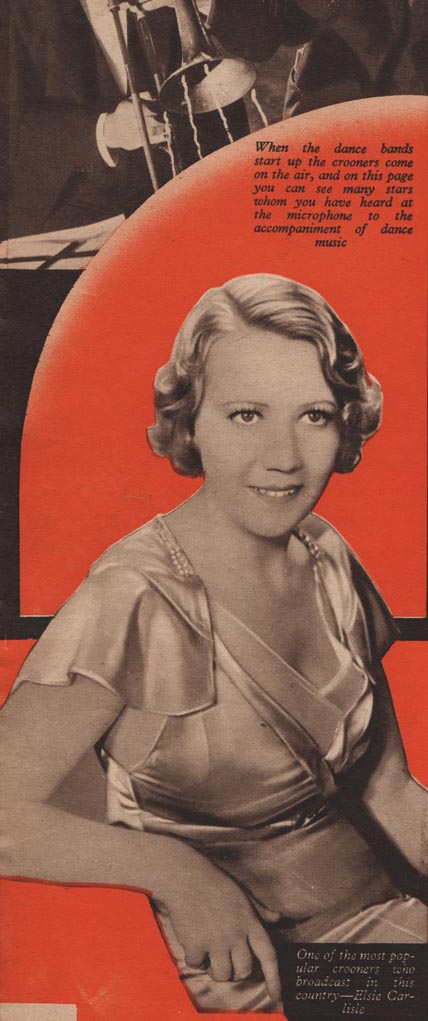
Elsie Carlisle appears prominently in the center spread of the first issue of Radio Pictorial (January 19, 1934), a weekly publication. The item is entitled “CROONERS!” and it also depicts the Boswell Sisters, Edith Baker, Hildegarde, Gertrudge Lawrence, Eve Becke, and Sheila Borrett (the first female national radio announcer). Elsie would record “Without That Certain Thing” and “Who Walks In When I Walk Out?” that same month.
Elsie Carlisle recorded “Joseph, Joseph” and “Change Partners” in November, 1938, and then had to stop work entirely for many weeks due to ill health. While her malady is unknown, her absence was noticed, with the Daily Mail describing her has having been “seriously ill”:
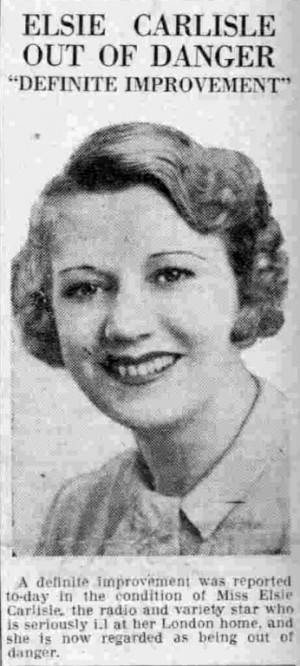
A week earlier, the Gloucestershire Echo had described her condition as “critical.” Whatever the affliction, Elsie did recover, and she went back to recording, broadcasting, and performing publicly in February. In an interview with a reporter, she attributed the causes of her illness to the stress of her professional obligations.
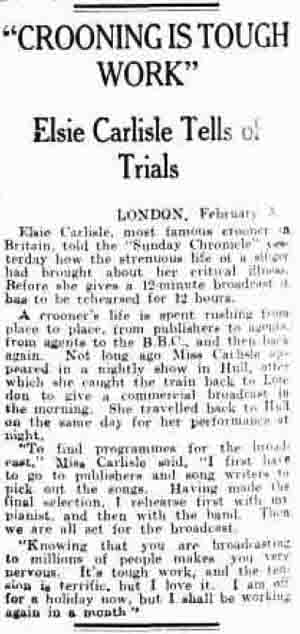
From the Newcastle [New South Wales, Australia] Morning Herald and Miners’ Advocate, Tuesday, February 21, 1939:
“CROONING IS TOUGH WORK”
Elsie Carlisle Tells of Trials
LONDON, February 5.
Elsie Carlisle, most famous crooner in Britain, told the “Sunday Chronicle” yesterday how the strenuous life of a singer had brought about her critical illness. Before she gives a 12-minute broadcast, it has to be rehearsed for 12 hours.
A crooner’s life is spent rushing from place to place, from publishers to agents, from agents to the B.B.C., and then back again. Not long ago Miss Carlisle appeared in a nightly show in Hull, after which she caught the train back to London to give a commercial broadcast in the morning. She travelled back to Hull on the same day for her performance at night.
“To find programmes for the broadcast,” Miss Carlisle said, “I first have to go to publishers and song writers to pick out the songs. Having made the final selection, I rehearse first with my pianist, and then with the band. Then we are all set for the broadcast.
“Knowing that you are broadcasting to millions of people makes you very nervous. It’s tough work, and the tension is terrific, but I love it. I am off for a holiday now, but I shall be working again in a month.”
[From the Barrier Miner (New South Wales, Australia), Thursday, 31 October, 1935.]CROONER HAS BUSY LIFE
No Time To Marry; Sleeps 6 Hours
Miss Elsie Carlisle, ace woman crooner, has no time for introspection, no time to marry, no time to sleep more than six hours a night, no time, even, to weed out her cupboards which burst with clothes she does not like.
“I give money to acquaintances who want to borrow,” she says, “Then they don’t come back. I have no time to see them again.”
That is why she “made” that song, “Little Man, You’ve Had a Busy Day.” She understands, writes Corinne Irwin, in the London “Daily Express.”
Elsie Carlisle has that “something” in her voice and personality which reaches across the footlights to people of all ages and kinds. She cannot tell you what it is. It was born in her, and has increased with the experience of years.
INSTANT SUCCESS
As a tousled, golden-headed child of 12 she faced her first audience in a Manchester theatre.
“I was an instant success,” she told me. “I knew then they were mine; I was theirs. I belong to the public until they tire of me. When they do I shall know it at once. I shall quit.”
Most women’s resources could not stand this constant usurpation by the public of their private lives. Elsie Carlisle has risen from a sick bed with a temperature of 104 degrees to sing to her faithful public.
She is the complete trouper in its finest traditional meaning. Her background is the theatre; her home is its dressing room.
“I record at ten; rehearse for a show in the afternoon; give my act at the first house here; rush to the B.B.C. for a twenty-minute broadcast; rush back for my numbers in the second house; go home, take off my stage make-up, change into an ordinary evening gown, and sing at a party which does not begin until after midnight,” she said.
“I am so exhausted sometimes I scarcely know what to do with myself. I have to buy my clothes as I pass a shop; just when I see something I fancy in the window. Half the time when I get the dress home I do not like it. I buy some material, then I have no time for fittings.”
Luminous brown eyes gleamed with amusement.
“I am always losing hats. It is a habit of mine to take my hat off when I am talking to people. But I never pick them up again. Elsie Carlisle’s hats are strewn all over England.”
THREE SECRETARIES
She added vehemently, “Anybody who thinks that the more money you have, the more fun, is mistaken. Not so long ago I sang for the joy of it. Now I have to make it a business.”
“I have three secretaries, two pianists, a chauffeur, a stage manager, a business manager, six times as many frocks as I had before, and two dozen stage costumes. All these have to be paid for.
Since I cannot afford the luxury of relaxation, I at least demand luxury in my surroundings. I like a comfortable bed, a shower that works, as well as a comfortable bath. I want to eat what and where I like.”