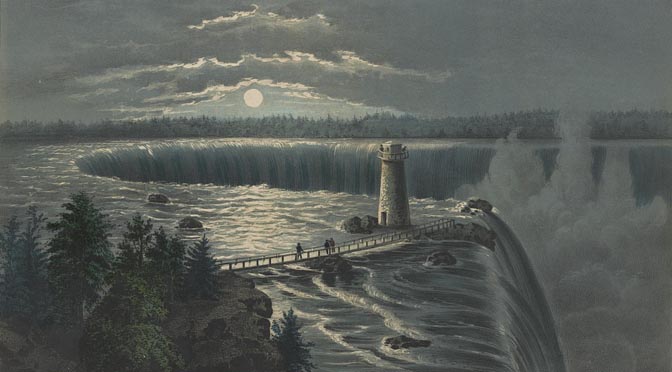
“Moonlight on the Waterfall” (1937)

“Moonlight on the Waterfall.” Words and music by Jimmy Kennedy and Wilhelm Grosz (the latter employing the pseudonym “Hugh Williams”). Recorded by Jack Harris and His Orchestra with Elsie Carlisle as vocalist on October 25, 1937. HMV B.D. 5290 mx. OEA 5108-1.

Personnel: Jack Harris-vn dir. Alfie Noakes-Doug Holman-t / Lewis Davis-Don Binney-tb / Harry Karr-cl-as-f / Freddy Williams-cl-as / Harry Smith-cl-as-ts / George Glover-bar / Max Jaffa-Bill Sniderman-vn / Bert Read-cel-a / Cyril Halliday-Joe Brannelly-g / Alf Gray-d

Jack Harris and His Orchestra (w. Elsie Carlisle) – “Moonlight on the Waterfall” (1937)

A composition by the prolific songwriter Jimmy Kennedy (collaborating with the exiled Austrian composer Wilhelm Grosz, who worked in Britain under the name Hugh Williams), “Moonlight on the Waterfall” associates the image of an lovely outdoor setting with the memory of a lost lover.  The lyrics do not have any claim to being particularly profound, but Elsie Carlisle does justice to the song’s melancholy beauty with the sweetness of her delivery.  This recording is the product of Elsie’s brief but productive collaboration with the band of American-born bandleader Jack Harris.

In 1937 there were recordings of “Moonlight on the Waterfall” by such bands as Ambrose and His Orchestra (with vocals by Vera Lynn), Mantovani and His Orchestra (Ken Crossley, vocalist), Billy Cotton and His Band (with vocalist Peter Williams), Billy Thorburn and His Music (with Eddie Guray, vocalist), and Maurice Winnick and His Sweetest Music (in “Melody Medley No. 2”).  There were also solo versions by Ramona Davies, Dorothy Squires and Arthur Tracy.
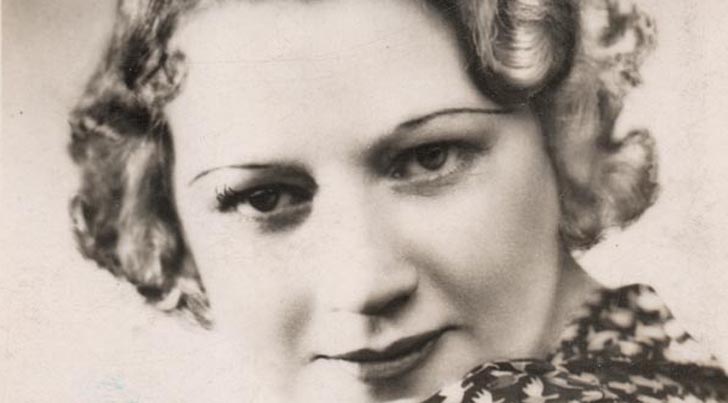
“He’s a Good Man to Have Around” (1929)

“He’s a Good Man to Have Around.” Composed by Milton Ager, with lyrics by Jack Yellen, for the 1929 film Honky Tonk. Recorded by Elsie Carlisle (as “Sheila Kay”), with Cecil Norman and His Band, in London, October 16, 1929. World Echo A. 1013.

Personnel: Lloyd Shakespeare-t / Ben Oakley-tb / Les Norman-as / vn / Cecil Norman-p / __ Stanley-bb

He’s a Good Man to Have Around – Elsie Carlisle (as Sheila Kay)

Video by David Weavings (YouTube)

“He’s a Good Man to Have Around” is a torch song fashioned loosely after the model of Mistinguett’s “Mon homme” or its English adaptation “My Man” (introduced by Fanny Brice in the 1921 Ziegfeld Follies). The singer catalogues her “man’s” various faults and insists that she loves him in spite of them. One lyrical advantage that “He’s a Good Man to Have Around” has over comparable songs (such as “Hangin’ On to That Man”) is that the man’s moral deficits creep up comically in intensity; at first one expects the song to remain light, insofar as the man’s faults are merely not being good-looking, being a poor dancer and a poor speaker, and occasionally being mildly irritating. Indeed, the lyrics as used in Elsie’s August 23, 1929 recording of the song with Philip Lewis and His Dance Orchestra (a.k.a. the Rhythm Maniacs)1 stop at this point; they complement the comparatively upbeat instrumental interpretation nicely. In the October 16 Worldecho recording, however, Elsie sings the whole song, including the parts about how her lover is untrustworthy, unfaithful, and apparently such a dangerous fellow as to warrant her having bought a pistol — which she won’t use, for “He’s a Good Man to Have Around!” Elsie Carlisle recorded this record and three others with Worldecho under the name “Sheila Kay”; as she was recording under her own name for the Dominion label at the time, it may be that contractual obligations necessitated the use of the pseudonym.

Originally written for the 1929 film Honky Tonk starring Sophie Tucker (which does not survive as a movie, although the Vitaphone soundtrack is intact), “He’s a Good Man to Have Around” was first recorded by Tucker herself (with Ted Shapiro’s Orchestra). In 1929 versions of the song were also recorded in America by Herman Kenin and His Ambassador Hotel Orchestra, Lee Morse and Her Blue Grass Boys, The Cotton Pickers (both with Libby Holman and without), Kate Smith and the Harmonians, and Jimmy Noone’s Apex Club Orchestra (with vocals by Helen Savage).

“He’s a Good Man to Have Around” was recorded in 1929 in Britain by Florence Oldham (accompanied by Len Fillis on the guitar and by Sid Bright on the piano), Lily Lapidus, the Rhythmic Eight (with vocals by Maurice Elwin), The Picadilly Players (Eddie Collis, vocalist), Mabel Marks, Belle Dyson, the Blue River Band (with vocalist Sybil Jason), and Mabel Lawrence.

Notes:

  1. It is incidentally amusing to hear take one of this Decca recording, in which Elsie gets a couple of notes wrong!

“My Cutey’s Due at Two-to-Two Today” (1926)

“My Cutey’s Due at Two-to-Two Today.” Music by Albert Von Tilzer, lyrics by Leo Robin (1926). Recorded by Elsie Carlisle with piano and vocal accompaniment by Carroll Gibbons in London on October 6, 1926. Zonophone 2815.

My Cutey’s Due At Two-To-Two To-Day – Elsie Carlisle

Video by David Weavings (YouTube)

Von Tilzer and Robin’s “My Cutey’s Due at Two-to-Two Today,” an example of the “train song” genre, is a light composition that makes up for a fundamental lack of profundity by being ridiculously catchy, almost addictive. It speaks primarily of faithfulness in one’s lover’s absence and of the giddy anticipation of reunion. Elsie Carlisle brings to it the requisite frantic, girlish enthusiasm and applies her vaguely conversational style of delivery to the song’s rhythmical patter with great effectiveness. She is accompanied on this record, not only by Carroll Gibbon’s piano playing, but also by his voice; he engages in a muted antiphony with Elsie for part of the song.

“My Cutey’s Due” was recorded in America in 1926 by Sam Lanin and His Orchestra (as the Missouri Jazz Band), Ted Weems (Park Gibbs, vocalist), the Happiness Boys (Billy Jones and Ernest Hare), The Clevelanders (with vocals by Tom Stacks), and the Little Ramblers (with vocalist Ed Kirkeby). In Britain there were 1926 versions by Bert Firman’s Dance Orchestra, Don Parker and His Band, Victor Sterling and His Band, Van Straten and His Riviera Dance Orchestra (with vocals by Harry Fay). In early 1927 there were recordings made by Alfredo’s Band and by the Picadilly Revels Band.

“Stop the Sun, Stop the Moon” (1932)

“Stop the Sun, Stop the Moon.” Words and music by Hartwell “Harty” Cook, W. Mercer Cook, and J. Russel Robinson. Recorded by Ray Starita and His Ambassadors with vocalist Elsie Carlisle on September 1, 1932. Four-in-One 6 mx. S2557-2.

Personnel: Ray Starita-reeds dir. Nat Gonella-t / tb / prob. Chester Smith-reeds / Nat Star-reeds / George Glover-reeds-vn / George Hurley-vn / George Oliver-g / Arthur Calkin-sb / Rudy Starita-d-vib-x1

Ray Starita and His Ambassadors (w. Elsie Carlisle) – “Stop the Sun, Stop the Moon” (1932)

“Stop the Sun, Stop the Moon (My Man’s Gone)”2 is a 1932 composition by Harty Cook, Mercer Cook, and J. Russel Robinson (the latter two also produced the popular “Is I in Love? I Is” that same year). In this song, the singer makes almost Biblical demands for the powers of nature — and technology, for that matter — to cease their usual operations, for she has lost her man. This sort of theme was suited to Elsie Carlisle’s dramatic manner of delivery, and in this recording her impassioned complaint serves as a fitting summation to the pulsating instrumental interpretation of the tune by Ray Starita and His Ambassadors’ Band. They would do another take of the song that day with Elsie, and it appears on Sterno 1028.

There were recordings of “Stop the Sun, Stop the Moon” in America that year by Joel Shaw and His Orchestra (with vocals by Dick Robertson), Dick Robertson and His Orchestra (with vocalist Chick Bullock), the Dorsey Brothers’ Orchestra (with the Boswell Sisters), Chick Bullock and His Levee Loungers (with Chick Bullock singing), the Ted Dahl Orchestra, and Paul Whiteman and His Orchestra (with vocalist Mildred Bailey).

In addition to the two record sides made by Ray Starita with Elsie Carlisle, there was a 1932 British version of “Stop the Sun, Stop the Moon” by Ambrose and His Orchestra (with vocalist Sam Browne).

Notes:

  1. According to Brian Rust and Sandy Forbes, British Dance Bands on Record (1911-1945) and Supplement (1989), p. 1021.
  2. The subtitle of the song is also found as “My Gal’s Gone” when the singer is a man.

“The Spring Don’t Mean a Thing” (1934)

“The Spring Don’t Mean a Thing.” Composition usually attributed to Lane Leighton; on this disc “Kennedy” is given the credit. Recorded by Elsie Carlisle on August 23, 1934. Decca F. 5173 mx. TB1498-2.

Elsie Carlisle – “The Spring Don’t Mean a Thing” (1934)

This exceedingly melancholy tune describes a love relationship that began in the spring. The affair’s dissolution has, for the speaker of the lyrics, stripped that season of its usual happy associations. Elsie Carlisle, ever the torch singer, draws out the deep pathos of the music in this violin-dominated arrangement.

“The Spring Don’t Mean a Thing to Me” (for that is the song’s full title) was also recorded in 1934 by Billy Cotton and His Band (with vocalist Alan Breeze), Harry Roy and His Orchestra (with vocals by Sam Browne), and Teddy Joyce and His Orchestra (with Eve Becke):

Teddy Joyce and His Orchestra (with Eve Becke) – “The Spring Don’t Mean a Thing to Me” (1934)

“The Spring Don’t Mean a Thing to Me” was included in Charlie Kunz’s “Piano Medley No. 14” (on Sterno). It can also be heard in the background in the 1945 British movie Waterloo Road (at 57:55).