Solo Recordings

It seems almost a misnomer to speak of Elsie Carlisle “solo” recordings, for she always had accompanists. What I here call “solo” recordings are records on which her name is featured, rather than that of a band, and usually only when the accompanists cannot be safely identified.

“We Just Couldn’t Say Goodbye” (1932)

“We Just Couldn’t Say Goodbye.” Words and music by Harry Woods (1932). Recorded by Elsie Carlisle with an instrumental trio in Manchester on September 23, 1932. Decca F. 3193 mx. KB-134-1.

Elsie Carlisle – “We Just Couldn’t Say Goodbye” (1932)

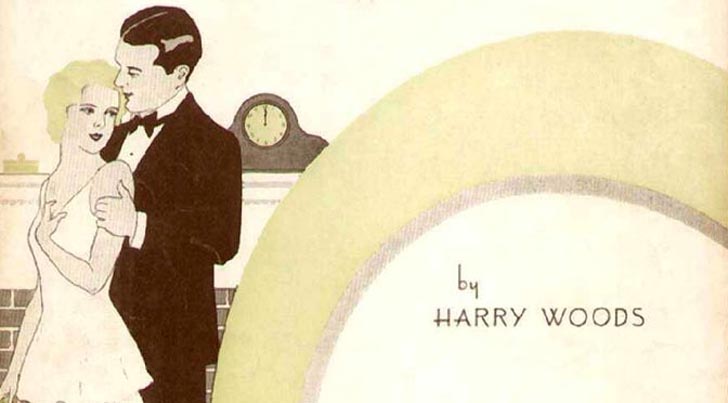
A light, romantic song about two lovers’ reconciliation, Harry Woods’s “We Just Couldn’t Say Goodbye” is noteworthy for its fanciful personification of pieces of furniture. When the couple is on the verge of parting, a chair and a sofa cry. A smiling clock expresses its feelings about the situation and brings the two people back together again, at which point the room in which everything happens sings and dances. Elsie Carlisle’s delivery of the lyrics is varied; it starts out somber, almost plodding, and becomes more upbeat as the relationship between the lovers improves. She engages in a sort of call and response with the clarinet at one point and almost whispers the final “I tell you confidentially.” Elsie’s is not exactly a lively take on the tune; it is, rather, a very deliberate interpretation of the sense of the lyrics, and of the other versions of the song recorded that year, it most closely resembles that of the American-born but London-based Layton and Johstone.

In America in 1932 there were versions of “We Just Couldn’t Say Goodbye” recorded by Guy Lombardo and His Royal Canadians, Chick Bullock and His Levee Loungers (with vocals by Chick Bullock), Ralph Bennett and His Seven Aces, The Dorsey Brothers Orchestra (with the Boswell Sisters), Paul Whiteman and His Orchestra (Mildred Bailey, vocalist), and Freddy Martin and His Orchestra. Annette Hanshaw sang it on a record and August 1932 and would go on to sing it in a film (the 1933 Captain Henry’s Radio Show). Even Shirley Temple sang it, in the 1933 film Kid in Hollywood, which is as cute as it is cacophonous.

In Britain, 1932 saw recordings of “We Just Couldn’t Say Goodbye” by the Blue Mountaineers, the Savoy Hotel Orpheans (with vocals by Jack Plant), Ambrose and His Orchestra (Sam Browne, vocalist), Billy Cotton and His Band (Cyril Grantham, vocalist), Jack Hylton and His Orchestra (with vocals by Pat O’Malley), Nat Star (as Bernie Blake and His Band, with Les Allen as vocalist), Jay Wilbur and His Band (vocalist Tom Barratt), and Jack Plant (as Jack Gordon). Notable duets were recorded by, as I have noted, Layton and Johnstone, and also by Hardy and Hudson.


"We Just Couldn't Say Goodbye" sheet music
“We Just Couldn’t Say Goodbye” sheet music

“What’s the Use of Crying?” (1927)

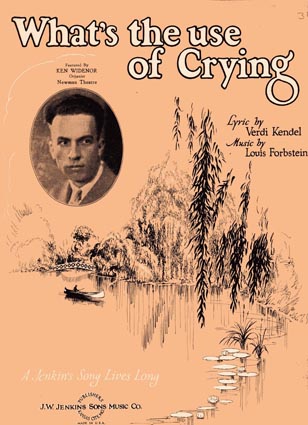
“What’s the Use of Crying?” Lyrics by Verdi Kendel, music by Louis Forbstein (1926). Recorded by Elsie Carlisle, accompanied by violin and piano (the latter played by Arthur Young), on August 22, 1927. HMV B2579 mx. Bb11403-2.

“What’s the Use of Crying?” – Elsie Carlisle

This song’s lyricist is comparatively obscure; its composer, Louis Forbstein, would later change his surname to Forbes and gain some amount of fame as musical director for David O. Selznick films (including “Gone with the Wind”). “What’s the Use of Crying?” is a song of unrequited love that begins in a rather moody register but quickly becomes more upbeat as the tempo is twice ratcheted up and the singer professes to have acquired a spirit of resignation in the face of her troubles, asking, “What’s the use of crying just for someone like you?”

Elsie Carlisle’s is the only British recording of this song that I have discovered. It was in vogue in America in late 1926-early 1927, with versions by Lee Sims, Charley Straight’s Orchestra, Ted Weems, Bessie Coldiron (as “The Sunflower Girl”), Greta Woodson, Gypsy & Marta (unissued), Peggy English (as Jane Gray), Bob Haring’s Dixie Music Makers, Harry Raderman (Arthur Hall, vocalist), and Willard Robison (accompanying himself on the piano).

"What's the Use of Crying" sheet music
“What’s the Use of Crying” sheet music

“All I Do Is Dream of You” (1934)

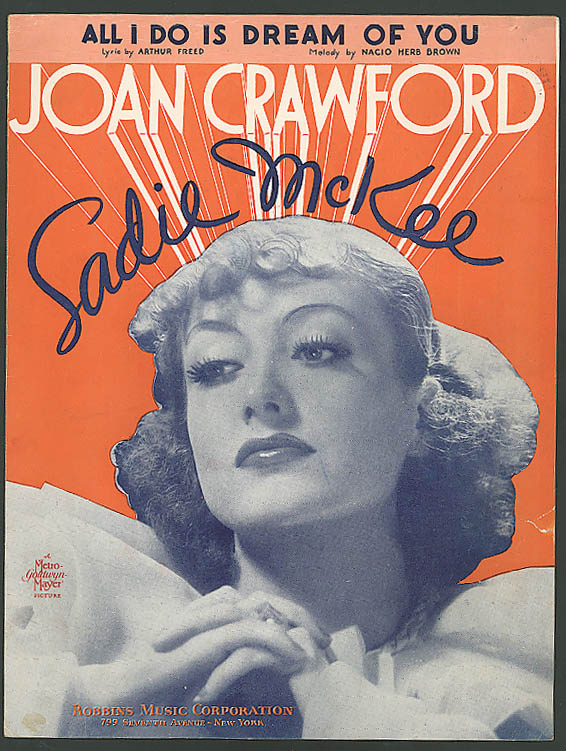
“All I Do Is Dream of You.” Words by Arthur Freed, music by Nacio Herb Brown (composed for the 1934 film Sadie McKee).  Recorded by Elsie Carlisle on July 18, 1934.  Decca F-5122.

https://www.youtube.com/watch?v=f3EQof9K0qk

Elsie Carlisle – All I Do Is Dream of You

Video by longpast78 (YouTube)

“All I Do Is Dream of You” was composed in 1934 by Nacio Herb Brown, with lyrics by Arthur Freed, for the Joan Crawford movie Sadie McKee, where it was introduced by actor Gene Raymond.  It is perhaps now more famous for having been sung by Debbie Reynolds in the 1952 film Singin’ in the Rain.  A great deal of Elsie Carlisle’s artistic output in the early 1930s drew on Hollywood music, but she made the songs her own, and her version of “All I Do Is Dream of You” is surprisingly intense and passionate.

In America “All I Do Is Dream of You” was recorded in 1934 by Angelo Ferdinando’s Orchestra (with vocals by Dick Robertson), Jan Garber and His Orchestra (with vocalist Fritz Heilbron), Henry Busse and His Orchestra (Rex Griffith, vocalist), and Freddy Martin and His Orchestra.  Chico Marx performed the song with great virtuosity on the piano in the 1935 film A Night at the Opera.

In Britain the song was very popular that year, having been recorded by Ray Noble and His Orchestra (with Al Bowlly providing the vocals), Jack Payne and His Band (with vocals by Jack Payne), Roy Fox and His Band (Sid Buckman, vocalist), Teddy Joyce and His Dance Music, Bertini and His Orchestra (with Donald Peers), and Henry Hall (with Les Allen, in a Bert Read arrangement).  A short film exists of Charlie Kunz playing “All I Do Is Dream of You” in a piano solo.

"All I Do Is Dream of You" sheet music featuring Joan Crawford
“All I Do Is Dream of You” sheet music featuring Joan Crawford

“’Leven Pounds of Heaven” (1932)

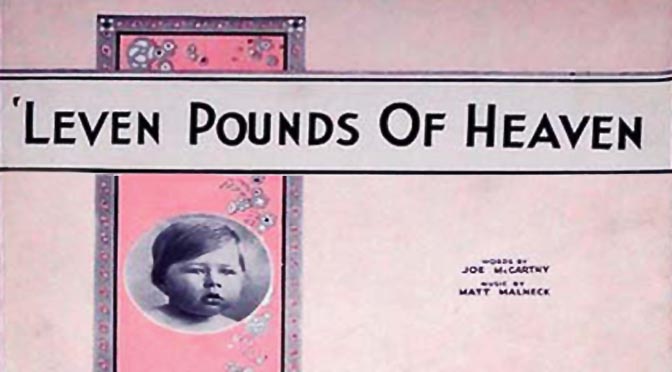
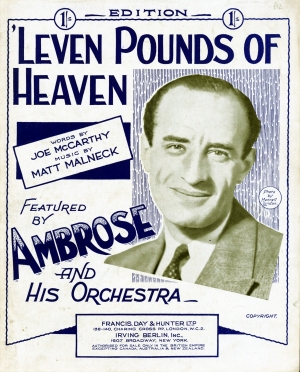
“’Leven Pounds of Heaven.” Words by Joe McCarthy, melody by Matt Malneck (1930). Recorded by Elsie Carlisle with orchestral accompaniment on June 23, 1932. Decca F. 3038.

Elsie Carlisle – ’Leven Pounds of Heaven

Video by Andy LeMaitre (YouTube)

The lyrics of “’Leven Pounds of Heaven” represent a mother’s effusive confession of having found life’s meaning in the form of an eleven-pound baby (sex unknown). Such a song naturally risks drowning in its own sappiness. The Matty Malneck melody is deeply attractive, though, and Elsie Carlisle brings to it her own addictive variety of treacle that seems to have suited the British palate in 1932.

Elsie had recorded “’Leven Pounds of Heaven” six days earlier with Ambrose and His Orchestra (HMV B. 6200), and she would sing part of it again with them the next year in a medley (“Memories of the Mayfair,” recorded October 5, 1933 on Brunswick 01605 and Decca F. 6239).

“’Leven Pounds of Heaven” was recorded in 1931 in the United States by Paul Whiteman and His Orchestra (with vocals by Mildred Bailey). In the summer of 1932 there were British versions, in addition to those featuring Elsie Carlisle, by Teddy Dobbs’s Blue Lagoons, The Blue Lyres (an Ambrose group, with vocalist Anona Winn), and Tommy Kinsman and His Band (with vocals by Les Allen).

"'Leven Pounds of Heaven" sheet music featuring Ambrose
“’Leven Pounds of Heaven” sheet music featuring Ambrose

Elsie Carlisle in June’s “Discographer Magazine”

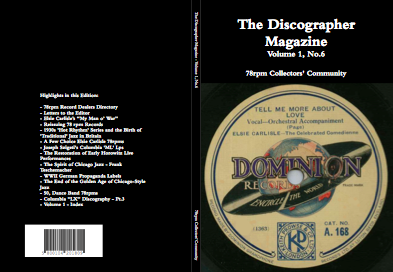
78rpmcommunity.com (The 78rpm Collector’s Community), a social network similar to Facebook but focused entirely on 78 rpm recordings and technology, has a journal that it publishes in both digital and print form.  This month’s Discographer has two items on Elsie Carlisle in it that are worth looking at (amidst other excellent articles dealing with jazz, dance band, and classical recordings).

I wrote the first article, on pages 8-12.  “Elsie Carlisle’s ‘My Man o’ War (Dominion C 307 & Filmophone 143)” discusses Elsie Carlisle’s most naughty song, and addresses the rumor that its first recording incurred a fine for pornography that brought down Dominion records (a story that I do not necessarily believe, but which is fun to repeat).  I also compare Elsie Carlisle’s two versions of the song to the earlier one by Lizzie Miles and attempt to explain why Elsie’s dramatic delivery of the lyrics makes the song so awfully funny.

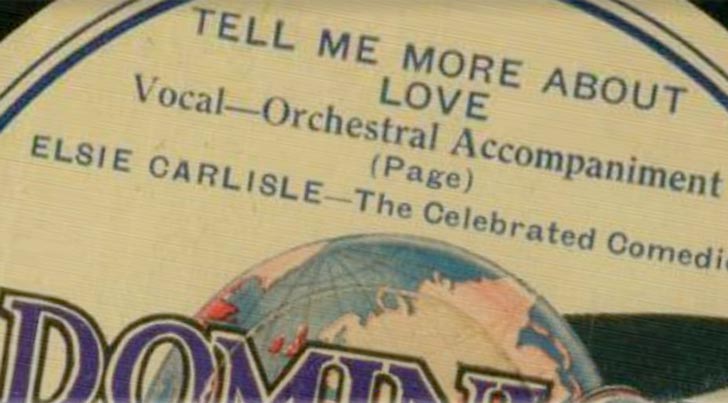
There is also an article on page 26-29 featuring Mick Johnson‘s admirable restorations of a number of Elsie Carlisle recordings on for the Dominion label. Dominion records were budget productions on poor-quality shellac, but Mick has done a fine job of reducing the amount of non-musical noise and allowing one to enjoy a clear and undistorted Elsie.

So be sure to read the Discographer Magazine:

Discographer Magazine 1.6 (June 2014)

"The Idol of the Radio." British dance band singer of the 1920s, 1930s, and 1940s.