“On a Dreamy Afternoon” (1932)

“On a Dreamy Afternoon.” Lyrics by Robert Hargreaves and Stanley J. Damerell, with music by Montague Ewing (1932). Recorded by Ray Starita and His Ambassadors’ Band on September 15, 1932, with vocals by Elsie Carlisle. Four-in-One 7.

Personnel: Ray Starita-cl-ts dir. Nat Gonella-t / t / tb / prob. Chester Smith-cl-as-bar-o / Nat Star-cl-as / George Glover-cl-ts-vn / George Hurley-vn / Harry Robens-p / George Oliver-bj-g / Arthur Calkin-sb / Rudy Starita-d-vib-x

Ray Starita and His Ambassadors w. Elsie Carlisle – “On A Dreamy Afternoon” (1932)

“On a Dreamy Afternoon” was composed by Montague Ewing, who was known for his light music. The lyricists Hargreaves and Damerell (who sometimes used the joint pseudonym “Erell Reaves”) more frequently collaborated with composer Tolchard Evans, turning out such popular tunes as “Lady of Spain” and “If.”

Ray Starita’s version of “On a Dreamy Afternoon” was made in 1932, the last year of his recording career and one of the best, when his band included such greats as Nat Gonella and Nat Star. It was also the only year he used Elsie Carlisle as a vocalist, though he did so quite a bit, turning out excellent recordings of “Kiss by Kiss,” “Let That Be a Lesson to You,” and “I Heard,” amongst others. “On a Dreamy Afternoon” has music and lyrics that are mellow and atmospheric and showcase nicely the sweet quality of Elsie’s voice — this is definitely not one of her torch songs, and there is nothing particularly naughty in it — it is soothingly beautiful and romantic.

The recording in the YouTube video above is one of two takes of the song recorded by Ray Starita with Elsie Carlisle that day; the other appears on Sterno 1026:


Other versions of this song were recorded in October 1932 by Arthur Lally (Maurice Elwin, vocalist), Jack Hylton and His Orchestra (with vocals by Pat O’Malley; hear the unissued take 3 on jackhylton.com), and Carroll Gibbons and the Savoy Hotel Orpheans, with Cavan O’Connor singing).
“He’s My Secret Passion” (1930)

“He’s My Secret Passion.” Composed by Arthur Young, with lyrics by Val Valentine (1930). Recorded by Elsie Carlisle with orchestral accompaniment (probably under the musical direction of Jay Wilbur) c. September 3, 1930. Imperial 2333.

Personnel:  ?Jay Wilbur dir. Jack Miranda-cl-ts / Eric Siday-vn / Harry Jacobson-p-cel / Len Fillis-g

Elsie Carlisle – “He’s My Secret Passion” (1930)

“He’s My Secret Passion” was written for a British crime drama called “Children of Chance” (1930) starring Elissa Landi and John Stuart. Elsie Carlisle’s September 1930 versions of the song appear on Imperial 2333 mx. 5464 with the take numbers -3, -4, and -5, and discographers Richard Johnson and Ross Laird have deduced from the high take numbers that recording spanned over more than one session. Elsie had begun to record for Imperial, where Jay Wilbur was musical director, the previous month after a four-month hiatus following the closing of Dominion Records (whose music Wilbur had also supervised).

One might reasonably call “He’s My Secret Passion” a torch song, insofar as it involves a longing lament over an unrealized romance, but the lyrics involve enough amorous boasting (e.g. “I’ll burn him up when I sit on his knee”) that perhaps the song transcends the genre. Elsie conveys her yearning with a slightly quavering voice, and her delivery becomes more confident as the argument of the lyrics becomes stronger. The studio band plays in a subdued and mellow fashion, nicely showcasing Elsie’s voice.

1930 saw British versions of “He’s My Secret Passion” (often turned into “She’s My Secret Passion,” as suggested in the original sheet music, when sung by male vocalists) by the Rhythm Maniacs (vocalist Ella Logan), Ambrose and His Orchestra (Sam Browne, vocalist), the Four Bright Sparks (vocalist Queenie Leonard, with Arthur Young on the piano), Harry Bidgood’s Broadcasters (Tom Barratt, vocalist), Bert Madison and His Dance Orchestra (Nat Star, again with Tom Barratt doing the singing), Len Fillis’s Phantom Players (vocalist Al Bowlly), and Jay Wilbur and His Band (with Les Allen as vocalist).

In America, the song was recorded in 1930 by Doris Robbins, Danny Yates and His Orchestra (with vocals by Smith Ballew), Lee Morse and Her Blue Grass Boys, Marion Harris, and in February 1931 by McKinney’s Cotton Pickers (with vocals by Donald King).

“What’s the Use of Crying?” (1927)

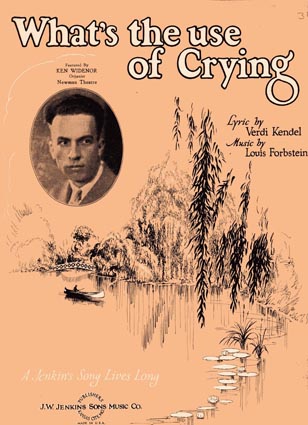
“What’s the Use of Crying?” Lyrics by Verdi Kendel, music by Louis Forbstein (1926). Recorded by Elsie Carlisle, accompanied by violin and piano (the latter played by Arthur Young), on August 22, 1927. HMV B2579 mx. Bb11403-2.

“What’s the Use of Crying?” – Elsie Carlisle

This song’s lyricist is comparatively obscure; its composer, Louis Forbstein, would later change his surname to Forbes and gain some amount of fame as musical director for David O. Selznick films (including “Gone with the Wind”). “What’s the Use of Crying?” is a song of unrequited love that begins in a rather moody register but quickly becomes more upbeat as the tempo is twice ratcheted up and the singer professes to have acquired a spirit of resignation in the face of her troubles, asking, “What’s the use of crying just for someone like you?”

Elsie Carlisle’s is the only British recording of this song that I have discovered. It was in vogue in America in late 1926-early 1927, with versions by Lee Sims, Charley Straight’s Orchestra, Ted Weems, Bessie Coldiron (as “The Sunflower Girl”), Greta Woodson, Gypsy & Marta (unissued), Peggy English (as Jane Gray), Bob Haring’s Dixie Music Makers, Harry Raderman (Arthur Hall, vocalist), and Willard Robison (accompanying himself on the piano).

"What's the Use of Crying" sheet music
“What’s the Use of Crying” sheet music

“Poor Kid” (1931)

“Poor Kid.” Music by Jesse Greer, lyrics by L. Wolfe Gilbert. Recorded in London by Elsie Carlisle in August 1931 under the musical direction of Jay Wilbur. Imperial 2532 mx. 5770-2.

Elsie Carlisle – “Poor Kid” (1931)

This melancholy 1931 torch song saw American versions  by Don Bigelow, Ben Selvin, and Ben Bernie. In Britain there were versions by Ambrose and His Orchestra (Sam Browne, vocalist), Jack Payne, Roy Fox and His Band (Al Bowlly, vocalist), Eddie Gross-Bart and His Café Anglais Band (Eddie Gross-Bart doing the vocals), Harry Hudson (Al Bowlly, vocalist), and Howard Godfrey’s Aldwych Players (Les Allen, vocalist).  Betty Bolton did a solo version under the pseudonym Gracie Collins.

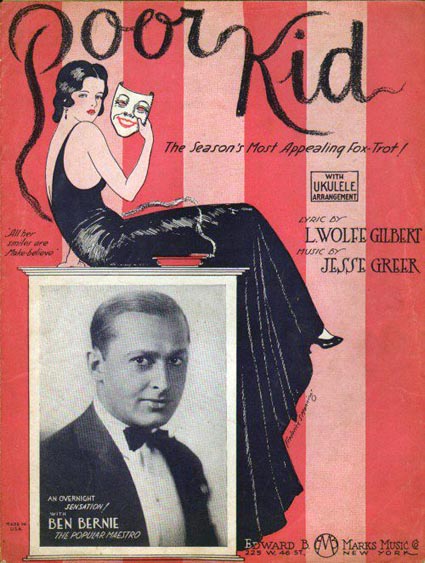
"Poor Kid" sheet music featuring Ben Bernie
“Poor Kid” sheet music featuring Ben Bernie

“Pardon Me, Pretty Baby” (1931)

“Pardon Me, Pretty Baby.” Words by Ray Klages and Jack Meskill, music by Vincent Rose. Recorded by Elsie Carlisle under the musical direction of Jay Wilbur in August 1931. Imperial 2532.

Elsie Carlisle – “Pardon Me, Pretty Baby” (1931)

Elsie Carlisle recorded this version of the popular “Pardon Me, Pretty Baby” for the Imperial label in August 1931 under the musical direction of Jay Wilbur. It is a light song with a chatty patter representing a persistent but inept attempt at a pickup. The tune is catchy, but a trifle repetitive. Elsie makes the song exciting by alternating between playful singing and exaggerated conversational interjections, a technique which reminds one that she was a veteran of musical theater.

In 1931 there were many treatments of “Pardon Me, Pretty Baby” on both sides of the Atlantic. In America, they include those of Joe Venuti’s Blue Four, Rudy Vallée and His Connecticut Yankees, Fred Rich and His Orchestra, Benny Goodman, Frank Novak’s Collegians, Ben Bernie and His Orchestra, “Whispering” Jack Smith, Sam Lanin’s Ipana Troubadours, and Gus Arnheim’s Cocoanut Grove Orchestra.

The song was equally popular in Britain, with versions by Jack Payne (with a vocal trio including Billy Scott-Coomber), Ambrose (with two takes on June 19, 1931 — both with Sam Browne as vocalist — one take as Ambrose and His Orchestra and the other as the Blue Lyres), Jack Harris and His Grosvenor House Band (vocalist Harry Bentley), Maurice Winnick and His Band (“Topical Tunes,” with Al Bowlly on the vocals), the Arcadians Dance Orchestra (Bert and John Firman, with a vocal trio including Maurice Elwin), Harry Hudson (Sam Browne, vocalist), the Rhythmic Eight, Eddie Gross-Bart and His Café Anglais Band, Arthur Lally (credited as Al Dollar and His Ten Cents, with Sam Browne as vocalist), Jan Ralfini and His Band (with Tom Barratt as vocalist), Harry Bidgood’s Broadcasters (Tom Barrat, vocalist), Jay Wilbur and His Band (as the Radio Syncopators, with Les Allen singing), and Howard Godfrey’s Aldwych Players (also with Les Allen as vocalist). Betty Warren was notable in her live renditions of the song in Lawrence Wright’s Blackpool North Pier production “On with the Show” (1931).

The composer of “Pardon Me, Pretty Baby,” Vincent Rose, also wrote “Umbrella Man,” which Elsie Carlisle recorded in 1939.

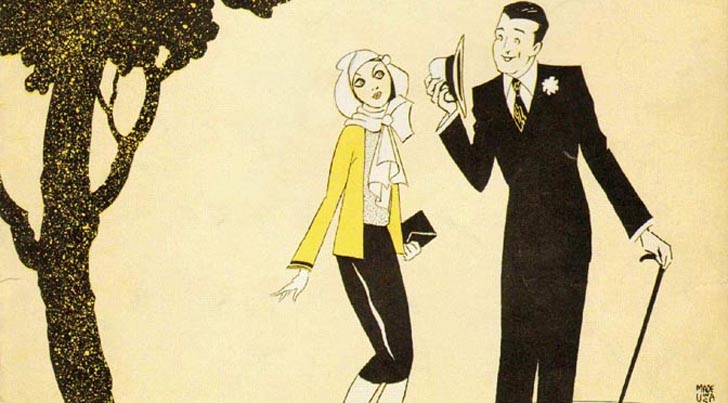
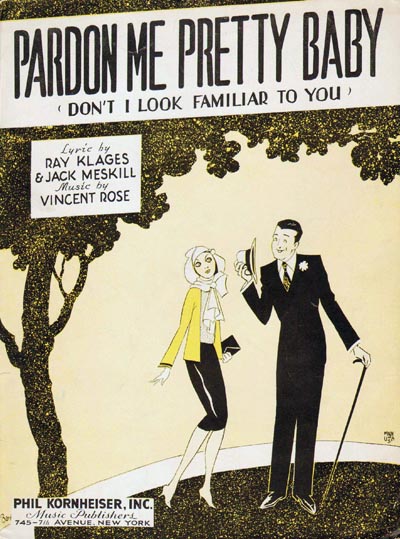
"Pardon Me, Pretty Baby" sheet music
“Pardon Me, Pretty Baby” sheet music