It seems almost a misnomer to speak of Elsie Carlisle “solo” recordings, for she always had accompanists. What I here call “solo” recordings are records on which her name is featured, rather than that of a band, and usually only when the accompanists cannot be safely identified.
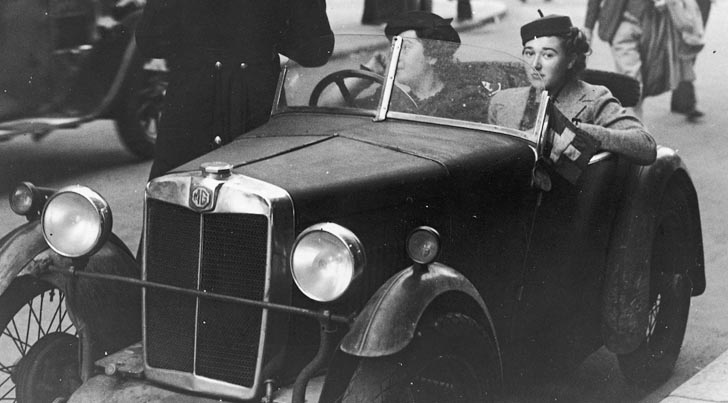
“Waiting for the Lights to Change.” Composed by Cyril Ray. Recorded by Elsie Carlisle with orchestral accompaniment on May 28, 1935. Decca F. 5568 mx. GB7166-1.
“Waiting for the Lights to Change” appears to have been recorded only by Elsie Carlisle. Its composer, Cyril Ray, was in 1935 primarily involved in directing the music for comedy films starring Leslie Fuller, but it is not at all certain that “Waiting for the Lights to Change” was part of a soundtrack. If it had been, one would expect to see the name of the movie printed on the record for marketing purposes.
This languid and melancholy song uses an extended traffic-related metaphor to describe the feeling of being at an impasse in life. At first the gridlock appears to be general, but soon we learn that the singer has encountered a more specific roadblock in her love life: a relationship represented by a street marked “THROUGH” that suddenly presents her with a red light — love thwarted. Elsie Carlisle, veteran torch singer, takes what is fundamentally a very repetitive song and uses it to create a somber atmosphere that is somehow deeply attractive, much as she had done earlier in 1935 with “I’ve Got an Invitation to a Dance.”
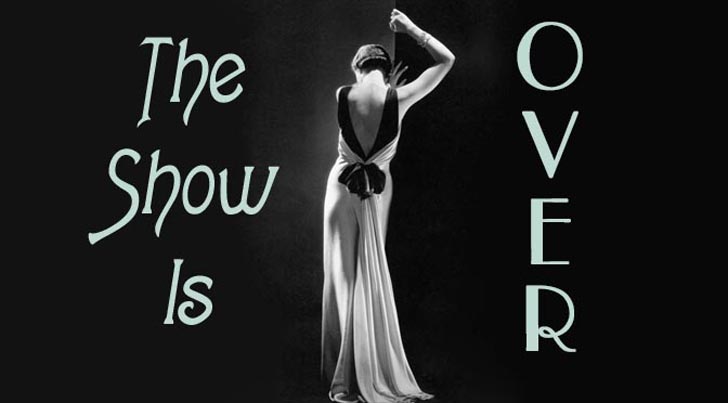
“The Show Is Over.” Words and music by Sam Coslow, Con Conrad, and Al Dubin (1934). Recorded by Elsie Carlisle with orchestral accompaniment on May 18, 1934. Decca F. 3990 mx. TB1259-2.
“The Show Is Over” is a “fox trot ballad” in which the singer expresses disappointment and a sense of disillusionment over a love relationship that has been dissolved. It relies on an extended theatrical metaphor: the singer has “played the part of the fool in the play” by being taken in by her former partner, who was “just acting a part in the play” when he pretended to be in love. Realizing that their relationship has been more like acting than real life and that in reality her lover is in love with someone else, the singer suggests that the two put away any pretense of being friends, concluding that “the show is over.”
The song had three songwriters, but I detect most in it the sensibility of Sam Coslow. Elsie Carlisle recorded four songs in 1934 for which Coslow had written words, music, or both, the others being “This Little Piggie Went to Market,”“A Place in Your Heart,” and “My Old Flame.” All are excellent songs, in spite of the fact that they take the risk of being saccharine, sentimental, or overly serious. All four songs, therefore, benefit from Elsie Carlisle’s skills as an actress; even while singing that “the show is over,” she impersonates perfectly the disillusioned lover and lends sincerity to what could otherwise be a somewhat artificial role.
“He’s the Last Word.” Lyrics by Gus Kahn, music by Walter Donaldson (1926). Recorded by Elsie Carlisle with accompaniment by piano (Arthur Young) and violin at Studio B, Hayes, Middlesex, on May 6, 1927. HMV B. 2579 mx. Bb10689-2.
“He’s the Last Word” follows an argument familiar to aficionados of popular music: its singer goes through a catalogue of her “sweet somebody’s” various deficits (insufficient talent at dancing, for example), only to conclude that when it comes to romance, “he’s the last word” — he is the very best. In her recording of the song, Elsie Carlisle is pure enthusiasm, and her frequent nonsensical ejaculations remind us of the fun, popular genre that she is working in. She has excellent accompanists in this recording on the piano and violin. Richard J. Johnson identifies the pianist as Carroll Gibbons and does not attempt to name the violinist.1
Contemporary record reviewer and industry insider Edgar Jackson was under a very different impression as to the identities of the accompanists, writing that
Elsie Carlisle has a thoroughly good vocal record of “He’s the Last Word” [54 at 78] (B2579). She sings tunefully, and is one of the most stylish and rhythmical of all our English comediennes. She has been excellently accompanied by Hugo Rignold (violin) and Arthur Young (piano)—Young does one of the best piano solo choruses I have heard. I wish I could say as much for his effort in “What’s the Use of Crying?” by the same artists on the reverse side.2
As it turns out, the evidence of the Kelly Online Database, which is based on HMV’s ledgers themselves, is that it was Arthur Young on the piano for “He’s the Last Word” (see my discography for further discussion). The suggestion that the violinist is Rignold is interesting. Hugo Rignold was already famous for his exceedingly “jazzy” playing, and certainly the violinist in “He’s the Last Word” gives the impression of being lively and playful, employing double and triple stops.3
In Britain in 1927, in addition to Elsie Carlisle’s, there were versions of “He’s the Last Word” by The Savoy Orpheans (directed by Carroll Gibbons), Syd Roy’s Lyricals, and Bert Firman’s Dance Orchestra (as Eugene Brockman’s Dance Orchestra).
Notes:
Elsie Carlisle: A Discography. Aylesbury, UK, 1994, p. 6. ↩
The names are emphasized in the original. “The Gramophone Review.” The Melody Maker and British Metronome 2.24 (Dec. 1, 1927): 1273. ↩
See Bret Lowe’s comments below about the violin playing in this recording and his suggestion that the violinist might have been Eric Siday. ↩
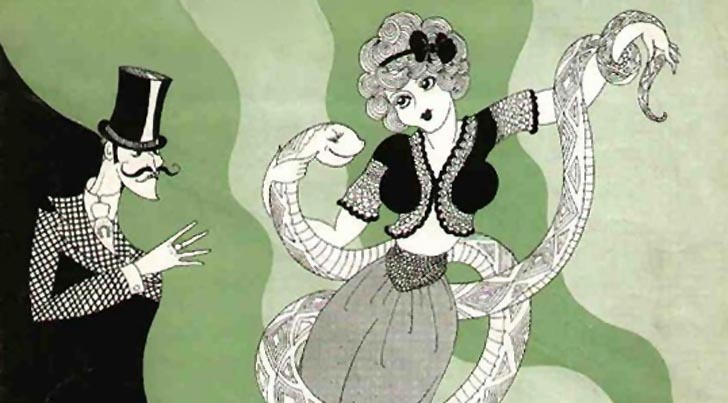
“Sweet Flossie Farmer (The Lovely Snake Charmer).” Words by Mort Dixon, music by Allie Wrubel (1935). Recorded by Elsie Carlisle with orchestral accompaniment on April 18, 1935. Decca F. 5524 mx. GB 7098-2.
“Sweet Flossie Farmer” is a comical song with a circus setting (like Elsie Carlisle’s duet with Sam Browne from the previous year, “Mr. Magician”). The scenario is simple: the title character, “Flossie Farmer,” is a professional snake charmer who is paradoxically attracted to a man repeatedly described as a “snake in the grass.”1 He is an animal trainer, but Flossie cares only for him, not for his animals, whose difficult polysyllabic names Elsie relishes rattling off while dismissing them: “rhinoceroses,” “hippopotamuses,” “sea lionesses” — she appears to give up after the gaffe “kangaroos-a-mooses!” — and the orchestra provides her with a satisfying antiphonal chorus of nonsense sounds. This animal trainer is a very bad man, we are to understand, who is only interested in sex, and he appears to succeed in his lechery, only to be bitten by Flossie’s snakes, who appear to be motivated by both jealousy and loyalty.
“Sweet Flossie Farmer,” like “Fare Thee Well, Annabelle” (which Elsie would record two months later), was composed by Hollywood songwriters Mort Dixon and Allie Wrubel. Newspapers of the time suggest that “Sweet Flossie Farmer” was, like “Fare Thee Well, Annabelle,” introduced in the film Sweet Music by Rudy Vallée and Ann Dvorak, but I cannot find the scene in which it occurs; there may very well be different cuts. In the 1935 Warner Bros. cartoon Hollywood Capers a small female animal sings the song. It was also recorded in America by Ozzie Nelson and His Orchestra, and in Britain it was included in 1936 in a medley by the Bert Feldman Company.
Notes:
As a classicist, I would be remiss if I did not point out that this is one of Elsie’s rare references to the Roman poet Virgil (Eclogues 3.93). ↩
“Public Sweetheart No. 1.” Lyrics by Graham John (pseudonym of Graham John Colmer), music by Martin Broones. Composed for the musical comedy Seeing Stars (1935). Recorded by Elsie Carlisle with orchestral accompaniment on November 29, 1935. Decca F. 5818 mx. GB7528-1.
Martin Broones, who also wrote the tune for “I Can’t Get Over a Girl Like You (Loving a Boy Like Me)” (which Elsie sang in 1927), collaborated in 1935 with Graham John Colmer to produce a score for a musical comedy called “Seeing Stars,” which opened at the Gaiety Theatre in London. With a run of 236 performances, it could be considered a success, in spite of critics’ having difficulty discerning any real plot. This lack of a conventional storyline might help to explain why a show set in a modern hotel on the French Riviera has a bawdy song set during the time of the Crusades in it.
The singer tells the story of herself as an English lady left all alone by her husband, who has gone off fighting abroad. This simple premise is followed by a brazen account of her life on the home front:
War is war, and in war, I knew,
There was work that only girls could do.
And so, while the others were ballyhooing,
Night and day I was doing
Quiet little acts of charity,
And what do you think they called me?
‘Public Sweeheart No. 1!’
Loved by every mother’s son.
While my old man was away,
I did one good deed each day.
The greatest impediment to her practicing, not the world’s oldest profession, surely, but perhaps its oldest avocation, is a chastity belt whose awkwardness proves to be quite funny: “Have you ever tried to run / When your undies weighed a ton?” the lady asks. At any rate, Richard the Lion-Hearted has a master key, so the “fireworks” and shamelessness can continue. The nickname “Public Sweetheart No. 1” is most likely a play on “Public Enemy No. 1,” the epithet given by the Chicago Police and later by the FBI to Al Capone, John Dillinger, and finally bank robber Pretty Boy Floyd in the years leading up to the opening of “Seeing Stars” in London.
Elsie Carlisle delivers the lyrics in a sort of parlando singing where natural English intonation often trumps the tune. One might be reminded of the recitatives of Rex Harrison, but whereas he appears to have been primarily motivated to sing thus by a very limited vocal range, Elsie’s leaning towards a more declamatory style has a very theatrical and comic effect. The overall sound of the song is closer to musical hall than dance band.
“Public Sweetheart No. 1” was also recorded in late 1935 by Billy Cotton and His Band (with vocalist Alan Breeze) and by Florence Desmond, who had introduced the song on stage in the first place. It was also recorded as part of a “Seeing Stars” medley by the Debroy Somers Band, Somers having been the musical director for the stage production.
"The Idol of the Radio." British dance band singer of the 1920s, 1930s, and 1940s.