Latest posts

Ambrose, Solo Recordings

“Smoke Gets in Your Eyes” (1934)

“Smoke Gets in Your Eyes.” Composed by Jerome Kern, with lyrics by Otto Harbach, for their musical Roberta (1933). Recorded by Elsie Carlisle in London on October 31, 1934.  Decca F-5289 mx. TB-1696-1.

Elsie Carlisle – “Smoke Gets in Your Eyes” (1934)

Elsie Carlisle, so often the torch singer, beautifully conveys the pathos of the lyrics of the show tune “Smoke Gets in Your Eyes.” As a veteran of light musical stage drama, Elsie had a voice suited to the song, with its memorable full-octave melodic ascension at the beginning (more reminiscent of European operetta than of popular song). It was perhaps in consideration of this perfect match between her vocal capabilities and the already popular song that Decca had Elsie record “Smoke Gets in Your Eyes” twice in two days, first as a “solo” record, and again the next day with Ambrose and His Orchestra, in an arrangement that is perhaps somewhat less of a tear-jerker and more suited to dancing:

“Smoke Gets in Your Eyes.” Recorded by Ambrose and His Orchestra with vocals by Elsie Carlisle on November 1, 1934. Decca F-5293.

“Smoke Gets in Your Eyes” – Ambrose & His Orchestra
Video by Playedback (YouTube)

It seems hard to believe, but the perennial favorite “Smoke Gets in Your Eyes” was twice discarded from shows before it actually got used in the Broadway musical Roberta. Jerome Kern originally composed it as a tap dance number to be performed during a scene change in his 1927 hit Showboat, but for one reason or another, it was cut. In 1932 Kern retooled it as a march to be used as the theme song for an NBC radio series which never aired. It was in the light, romantic 1933 drama Roberta that “Smoke Gets in Your Eyes” was finally introduced to the public, this time retooled as a sentimental ballad, either at the suggestion of the producer or of lyricist Otto Harbach. Harbach’s lyrics borrow their tag line “When you’re heart’s on fire, smoke gets in your eyes” from a Russian proverb. The original Broadway production of Roberta starred, amongst others, Bob Hope, Fred MacMurray, Fay Templeton, Ray Middleton, and Sydney Greenstreet, but it was Ukrainian actress Tamara Drasin, playing a Russian princess, who first sang “Smoke Gets in Your Eyes.”

Notable American recordings in 1933 and 1934 include ones by Gertrude Niesen (with orchestral accompaniment directed by Ray Sinatra), Paul Whiteman and His Orchestra (with vocals by Bob Lawrence), Emil Coleman and His Riviera Orchestra (with vocalist Jerry Cooper), Leo Reisman and His Orchestra (with vocals by Tamara Drasin, from the original Broadway production), Chick Bullock and His Levee Loungers, Dick Robertson, and Ruth Etting. Film audiences would hear the song performed by Irene Dunne in a 1935 movie of Roberta.

In 1934 there were other British recordings of “Smoke Gets in Your Eyes” by Jay Wilbur and His Band (Sam Browne, vocalist), Charlie Kunz’s Casani Club Orchestra (with vocals by Harry Bentley), Harry Roy and His Orchestra (with vocals by Ivor Moreton), Jack Payne and His Band (Billy Scott-Coomber, vocalist), Henry Hall’s BBC Dance Orchestra (with vocals by Dan Donovan, in a Bert Read arrangement), Lew Stone and His Band (with Alan Kane as vocalist, in a Stanley Black arrangement), and Joe Loss and His Kit-Cat Band.

Jay Wilbur

“Oh! What a Surprise for the Du-ce!” (1940)

“Oh! What a Surprise for the Du-ce!” Original melody by Nino Casiroli (1939), English lyrics by Phil Park (1940). Recorded by Elsie Carlisle under the musical direction of Jay Wilbur in London on December 31, 1940.  Rex 9904 mx. R-5203-1.

Elsie Carlisle – “Oh! What a Surprise for the Du-ce!” (1940)

On October 28, 1940, Italian ambassador to Greece Emmanuele Grazzi presented Greek Prime Minister Ioannis Metaxas with an ultimatum:  allow Axis forces to occupy strategic locations in Greece or be invaded. Metaxas responded in diplomatic French, “Alors, c’est la guerre!” (“Then it’s war!”), but rumor had it that he responded laconically «Όχι» (“Ohi,” “No!”), which is why October 28 is celebrated to this day as Ohi Day (Επέτειος του «Όχι»), in memory of Greece’s defiance of Axis bullying.

War ensued, but it was not the easy conquest that Italy had expected. An Italian attempt at invading Greece was met with a counterattack in which Greece occupied a large part of Albania, by then an Italian protectorate. The Italians were held at bay for five months, and it was only in April 1941, when the Germans invaded Greece, that the Greco-Italian War came to an end. In the meantime Greece had diverted Axis resources and delayed their progress, thus contributing to future victory by Allied forces.

Greece’s inspiring example was not lost on the world. English lyricist Phil Park was quick to adapt a popular Italian song, Evviva la Torre di Pisa, inventing lyrics that mocked Mussolini’s pretensions. “Oh! What a Surprise for the Du-ce!” uses clever wordplay to highlight the irony of Greece’s successfully blunting Fascist aspirations in the Balkans:

His troubadors advance with roars of "Viva!  Oh, viva!"
In armoured cars they strum guitars
Till frilly white skirts
Play the deuce with Blackshirts.
Oh! What a surprise for the Du-ce, the Du-ce,
He can't put it over the Greeks!

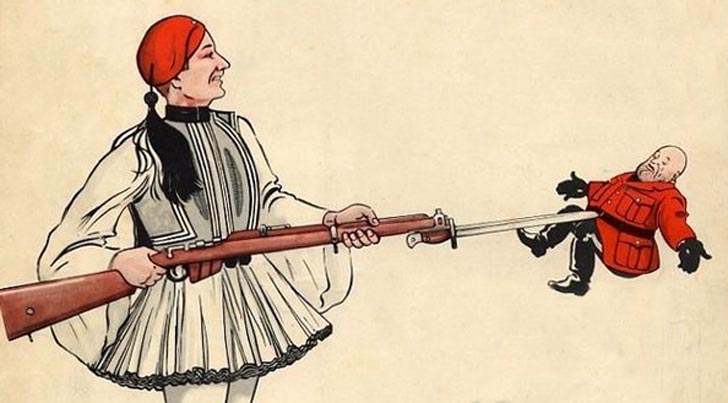
The “frilly white skirts” were the Evzones, an elite Greek infantry group known for their white, kilt-like traditional garb. The expression “play the deuce” reminds us of the ever-present “Du-ce,” and the Blackshirts are, of course, the Fascists, with contrasting clothing.

Elsie Carlisle, already a confirmed wartime singer, delivers the lyrics in a mock-operatic fashion with occasional asides in the comical, chatty tone for which she was famous. “Oh! What a Surprise for the Du-ce!” was definitely catchy, and it was adapted into Greek by Paul Menestrel as Πω πω τι έπαθε ο Μουσολίνι and recorded by popular singer and actress Sophia Vembo (who even sings some of the English lyrics near the end of the song). In Britain, in addition to Elsie Carlisle’s rendition, there were recordings in 1940 by Florence Desmond, Ambrose and His Orchestra (with vocals by Sam Browne), and Jack White and His Band (Anton Mosley and Ronnie Priest, vocalists), with a further recording in mid-January 1941 by Billy Cotton and His Band (with vocals by Alan Breeze).

Solo Recordings

“One Little Kiss” (1934)

“One Little Kiss.” Written by Bert Kalmar and Harry Ruby for the RKO Radio Film Kentucky Kernels (1934). Recorded by Elsie Carlisle with orchestral accompaniment in London on October 31, 1934. Decca F-5289 mx. TB-1698-2.

Elsie Carlisle – “One Little Kiss” (1934)

“One Little Kiss” was written for the 1934 RKO Radio Film Kentucky Kernels starring comedy duo Wheeler and Woolsey. In the movie, the various characters sing increasingly silly versions of the song in succession. The apex of the wackiness takes the form of child star Spanky McFarland’s singing to a dog and Woolsey’s serenading a donkey. It comes as no surprise that Bert Kalmar and Harry Ruby, who wrote the screenplay of Kentucky Kernels and composed its songs, had contributed to the 1932 Marx Brothers movie Horse Feathers and composed the anthem “Everyone Says I Love You,” which is similarly rendered by the film’s various characters with increasingly comic bathos.1

Elsie Carlisle’s version of “One Little Kiss” lacks the silliness of its celluloid antecedent, the last vestige of which, perhaps, is the repetition of the phrase “One teeny little, weeny little kiss.” Instead, it is a comparatively serious interpretation of the lyrics which highlights the inherent merits of the catchy melody. As with most popular songs from musical comedies, “One Little Kiss” saw a number of treatments in 1934. In America, there were versions by Cliff Edwards and the Eton Boys, Harry Reser and His Orchestra (with vocals by Tom Stacks), and Ted Weems and His Orchestra (with Gene Glennan as vocalist). In Britain, in addition to Elsie Carlisle’s version, there were recordings of “One Little Kiss” made by Brian Lawrance and His Quaglino’s Quartet in November 1934 and by Kitty Masters and Val Rosing in February 1935.

  1. See also Erin Elisavet Kozák’s article on “The Marx Brothers’ ‘Everyone Says “I Love You’ in Film and Popular Music.” The Discographer Magazine 3.5 (2016), especially p. 4. ↩︎