“One Little Kiss.” Written by Bert Kalmar and Harry Ruby for the RKO Radio Film Kentucky Kernels (1934). Recorded by Elsie Carlisle with orchestral accompaniment in London on October 31, 1934. Decca F-5289 mx. TB-1698-2.
Elsie Carlisle’s version of “One Little Kiss” lacks the silliness of its celluloid antecedent, the last vestige of which, perhaps, is the repetition of the phrase “One teeny little, weeny little kiss.” Instead, it is a comparatively serious interpretation of the lyrics which highlights the inherent merits of the catchy melody. As with most popular songs from musical comedies, “One Little Kiss” saw a number of treatments in 1934. In America, there were versions by Cliff Edwards and the Eton Boys, Harry Reser and His Orchestra (with vocals by Tom Stacks), and Ted Weems and His Orchestra (with Gene Glennan as vocalist). In Britain, in addition to Elsie Carlisle’s version, there were recordings of “One Little Kiss” made by Brian Lawrance and His Quaglino’s Quartet in November 1934 and by Kitty Masters and Val Rosing in February 1935.
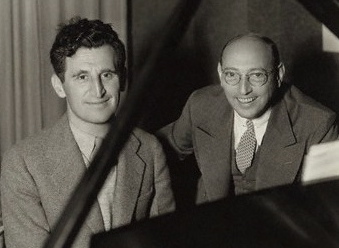
Harry Ruby and Bert Kalmar at the piano
See also Erin Elisavet Kozák’s article on “The Marx Brothers’ ‘Everyone Says “I Love You’ in Film and Popular Music.” The Discographer Magazine 3.5 (2016), especially p. 4. ↩︎
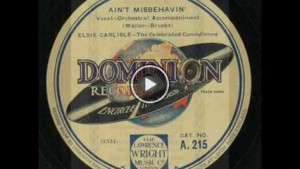
“Honey.” Music by Richard A. Whiting, lyrics by Haven Gillespie and Seymour Simons (1928). Recorded by Elsie Carlisle under the musical direction of Jay Wilbur in London, c. mid-October 1929. Dominion A-215 mx. 1532-2.
“Honey” is a sentimental 1928 foxtrot of which many popular recordings were made in 1929 and which is still quite familiar to the general public. Elsie Carlisle’s version of it, with piano and string accompaniment, is paired with “Ain’t Misbehavin'” on Dominion A. 215, and the juxtaposition seems fitting. In “Ain’t Misbehavin'” she articulates the themes of sincerity and fidelity convincingly in a straightforward interpretation of the lyrics. She sings “Honey” equally sweetly and with an air of innocence suited to its simple lyrics. In this song we find a sustained expression of affection; there is none of the unrequited love so frequently found in her other songs, and none of her famed naughtiness. “Honey” showcases Elsie’s mezzo-soprano voice and her ability to convey emotion in the musical medium.
The composer and lyricists of “Honey” are remembered for a number of other popular songs, many of which were featured in motion pictures. Whiting, Gillespie, and Simons had already collaborated in writing “Breezin’ Along with the Breeze” in 1926, and that same year Whiting and Simons (without Gillespie) had produced “Hello Baby.” Simons is perhaps best remembered for co-writing the 1931 song “All of Me” with Gerald Marks. Haven Gillespie penned the lyrics to “Santa Claus is Coming to Town” in 1934, and in that same year Whiting would compose the song “Rock and Roll” (whose title seems to be the origin of name of the musical genre) and “On the Good Ship Lollipop.” In 1937 he composed “Hooray for Hollywood” (with Johnny Mercer as his lyricist). “Honey” would later appear in the 1945 movie “Her Highness and the Bellboy,” starring Hedy Lamarr.
“Ain’t Misbehavin’.” Music by Fats Waller and Harry Brooks, with lyrics by Andy Razaf (1929). Recorded by Elsie Carlisle under the musical direction of Jay Wilbur in London, c. October 1929. Dominion A-215 mx. 1531-?.
Credited co-composer Harry Brooks, who has been occasionally dismissed as a mere arranger of the song for Hot Chocolates, would later explain that the tune of “Ain’t Misbehavin’” was written in imitation of the beginning notes and bridge of Gershwin’s 1924 song “The Man I Love.” Fats Waller claimed that the title “Ain’t Misbehavin’” was a reference to his inability to misbehave in alimony jail, which is where he claimed to have composed the song. Andy Razaf, who outlived Waller by three decades, would later explain that Waller was misbehaving in misleading people: Razaf had come up with the title and the lyrics in Waller’s house in New York, where they finished the whole song in 45 minutes.
Elsie Carlisle sang other music with lyrics by Andy Razaf, including “My Man o’ War,” “The Porter’s Love Song,” “My Handy Man,” and “My Handy Man Ain’t Handy No More,” but whereas those songs lean towards naughtiness – misbehavin’, one might almost say – “Ain’t Misbehavin’” is charming in that it defines the qualities of fidelity and sincerity by alluding to their opposites. Elsie sounds fetchingly innocent as she declares her loyalty and denies any misconduct. Particularly touching is how she handles the upwards and downards progressions with the lyrics
Like Jack Horner
In the corner,
Don't go nowhere.
What do I care?
Your kisses are worth waiting for,
Believe me.
It is ironic that Elsie’s recorded image would later make an unintentional appearance in what would appear to be a rather pornographic 1974 movie (I have not had the pleasure of seeing it myself) entitled Ain’t Misbehavin’, in which old footage is used of her singing “My Canary Has Circles Under His Eyes,” along with Fats Waller singing “Ain’t Misbehavin’” and “Honeysuckle Rose” (and Django Reinhardt playing Gershwin’s “The Man I Love,” and who knows what else that appears in this article), all interspersed with vintage lewd footage – or so I am told.
Autumn 1929 saw British bands begin to record this Jazz Age anthem. On October 8, Jack Hylton and His Orchestra, with Sam Browne as their vocalist, made two records, one of standard length, the other a longer “concert arrangement” on a twelve-inch disc (Billy Ternent being the arranger); both versions involve recurrent allusions to George Gershwin’s “Rhapsody in Blue.” That same day Bidgood’s Broadcasters also recorded “Ain’t Misbehavin’,” and as the season progressed there were versions made by the Rhythmic Eight, Hal Swain’s Café Royal Band, Ambrose and His Orchestra (with vocalist Lou Abelardo, in a Lew Stone arrangement), Arthur Roseberry and His Dance Band (as Bert Maddison and His Dance Orchestra, with vocal refrain by Len Lees), Cecil and Leslie Norman’s Savoy Plaza Band (Cavan O’Connor, vocalist), Nat Star and His Dance Orchestra (as Eugene Brockman’s Dance Orchestra), and Percival Mackey’s Band (with vocals by Billy Milton). Jim Kelleher’s Piccadilly Band recorded two takes of “Ain’t Misbehavin’” that were never issued. In November, Harry Jacobson sang the song while playing the piano, accompanied by the Edison Bell studio orchestra directed by Harry Hudson (you may hear it in John Wright’s British Dance Band Show podcast #275, at 8:09). In this latter rendition, the band musically cites “Rhapsody in Blue” (at 9:35), much as Jack Hylton’s orchestra had done.