Latest posts

Solo Recordings

“Conversation for Two” (1935)

“Conversation for Two.” Composed by Sammy Mysels, Billy Hueston, and Bob Emmerich (1935). Recorded by Elsie Carlisle with orchestral accompaniment on September 7, 1935. Decca F-5689 mx. GB-7369-1.

Elsie Carlisle – “Conversation for Two” (1935)

Elsie Carlisle sings this languid love song about small talk leading to romance with considerably less of the dramatic element than is her wont. Instead, she adapts her delivery to the slow yet catchy tune in such a way as to make it atmospheric. Even her dreamy humming “Mm-mm-mm-mm…” followed by “I love you” is seductively sedating. It is perhaps fitting that the flip side of the record is “Star Gazing,” a song which is similarly leisurely in pace and vaguely mesmerizing.

Elsie’s 1935 rendition of “Conversation for Two” is the only recording that I have found of the song. Even the sheet music appears to be rare. The three composers were all prolific, however. Mysels and Emmerich got involved in composing music for motion pictures, and Emmerich, a pianist in the Tommy Dorsey Band and songwriter for Fats Waller, went on to write “The Big Apple,” a song which popularized New York City’s peculiar sobriquet.

Ambrose, Solo Recordings

“His Majesty the Baby” (Two Versions; 1935)

In his 1914 essay “On Narcissism,” Sigmund Freud wrote

The child shall have it better than his parents; he shall not be subject to the necessities that we have recognized as prevailing in life.  Sickness, death, renunciation of enjoyment, and restrictions on his own will shall not be valid for the child; the laws of nature, like those of society, shall come to a halt before him; he shall really be the center and heart of creation, His Majesty the Baby, as we once thought ourselves to be (emphasis mine).

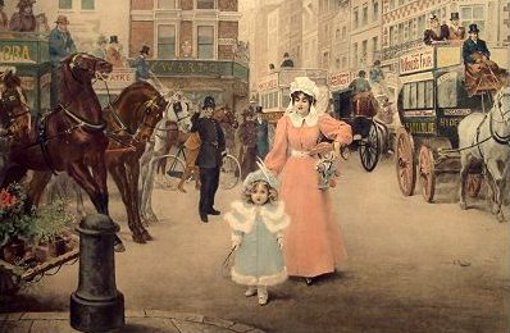
Freud was writing in German, of course, but he wrote the expression “His Majesty the Baby” in English.  He appears to have been alluding to a late Victorian painting by Arthur Drummond in the Royal Academy:

One can see that, in Drummond’s painting, the whole world seems to wait upon the ermine-clad infant center-of-attention.  Of course, Freud uses the idea of “His Majesty the Baby” to refer to how the child sees things, not its parents — and he pulls in all sorts of notions about primary narcissism and auto-eroticism that need not concern us here.

In 1935, the phrase “His Majesty the Baby” resurfaces as the title of a slow foxtrot composed by American songwriters Neville Fleeson, Arthur Terker, and Mabel Wayne.  Elsie Carlisle sang other Mabel Wayne songs involving childhood themes; in 1934 she recorded two versions of “Little Man, You’ve Had a Busy Day” that were issued and two versions of “Who Made Little Boy Blue.”  “His Majesty the Baby” has lyrics describing a baby who seems regal, the object of constant awe.  It is clear that it is the feelings of the adults surrounding the child that are being discussed, however, and that the imperious attitudes attributed to him are a mere transference of his parents’ reverence for his cuteness.

“His Majesty the Baby.” Words by Neville Fleeson and Arthur Terker; music by Mabel Wayne (1935). Recorded by Ambrose and His Orchestra with vocals by Elsie Carlisle on January 11, 1935. Decca F. 5379 mx. GB-6868-2.

Personnel: Bert Ambrose dir. Max Goldberg-t-mel / Harry Owen-t / Ted Heath-Tony Thorpe-tb / Danny Polo-Sid Phillips-Billy Amstell-reeds / Joe Jeannette-as / Ernie Lewis-Reg Pursglove-others?-vn / Bert Barnes-p / Joe Brannelly-g / Dick Ball-sb / Max Bacon-d

Ambrose and His Orchestra (v. Elsie Carlisle) – “His Majesty the Baby” (1935)

The version of “His  Majesty the Baby” that Elsie Carlisle recorded with Ambrose and His Orchestra begins with a substantial instrumental introduction that seems stately enough.  Elsie’s concise delivery of the lyrics leaves no doubt that the worship being demanded for the infant child is somewhat tongue-in-cheek; the song plays on the attitude of fawning obedience that people adopt when around a beloved baby.

Several days later Elsie would record (again for Decca) a solo version of “His Majesty the Baby”:

“His Majesty the Baby.” Words by Neville Fleeson and Arthur Terker; music by Mabel Wayne (1935). Recorded by Elsie Carlisle with orchestral accompaniment on January 14, 1935. Decca F. 5380 mx. GB6876-2.

Elsie Carlisle – “His Majesty the Baby” (1935)

This second interpretation of the song has a competent orchestral accompaniment, but it is Elsie’s voice that is the focus through the entire song, and one must admit that the piece suffers, not so much from “baby talk,” but from an exaggerated dramatization of infant bedtime.

Other notable British recordings of “His Majesty the Baby” were made in January 1935 by Billy Merrin and His Commanders (with vocals by Billy Merrin), the BBC Dance Orchestra under Henry Hall (with vocalist Kitty Masters), the New Mayfair Dance Orchestra under Percival Mackey (Jack Plant, vocalist), Harry Roy and His Orchestra (with vocals by Ivor Moreton), twice by Jay Wilbur and His Band with Eve Becke, and by Lou Preager and His Romanos Restaurant Dance Orchestra (with vocalist Pat Hyde).  Phyllis Robins made a solo recording of the song that year.  The notable American recording is from July 1935 and is by Rudy Vallée and His Connecticut Yankees.

Jay Wilbur, Solo Recordings

“Alone and Afraid” (1931)

“Alone and Afraid.” Music by Jack Trent, with lyrics by Stan Leigh (1931). Recorded in London in May 1931 by Elsie Carlisle (under the musical direction of Jay Wilbur). Imperial 2489 mx. 5701-2.

Personnel: Jay Wilbur dir. Laurie Payne-Jimmy Gordon-cl-as-bar / George Clarkson-cl-ts / Norman Cole-?George Melachrino-vn / Billy Thorburn or Pat Dodd-p / Bert Thomas-g / Harry Evans-sb / ?Max Bacon-d-vib

Elsie Carlisle – “Alone and Afraid” (1931)

Elsie Carlisle recorded more than a few torch songs in her time, but “Alone and Afraid” stands out as a particularly noteworthy example of her efforts. I have argued elsewhere that one of Elsie’s foremost talents as a dance band singer was to establish the audience’s idea of her persona in a very limited time frame (often in under a minute of singing). In “Alone and Afraid” Elsie has more time, as it is not a dance band record, and so she uses most of one side of a record to produce the perfect vocal tearjerker. She sings of a deep disappointment, of unrequited love, or at the very least, of an asymmetrical relationship subject to unfortunate misunderstanding (“I gave my love, but his was lent”). The tune is memorable and can even be played as an upbeat dance number, as we find out near the beginning of the 1931 Stanley Lupino film The Love Race.

In the same year, Elsie recorded a short film of her singing “Alone and Afraid” and “My Canary Has Circles Under His Eyes,” accompanied by Harry Rubens on the piano (this may or may not be the same pianist as the Harry Robens who played briefly for Ray Starita’s band):

Elsie Carlisle (1931)

Very little camera footage survives of Elsie Carlisle, so it is hard to place this particular performance in the context of her career as a musical actress, but I find this film short both mesmerizing and satisfying. The quality of the singing is excellent and comparable to that of the record, but Elsie’s acting is really delightful. Her intense gazes into the camera leave one with the impression that she is sharing something very sincere.

“Alone and Afraid” was also recorded in 1931 in Britain by Jerry Hoey and His Band (v. Joe Leigh), Jack Payne and His BBC Dance Orchestra (v. Jack Payne), and Arthur Lally and the Million-airs (v. Cavan O’Connor).