“Rock Your Cares Away.” Words and music by Leonard Blitz (as Leo Towers), Harry Sugarman (as Harry Leon), Lawrence Wright (as Horatio Nicholls) (1932). Recorded in London on November 5, 1932 by Rudy Starita and His Ambassadors with vocalist Elsie Carlisle. 4 in 1 – 17 mx. X-218-2.
Personnel: probably Nat Star-cl-as dir. / Nat Gonella-t / t / tb / cl-as / cl-ts / vn / p / bj-g / bb-sb / Rudy Starita-d-vib-x
It is a little difficult to taxonomize this recording of “Rock Your Cares Away” by bandleader. It is clearly Ray Starita’s band, as is indicated on the label of the Sterno recording made at the same session (Sterno and 4 in 1 were both products of the British Homophone Company), but Ray had not returned from a vacation to America the previous summer and so could not have directed the music. The 4 in 1 record from the session mentions not Ray, but his brother Rudy Starita, the percussionist who did eventually take over control of the band from his brother. And yet Rust and Forbes think it likely that this particular session was led by Nat Star, who was generally in charge of dance music at Homophone1.
Whoever directed it, the result was a memorable piece of lively dance band music. The lyrics of “Rock Your Cares Away” exhort us to cast away gloom, live in the moment, and “…rock [our] cares away / In a cradle of dreams.” The Star/Starita 4 in 1 version is uptempo; Elsie Carlisle’s vocal refrain, while brief, is memorable for its ebullience. Her enthusiastic delivery is infectious and evocative of a carefree mental state, and she gets across the song’s message through raw energy rather than mere earnestness.
“Mad about the Boy.” Words and music by Noël Coward for the 1932 revue Words and Music. Recorded in London on November 5, 1932 by Rudy Starita and His Ambassadors with vocalist Elsie Carlisle. 4 in 1 – 17 mx. X-218-2.
Personnel: probably Nat Star-cl-as dir. / Nat Gonella-t / t / tb / cl-as / cl-ts / vn / p / bj-g / bb-sb / Rudy Starita-d-vib-x
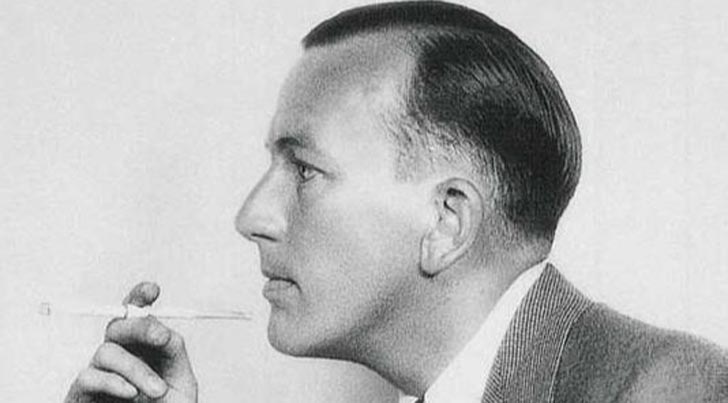
“Mad about the Boy” must be one of Sir Noël Coward’s most successful compositions, especially if we measure success by the fact that the song continues to be recorded and even used in advertising many decades after its debut on the London stage. It originated in the 1932 revue Words and Music, whose words, music, script, and direction were all done by Coward himself; the show included other memorable songs such as “Mad Dogs and Englishmen” and “Let’s Say Goodbye.” “Mad about the Boy” was sung on stage by a cast of female characters — a society lady, a prostitute, a schoolgirl, and a Cockney servant — who describe their passion for a movie star as they wait in line to see one of his films. The lyrics are predictably witty, using a surprising variety of rhymes for the monosyllables “mad” and “boy”.1
It is not clear whether the song was meant to reference a specific film actor. A great deal of effort has been put into identifying an unrequited real-life crush that Coward is said to have had on some American actor (the name Douglas Fairbanks, Jr. comes up frequently). Coward may have contributed to the idea that the song had a homosexual theme by writing verses for a businessman character to sing in the New York version:
(The character was cut from the production — the idea may have been too risqué for its time.)2 I find it ultimately unnecessary, however, to assume that the “boy” of “Mad about the Boy” must have a specific, real-world analogue — in any case, infatuation with an inaccessible celebrity is a very common occurrence.
…I’m mad about the boy
And even Doctor Freud cannot explain
Those vexing dreams
I’ve had about the boy.

…

When I told my wife
She said
"I never heard such nonsense in my life!"
Her lack of sympathy
Embarrassed me
And made me frankly glad about the boy.
Elsie Carlisle’s versions of “Mad about the Boy” were made with Ray Starita’s band, but in the bandleader’s absence — Ray had gone on vacation to America in the summer of 1932 and never returned to England. There are quite a few records whose labels read “Ray Starita and His Ambassadors” that were likely made without him; one of the records with “Mad about the Boy” on them (4 in 1 – 17) is the first to specifically mention Ray’s brother Rudy Starita instead. Yet Rust and Forbes hesitate to say that Rudy was actually the musical director for that session, writing that it was probably Nat Star who played that role.3
It should be noted that the band and Elsie recorded takes for two records of “Mad about the Boy” that day, a Sterno and a 4 in 1 (both products of the British Homophone Company).
The other dance bands’ arrangements of “Mad about the Boy” exclusively used the society lady’s lines from the Words and Music review. For some reason, the Starita band had Elsie sing the prostitute’s verse, which is rather more edgy:
I'm hardly sentimental;
Love isn't so sublime.
I have to pay my rental,
And I can't afford to waste much time.
Elsie’s alternately weepy and enraptured vocal complements the band’s funereally melancholy yet infectiously catchy treatment of the tune. Her evocation of a street-walker’s brooding obsession with a Hollywood persona is really quite convincing.
People who read my website are likely to be familiar with my good friend Jonathan Holmes, whose journalism, general music advocacy, and YouTube channel have made him almost synonymous with British dance band music:
Jonathan Holmes
Jonathan interviewed me yesterday for his “British Dance Music Programme.” We played Elsie Carlisle songs and discussed her life and career. We also talked a little about my new website, mauriceelwin.com. The interview will be broadcast several times tomorrow, Friday, February 26, on Phonotone Classic. Check out their website to tune in; I should be on at