Oscar Rabin, Solo Recordings

“Deep Water” (Two Versions; 1933)

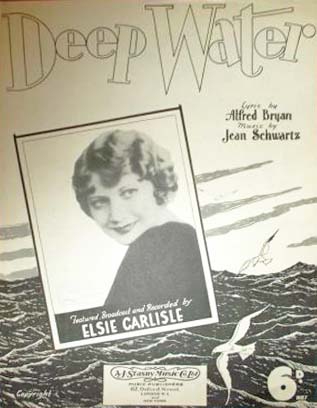
“Deep Water” was composed by Hungarian-born Tin Pan Alley composer Jean Schwartz, with words by Canadian lyricist Alfred Bryan. The song employs an extended metaphor of shipwreck to describe emotional distress and a feeling of desperate loneliness. The singer complains of being submerged in deep seawater and asks for an oar, a lifeline, or, failing those, prayers or sympathy. Her plight would appear to be entirely figurative, her ailment psychological depression, not drowning; so it is funny that the refrain ends with the complaint “Deep water never drowns my troubles for me!” Here the expression “drown your sorrows” (which usually refers to resorting to alcohol) is invoked, and it clashes with the larger theme of drowning from depression. The overall effect of the song is thus a playful, rather than a genuinely depressing, one.

Elsie Carlisle first recorded “Deep Water” on a solo record, with an excellent but anonymous studio band:

“Deep Water.” Music by Jean Schwartz, lyrics by Alfred Bryan (1931). Recorded by Elsie Carlisle on March 3, 1933. Decca F-3507 mx. GB-5629-1.

Elsie Carlisle – “Deep Water” (1933)

This March recording of “Deep Water” is melancholy for its first few seconds but straightway becomes more upbeat. Elsie’s delivery of the song’s complaint is in every way fun and is complemented by a piano solo whose virtuosity drowns any idea that the song is meant to be depressing.

On May 9, 1933, Elsie recorded three takes of “Deep Water” with Oscar Rabin and His Romany Band: one on Sterno 1187, one on Four-in-One 44, and one that appeared both on Plaza P-103 (with the band identified as “Brockman’s Band”) and on Lewis L-4 (where the band is called “Phil Conrad’s Serenaders.” The arrangement that Oscar Rabin used is somewhat more morose than Elsie’s original recording but catchy nonetheless:

“Deep Water.” Recorded by Oscar Rabin and His Romany Band (as Brockman’s Band) with vocals by Elsie Carlisle on May 9, 1933. Plaza P-103 mx. L-995-1.

Personnel: Harry Davis-bj-g dir. Hamish Christie-t-tb / Johnny Swinfen-Raymond Doughty-cl-as / Sid Brown-cl-ts / Oscar Rabin-bsx-vn-ldr / Alf Kaplan-p / Cecil Walden-d

Oscar Rabin and His Romany Band (with Elsie Carlisle) – “Deep Water” (1933)

The only other contemporary recording of “Deep Water” would appear to be the one that Maurice Winnick and his band made on May 12, 1933, with vocals by Sam Browne.

George Scott-Wood

“Two Sleepy People” (1939)

“Two Sleepy People.” Words by Frank Loesser, music by Hoagy Carmichael. Recorded by Elsie Carlisle under the musical direction of George Scott-Wood on February 1, 1939 at Studio 1, Abbey Road, London. HMV BD-661 mx. 0EA-7516-1.

Elsie Carlisle – “Two Sleepy People” (1939)

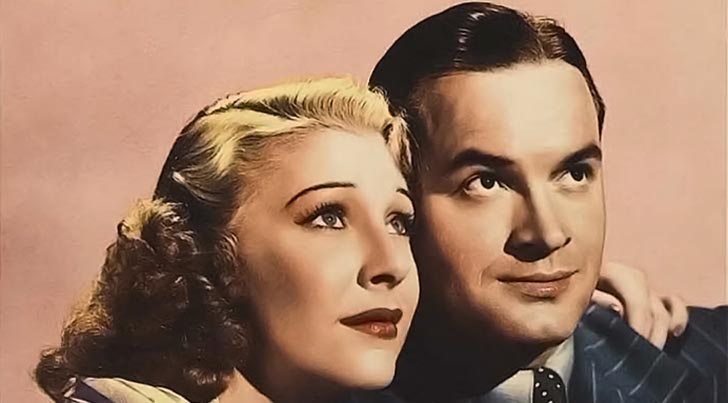
“Two Sleepy People” was composed by Tin Pan Alley greats Hoagy Carmichael and Frank Loesser for the 1938 Paramount feature Thanks for the Memory, where it was introduced by Bob Hope and Shirley Ross. The song describes a young couple who, in spite of the late hour and an increasing lack of conversational topics, are nonetheless “too much in love to say goodnight.” Eventually we learn that they are married and that their late-night behavior predated their nuptials; their change in marital status appears to have done little to alter the long hours they keep. The idea of a married couple so happy together that they are willing to go through life rather exhausted is but the kernel of this excellent, perennial song’s success. For Elsie Carlisle, in the later years of her recording career, “Two Sleepy People” provides an opportunity to showcase the continuing and perhaps even increased sweetness of her voice and dramatic delivery. It also gives her the chance to describe herself as “me, your little snooks!” The payoff in cuteness is inestimable.

“Two Sleepy People” was recorded in late 1938 and early 1939 by Kay Kyser and His Orchestra (with vocalists Ginny Simms and Harry Babbit),  Fats Waller and His Rhythm (with Fats himself singing), Hoagy Carmichael and Ella Logan (accompanied by Perry Botkin and His Orchestra), Chick Bullock, and Bob Crosby. It was broadcast four times by Artie Shaw and His Orchestra (the final time with vocalist Helen Forrest) and once by The Benny Goodman Quintet. It was also featured in the 1939 short film Jack Teagarden Orchestra with Hoagy Carmichael (1939).

The song was recorded around the same time in Britain by Carroll Gibbons and the Savoy Hotel Orpheans (with singers Anne Lenner and George Melachrino), Geraldo and His Orchestra (with vocals by Al Bowlly), Joe Loss and His Band (with vocalist Chick Henderson), Victor Silvester and His Ballroom Orchestra, Ambrose and His Orchestra (with Vera Lynn and Denny Dennis), Brian Lawrance and His Orchestra (with Brian Lawrance doing the singing), M. Pierre and His Strict Dance Tempo Orchestra (directed by Harry Leader), Nat Gonella, Josephine Bradley and Her Ballroom Orchestra, and Maxwell Stewart’s Ballroom Melody (in a Paul Jones medley).

Ambrose, Sam Browne

“Won’t You Come Home, Bill Bailey?” (1932)

“Won’t You Come Home, Bill Bailey?” Originally titled “Bill Bailey, Won’t You Please Come Home?”; words and music by Hughie Cannon (1902). Recorded by Ambrose and His Orchestra with vocalists Sam Browne and Elsie Carlisle in London on March 18, 1932. HMV B-6162 mx. 0B-3048-2.

Personnel: Bert Ambrose dir. Max Goldberg-Harry Owen-t / Ted Heath-Tony Thorpe-tb / Billy Amstell-cl-as / Joe Crossman-cl-as-bar / Joe Jeanette-cl-ts / Ernie Lewis-Teddy Sinclair-Peter Rush-vn / Bert Read-p / Joe Brannelly-bj-g / Don Stuteley-sb / Max Bacon-d1

Won’t You Come Home, Bill Bailey? Ambrose & his Orchestra (with Sam Browne & Elsie Carlisle
Video by David Weavings (YouTube)

Now a jazz standard, “Won’t You Come Home, Bill Bailey?” originated as a ragtime piece by American songwriter Hughie Cannon and predates Ambrose’s recording by thirty years. It has as its characters an emotionally desperate and abandoned battered wife and a smug husband who seems to think her situation serves her right. Somehow the song usually manages to sound upbeat, most often perhaps because musicians keep the refrain and omit the verses, leaving us to wonder who Bill Bailey is and why he is gone in the first place. In this her first recording session with Ambrose and His Orchestra, Elsie Carlisle plays the wife, who has ejected her husband from their home after he “took and throwed her down, / Bellowing like a prune-fed calf” — but she nevertheless blames herself. For this piece, Elsie adopts an attempt at negro dialect suited to her character:

Won't you come home, Bill Bailey?
Won't you come home?
I moans de whole day long.
I'll do de cooking honey,
I'll pay de rent!
I knows I've done you wrong!
'Member that rainy eve that
I throwed you out
With nothin' but a fine-toothed comb?
I knows I's to blame --
Well, ain't dat a shame?
Bill Bailey, wont you please come home?

The Ambrose recording lacks the second verse, in which it is revealed that Bill Bailey has somehow become rich and experiences Schadenfreude as he hears his wife moan for him.

“Won’t You Come Home, Bill Bailey?” had been recorded in Britain in late 1931 by Jay Wilbur and His Band (with vocalist John Thorne) and by Jack Leon’s Band — in both cases as part of a medley.

  1. Brian Rust and Sandy Forbes, British Dance Bands on Record (1911-1945) and Supplement, p. 25. ↩︎