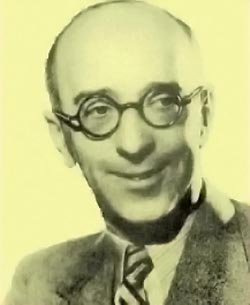
An accomplished bandleader in his own right, Jay Wilbur (1898-1970) had enormous influence over the recording of British dance band music and over Elsie Carlisle’s “solo” output in his role as musical director for such labels as Dominion, Imperial, Eclipse, and Rex. Just as it has long been the custom to identify the glorious voices (including Elsie’s) credited only as “vocal refrain” on dance band records, it is increasingly common to recognize the part that people such as Wilbur played in determining the sound of British popular music. It would be fair to say that Wilbur’s contributions to Elsie’s career rival those of Ambrose.
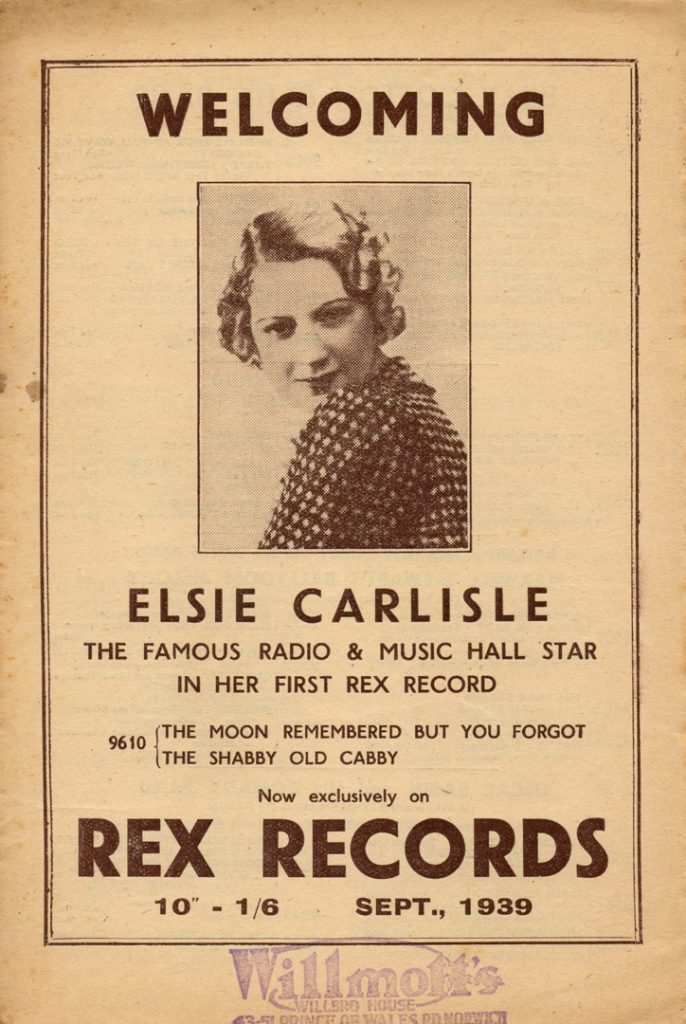
“The Moon Remembered, But You Forgot.” Words by Frank Eyton, music by Noel Gay. Composed for the comedy film Let’s Be Famous (1939). Recorded by Elsie Carlisle with orchestral accompaniment under the musical direction of Jay Wilbur on August 4, 1939. Rex 9610 mx. R-3786-1.
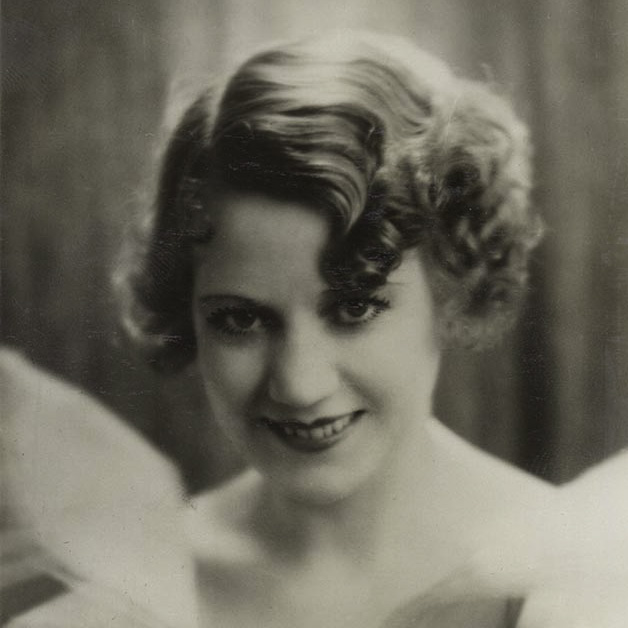
“The Moon Remembered, But You Forgot,” from the British comedy film Let’s Be Famous, was composed by Frank Eyton, an English popular lyricist most famous for having contributed to the words of “Body and Soul,” and Noel Gay, a prolific composer who also wrote such popular hits as “The Sun Has Got His Hat On” and “Lambeth Walk.” Its singer describes an outdoor anniversary rendezvous to which her partner does not show up. Left all alone in the presence of the evening moon, she engages in the pathetic fallacy, attributing to the moon human faculties, qualities, and emotions: memory, patience, certainty, and regret. Elsie Carlisle applies her best sincerity and pathos to this song on the first record she made for Rex Records (1939-1942). Rex was the last label that she was signed to, and it was there that she was reunited with musical director Jay Wilbur, who had played the same role in her career in the late 1920s and early 1930s, at Dominion, Imperial, and Eclipse. This was also the last record that Elsie made before war broke out in Europe.
“The Hut-Sut Song.” Words and music by Leo V. Killion, Ted McMichael, and Jack Owens (1941). Recorded by Elsie Carlisle with orchestral accompaniment under the direction of Jay Wilbur on July 4, 1941. Rex 10021 mx. R-5971-2.
Personnel: Jay Wilbur dir. Alfie Noakes-Chick Smith-t / 2 unknown from Paul Fenoulhet (t-tb) (Ted Heath/George Rowe (tb) / Frank Johnson-Frank Weir-cl-as / George Smith-Cliff Timms-ts / Matt Heft-p / Jack Simmons-g / Billy Bell-sb / Jack Simpson-d / vocal chorus by the orchestra1
“The Hut-Sut Song (A Swedish Serenade)” has lyrics consisting primarily of the repetitive, catchy refrain
“Hut-Sut Rawlson on the rillerah and a brawla, brawla sooit.”
There are recurring intimations that the mysterious words are Swedish — they are not, of course, anything of the kind, but rather nonsense of the first order. It would appear that “The Hut-Sut Song” is in some way an imitation of a much older song, “Hot Shot Dawson,” which begins with the words
“Hot Shot Dawson on a river boat with his brawlin’, sprawlin’ sweetie….”
In 1941, Time Magazine noted the existence of the older tune, but had difficulty finding anyone who could remember how it went. The similarity between the two songs probably indicates not plagiarism or authorial skullduggery, but mere hut-suttery.
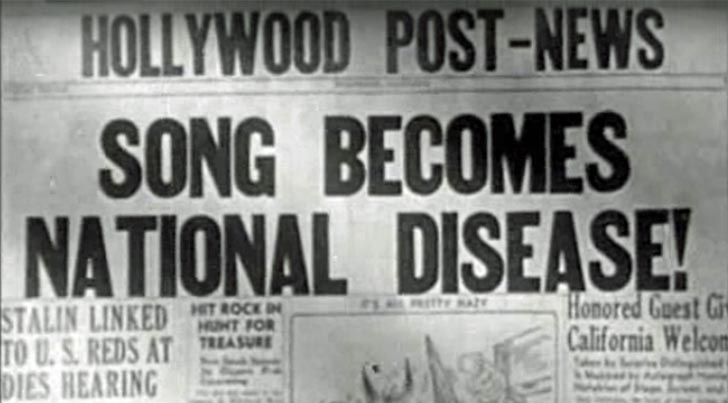
“The Hut-Sut Song” is a novelty song typical of its era (its nonsensical lyrics might remind one of the crypto-sensical and similarly infectious “Mairzy Doats,” which would be composed two years later). Its utter wackiness and surprising popularity inspired a short film portraying a boarding house full of people (played by “The King’s Men” ) who sing it incessantly. The proprietor has them removed to a mental hospital, where they continue singing “Hut-Sut” in a padded cell.
Elsie Carlisle’s version of “The Hut-Sut Song,” recorded under the direction of Jay Wilbur and with the instrumental and choral accompaniment of his studio band, is surprisingly pretty. It is perhaps precisely because the lyrics are so inane that they highlight nicely her crisp, sweet voice. Elsie’s wartime recordings are of a flavor very different from her earlier work, and while the underlying compositions are largely not to my taste, her vocal excellence shines with the aid of the slightly better bandwidth provided by more modern recording technology.
Other British recordings of “The Hut-Sut Song” were made by Lew Stone and His Band (v. Carl Barriteau), Nat Gonella, Harry Roy and His Band (v. Marjorie Kingsley), Billy Cotton and His Band (v. Dolly Elsie), and Harry Leader and His Band (in a Paul Jones Medley).
I would also note that there were three recordings of “The Hut-Sut Song” in 1941 by artists in Sweden! One can only wonder what the Swedes thought about the ridiculous suggestion that the song had anything to do with them, but apparently they were amused.
According to Richard J. Johnson in Elsie Carlisle: A Discography (1994). ↩︎
“Calliope Jane.” Composed by Hoagy Carmichael for Road Show (1941). Recorded by Elsie Carlisle with orchestral accompaniment, probably under the musical direction of Jay Wilbur, on June 24, 1941. Rex 10008 mx. R-5917-1.
Hoagy Carmichael composed “Calliope Jane” for a 1941 musical comedy called Road Show, starring Adolphe Menjou, Carole Landis, and John Hubbard. The movie features a musical number by a four-part close-harmony group named The Charioteers, former Vocalion gospel recording artists who were trying their hand at pop music with some success. Playing carnival workers, they sing to an absent party, “Calliope Jane,” asking her to ply her trade:
Calliope Jane,
Put on your bonnet and "ploop!" again,
For when you go "Ploop, ploop!"
You "ploop" all my cares away.
To their credit, The Charioteers lessened the awkwardness of this strange little song by singing the “ploops” in a very high register, so as to make it perfectly clear that they were imitating the sound of a calliope.
Not so Elsie Carlisle. I will concede that Elsie applies her most dulcet delivery to “Calliope Jane” in an arrangement that lets her play both the part of the interested audience (“Johnny”) and that of Calliope Jane herself, who explains that when she plays her calliope, she likes”to give it a dash of that swing.” But Elsie utters her “ploop, ploops” in the same register as the rest of the words, and I had to listen to her recording more than once to realize that the sounds were meant to be onomatopoetic. The overall impression made by her version is one of extreme silliness that verges on being somewhat embarrassing.
Not one of Elsie Carlisle’s finest moments, nor Hoagy Carmichael’s for that matter, and it would appear that few other artists took the bait and recorded “Calliope Jane.” The one exception was Arthur Young and His Swingtette, who had recorded it in London the previous day.