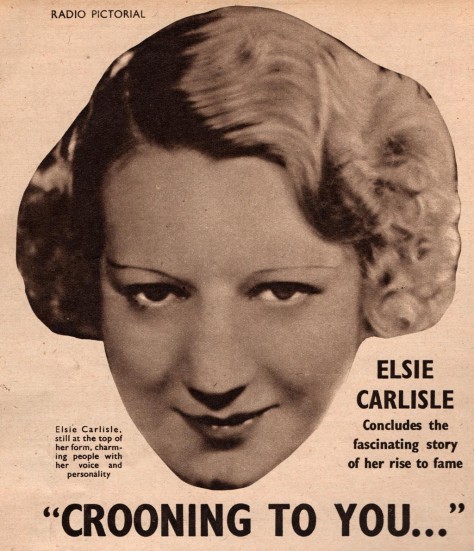
Radio Pictorial, a weekly publication for wireless aficionados, carried in its October 15, 1937 issue the final installment of an interview with Elsie Carlisle entitled “Crooning to You…” House style seems to have demanded that it take the form of redacted answers to suppressed questions; it is Elsie who does all the talking, and she appears to prattle on endlessly without any prompting, which was no doubt the intended effect. One may divine the glorious sort of fluff included in the item from highlights printed in bold at the top of the page:
★ When I Was Electrocuted—But The Show Went On :: Footballs Are SO Hard ! :: My Greyhounds :: Off to America
And who could argue with Elsie regarding the famed hardness of footballs, when — what, electrocuted??? Actually, that was rather a favorite story of Elsie’s, or perhaps of the magazine’s editors, for it would appear again in the 1938 Ralph Graves article “Radio Sweetheart No. 1.”
The salient points of the interview are that
- Elsie Carlisle is a normal human being, like you or I. She has nightmares about plane crashes — that sort of thing.
- Elsie is an absurdly resilient performer, utterly loyal to her fans. She insists that “[t]he show must go on,” even after a car accident or an accidental electrocution; regarding the latter she reports: “I got through the broadcast somehow, and I flatter myself that no listeners noticed any difference in my performance. But, it is a fact, I was in a coma the whole time.”
- She is comically impractical: “Nothing, however, could have been so painful as the first time I ever kicked-off at a football match. I was asked by the Variety Artistes Ladies’ Guild to start a match between Dick Kerr’s Ladies’ Football team and a team of French lady footballers. I went along in a small pair of silk shoes, and under-estimated the hardness of a football. I gave it a good kick, and for the rest of the day I could hardly feel my toes.”
- She is “passionately fond of dogs.” She tells a very sad story of one of her dogs being hit by a bus. She has started to keep greyhounds but is usually too busy performing to see them race.
- After a decade of turning down offers to come and perform and America, she…actually, it is hard to piece together if she has agreed to anything specific. “[I]f nothing crops up to frustrate my present plans, I shall soon be on my way to America,” she claims. She expresses hopes that the American public will be as welcoming to her as the British one, but that is as much as we get, and I have never seen anything to suggest that she ever did travel to America.
This is a fundamentally very silly article overshadowed by a not-very-flattering disembodied Elsie head — which is to say that it is exceedingly fun! Elsie seems to have been just as good at working the press as she was at singing, and she clearly worked hard to earn such commonly repeated epithets as “Idol of the Radio,” “Radio Sweetheart No. 1,” and, on a rare occasion when she was not feeling up to talking to the press, “Distinguished Woman Invalid” (The Dundee Evening Telegraph, January 4, 1939).